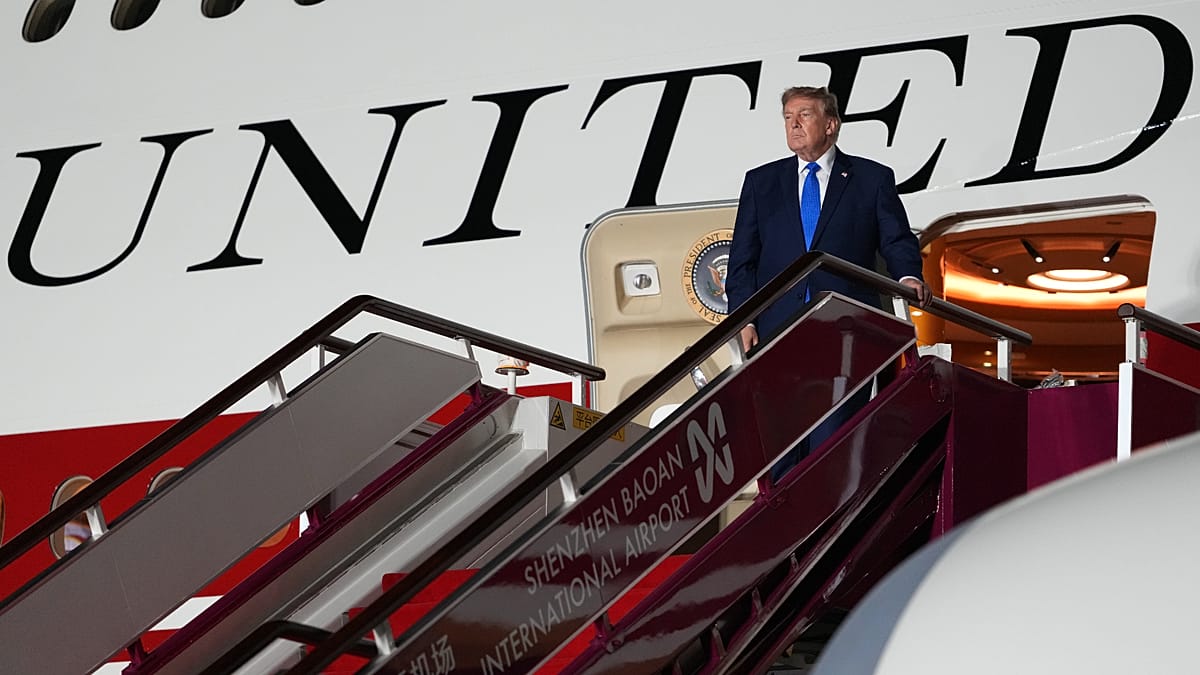
US President Donald Trump departed China on Thursday without meeting North Korean leader Kim Jong-un, despite having floated the possibility of such an encounter during his visit to Shenzhen for a rare trilateral summit with Chinese President Xi Jinping and Russian President Vladimir Putin on the sidelines of the Asia-Pacific Economic Cooperation (APEC) forum.
Speaking to reporters at the White House earlier in the week, Trump had said, “We may meet with Kim Jong-un also, so that'll be good.” However, a White House official had already indicated that no such meeting was on the agenda. The two leaders have not met face-to-face since June 2019.
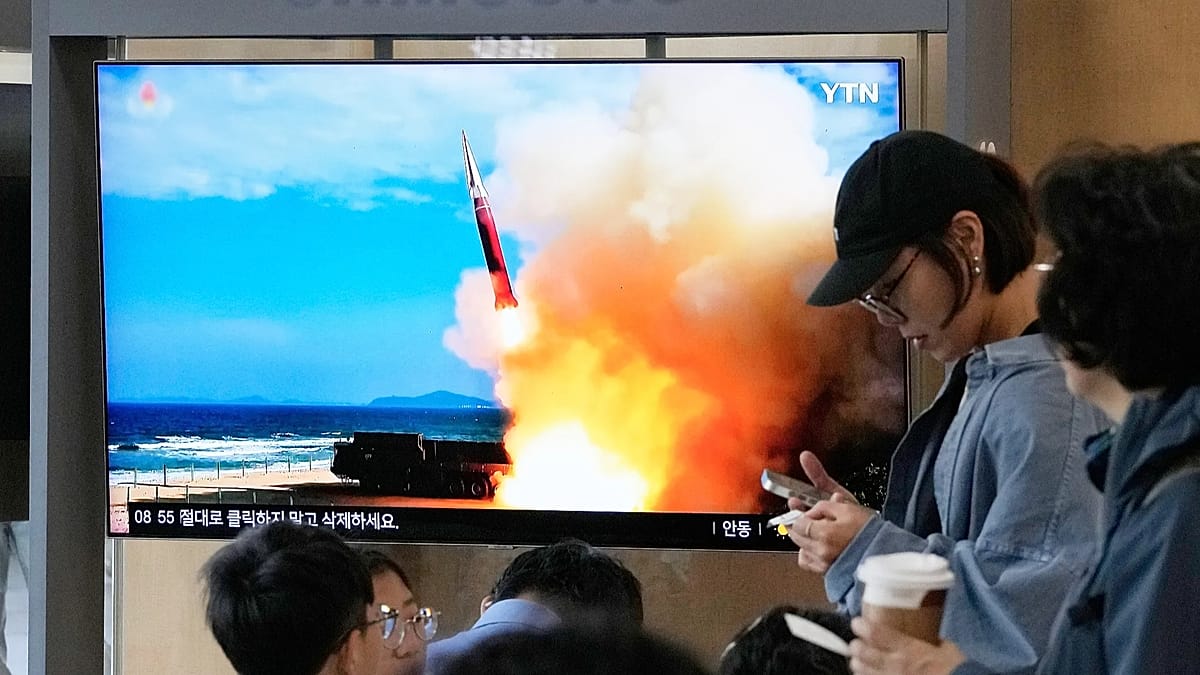
While Kim inspected sites in North Korea’s South Hamgyong province on Tuesday and Wednesday, according to South Korean news agency Newsis, the three major powers issued a joint “peace declaration” pledging dialogue on nuclear risk reduction and non-proliferation. Notably, the declaration made no explicit reference to the Korean Peninsula or Taiwan, although Chinese state media later reported that the leaders had exchanged views on the peninsula, Ukraine, nuclear non-proliferation, and the Middle East.
Seoul fears being sidelined
The summit has stoked anxiety in South Korea, Japan, and Taiwan that major powers could make decisions affecting regional security without consulting those directly involved. In the run-up to the meeting, South Korean media drew parallels with the Yalta Conference of 1945, where the US, UK, and Soviet Union reshaped the post-war order. Seoul has long been wary of being excluded from discussions about its own peninsula.
The omission of the Korean Peninsula from the declaration has somewhat eased fears of a “second Yalta,” but it has also raised concerns that denuclearisation is slipping down the diplomatic agenda of the major powers, according to South Korean outlet Money Today. Park Won-gon, a professor of North Korean studies at Ewha Womans University, suggested that China and Russia may have sided with Pyongyang, while Kim Jae-chun of Sogang University noted that the three powers view North Korea’s nuclear programme very differently.
However, Newsis speculated that the absence of a Trump-Kim meeting for the second consecutive year might actually ease concerns over potential US recognition of North Korea as a nuclear-armed state. South Korean President Lee Jae-myung, speaking at Thursday’s APEC summit, reiterated the importance of achieving peace and stability on the Korean Peninsula to bring prosperity to the region.
Japan seeks reassurances
In Japan, where relations with Beijing remain tense, the trilateral meeting has raised concerns. Japanese Prime Minister Sanae Takaichi exchanged greetings with Xi during APEC but did not hold a formal bilateral meeting. A ruling-party lawmaker told Fuji TV that Japan’s exclusion from the three-way talks could be seen as a diplomatic setback.
Takaichi, however, said at a press briefing in Shenzhen that she did not believe Japan’s interests would be undermined, as reported by TBS. She is reportedly arranging a phone call with Trump to discuss the outcome of his talks with Xi and Putin and to reaffirm bilateral cooperation, according to TV Asahi, citing Japanese government sources.
Japanese media also highlighted the three powers’ stance on the International Criminal Court (ICC), which is currently headed by Japanese judge Tomoko Akane. The joint declaration called for respect for the immunity of state officials and warned that the ICC and similar institutions must not abuse their jurisdiction. In March 2023, the court issued an arrest warrant for Putin over the alleged unlawful deportation and transfer of Ukrainian children.
Taiwan wary of great-power diplomacy
As with South Korea, Taiwanese media raised the spectre of “Yalta 2.0” ahead of the meeting. Broadcaster TVBS highlighted concerns that Taiwan could be used as a bargaining chip in negotiations. The question of Taiwan was raised in the bilateral meeting between Xi and Trump earlier on Thursday.
Tsai Jung-hsiang, a professor of political science at National Chung Cheng University in Taiwan, told the island’s Central News Agency that the US and China hold very different views on strategic stability. While Trump has aimed to avoid conflict over Taiwan during his tenure, Xi wanted the US to recognise Beijing’s position on sovereignty and territorial integrity, Tsai said.
Chinese state media framed the trilateral meeting as a positive step for international security and stability. Xi described the talks as “positive, constructive and fruitful,” with the three nations committed to “world peace,” according to Xinhua. He also proposed that the three countries hold regular high-level meetings and establish mechanisms to prevent and manage crises.
The summit has underscored the growing importance of great-power diplomacy, but it has also left regional allies wondering whether their voices will be heard. For Europe, the episode serves as a reminder of the shifting global order, where decisions affecting global security are increasingly made in forums that exclude traditional partners. As Poland has insisted, no lasting peace deal should be made without Europe's say. The trilateral declaration's silence on Ukraine, despite the ongoing war, has also drawn attention, with Putin hailing the talks as a new diplomatic chapter. Meanwhile, the first trilateral summit in Shenzhen has set a precedent that may shape future international negotiations.