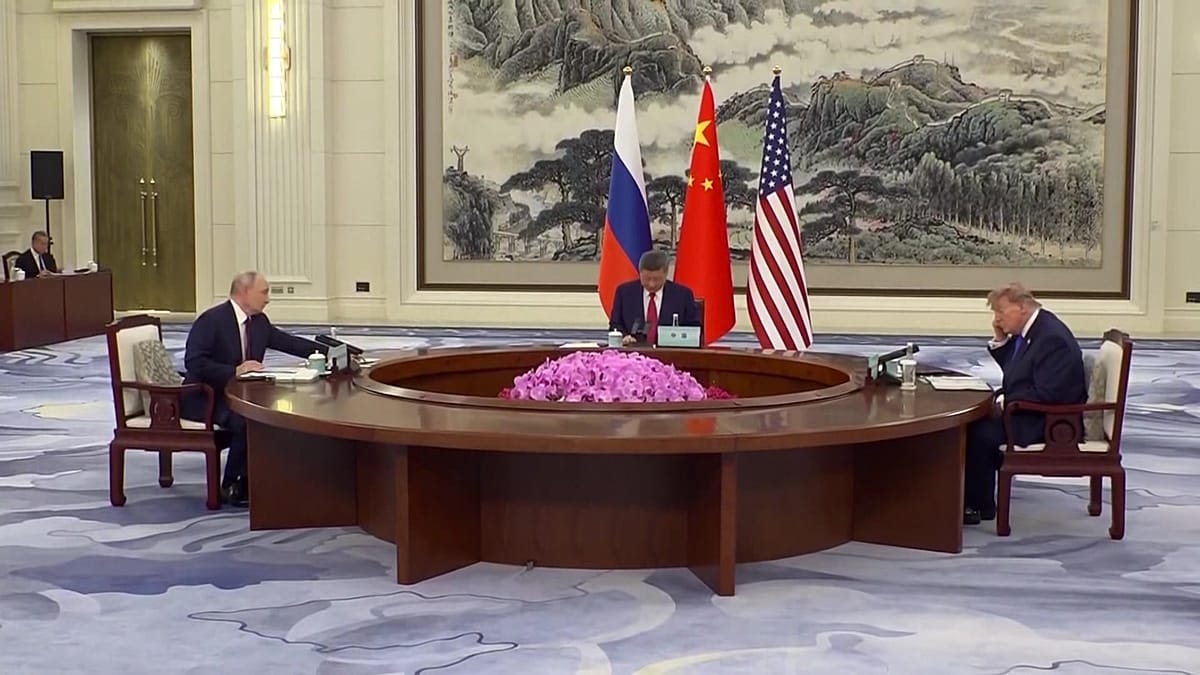
In a moment without precedent in post-Cold War diplomacy, the leaders of the United States, Russia and China sat down together on Thursday in Shenzhen for their first trilateral summit. Donald Trump, Vladimir Putin and Xi Jinping met at the Kylin Villa on the sidelines of the Asia-Pacific Economic Cooperation (APEC) forum, a setting chosen by Beijing to underscore its role as host and mediator.
The meeting carries profound implications for the global order, and for Europe in particular. With the war in Ukraine grinding into its third year, EU capitals have been anxious about any arrangement struck over their heads. The three presidents are expected to discuss Ukraine, the conflict involving Iran, nuclear weapons, trade and wider international security.
Europe watches from the sidelines
European leaders were not invited to the table, a fact that has not gone unnoticed in Brussels, Paris and Berlin. The EU has been a key financial backer of Kyiv, and the bloc's foreign policy chief has repeatedly stressed that any peace plan must involve Ukraine itself. A proposed €45 billion EU loan for Ukraine, announced as the Shenzhen talks got underway, signals that Brussels intends to keep its own leverage.
Ukrainian President Volodymyr Zelenskyy has said he expects a full briefing from Washington on what was discussed. His office confirmed that a detailed readout is expected in the coming days.
A new geometry of power
The trilateral format itself is a departure from the familiar bilateral summits that have defined great-power relations for decades. Analysts note that Xi, by hosting both Trump and Putin, is positioning China as a pivotal broker between Washington and Moscow. The choice of Shenzhen, a symbol of China's economic opening, also carries a message about trade and technology.
For Europe, the stakes are high. Any agreement that freezes the front lines in Ukraine without restoring Kyiv's territorial integrity would be seen as a betrayal by many EU member states, particularly those in the east. Conversely, a genuine de-escalation could ease energy prices and migration pressures that have tested European unity.
The meeting follows a series of preparatory contacts. Trump and Putin held a bilateral meeting just before the trilateral session, and Trump had earlier said that both Washington and Beijing wanted the Ukraine war to end before the summit. That statement, made in a social media post, was met with skepticism in European chancelleries, where officials recall that previous promises of a quick settlement have not materialized.
Nuclear and trade dimensions
Beyond Ukraine, the agenda includes nuclear non-proliferation. With the New START treaty expiring in 2026 and no successor in place, arms control experts in Europe are watching for any signs of a new framework. The three leaders also face the unresolved question of Iran's nuclear program, which has direct security implications for the Middle East and for European energy supplies.
Trade is another contentious area. Trump has threatened tariffs on Chinese goods, while the EU has its own disputes with both Washington and Beijing over subsidies and market access. A trilateral understanding on trade rules could reshape global supply chains, affecting European manufacturers from Wolfsburg to Lyon.
The symbolism of the Kylin Villa, named after a mythical creature that appears only in times of peace, was not lost on observers. Whether the meeting produces concrete outcomes or remains a photo opportunity will be judged by the actions that follow.
For now, European leaders are left to parse the statements from Shenzhen and to prepare for a world in which the three largest powers may coordinate more closely—or collide more sharply. Either way, the continent's voice, so central to the post-war order, risks being marginalised unless it finds new ways to assert its interests.