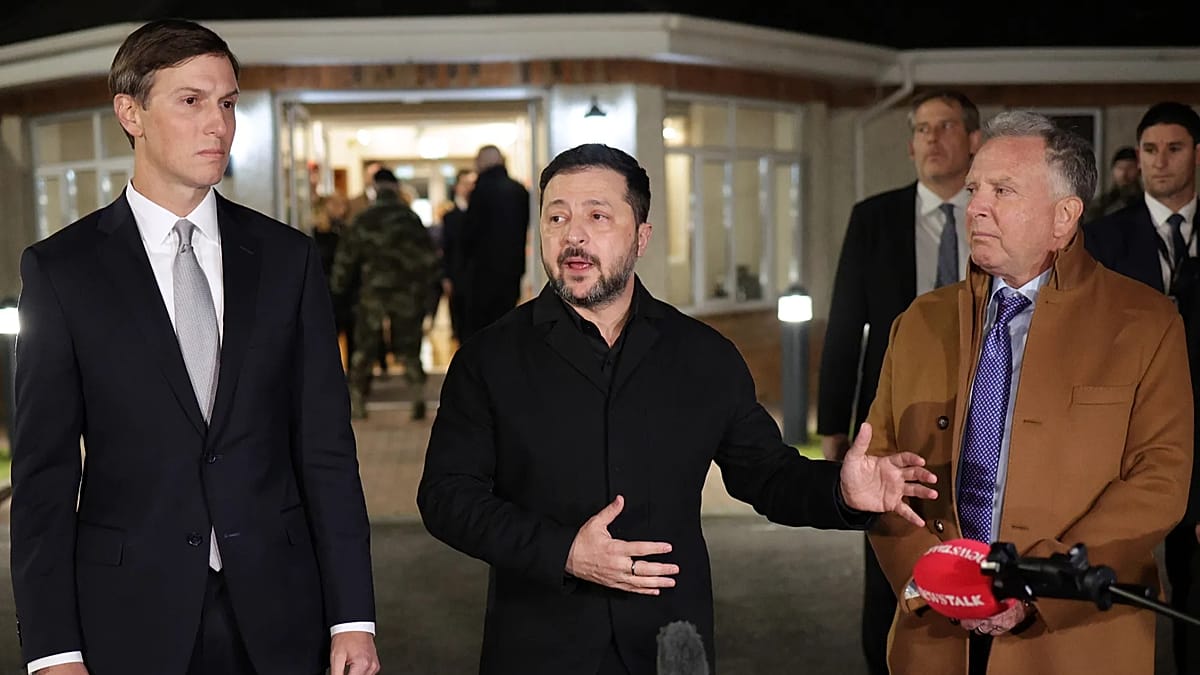
Ukrainian President Volodymyr Zelenskyy said on Wednesday that he expects US envoys to brief him on the talks taking place in China, as Donald Trump prepares to meet China's Xi Jinping and Russia's Vladimir Putin.
Trump has said he plans to raise limits on nuclear weapons and an end to the war in Ukraine in his historic trilateral meeting with Xi and Putin at the APEC summit in Shenzhen.
Speaking in his nightly video address, Zelenskyy said, “We and the Europeans have a clear, shared position: issues concerning Ukraine must be decided with Ukraine’s participation, and issues concerning Europe must be decided with Europe’s participation.”
The Ukrainian leader said the US envoys had told Kyiv they would give a debrief on the talks being held by Trump in China during meetings in Berlin on Thursday. Ukraine will also hear from other partners currently in China, he added.
Berlin talks as a counterweight
Germany, France and Britain are co-hosting talks in Berlin that begin only hours after Trump, Putin and Xi wrap up their landmark trilateral summit in Shenzhen. More than 30 European leaders are due to attend the Berlin meeting, along with Zelenskyy and US envoys Jared Kushner and Steve Witkoff, amid fears that Trump, Putin and Xi could make decisions on Ukraine without Kyiv and Europe.
The Berlin gathering is seen as an attempt by European capitals to assert their relevance in shaping the continent's security architecture, especially as Washington appears to be pursuing a bilateral track with Moscow and Beijing. The EU's proposed €45bn loan for Ukraine is likely to be a key topic, underscoring Europe's financial commitment to Kyiv's defence and reconstruction.
Zelenskyy's insistence on inclusion reflects a broader anxiety across European chancelleries that the US president might strike a deal with Putin that ignores both Kyiv's interests and the security concerns of EU member states, particularly those on the eastern flank such as Poland and the Baltic states.
Strained US-Ukraine relations
Trump has often boasted of his rapport with Putin, while relations between Washington and Kyiv appear to have deteriorated recently. Trump has rejected new sanctions on Russia, and Ukraine has faced disruptions in satellite support for its drones during the war.
But for the first time since February, Russian, Ukrainian and US negotiators held talks on ending the full-scale war in Abu Dhabi earlier this month, with security guarantees topping the agenda. The two-day session followed previous negotiations early this year that failed to produce any visible progress toward ending Europe’s most devastating conflict since World War II.
Meanwhile, fighting is continuing, despite the Trump administration's renewed diplomatic efforts to end the nearly five-year conflict. Russian drones attacked Kharkiv Oblast on the evening of Wednesday, hitting an apartment building, Ukrainian media reported, while Kyiv mayor Vitali Klitschko reported that drone debris fell in the Pecherskyi district of the city on Wednesday afternoon, causing fire. No injuries were reported, as emergency services were dispatched to the scene.
Earlier, Ukraine struck two oil refineries in southern Russia, something Zelenskyy has praised and described as the "effectiveness of Ukrainian-made weapons."
The preliminary meeting between Trump and Putin in Shenzhen has already raised eyebrows in European capitals, with many leaders wary of being sidelined in decisions that will shape the continent's future. The Berlin talks are an attempt to ensure that Europe has a seat at the table, even if the main negotiations are happening thousands of kilometres away.
As the war grinds on, the human cost remains high. The latest attacks on Kharkiv and Kyiv are a stark reminder that diplomacy has not yet brought relief to civilians. European leaders will be watching closely to see whether the Shenzhen summit produces any concrete steps towards peace, or whether it merely reinforces the perception that the fate of Ukraine is being decided without its consent.