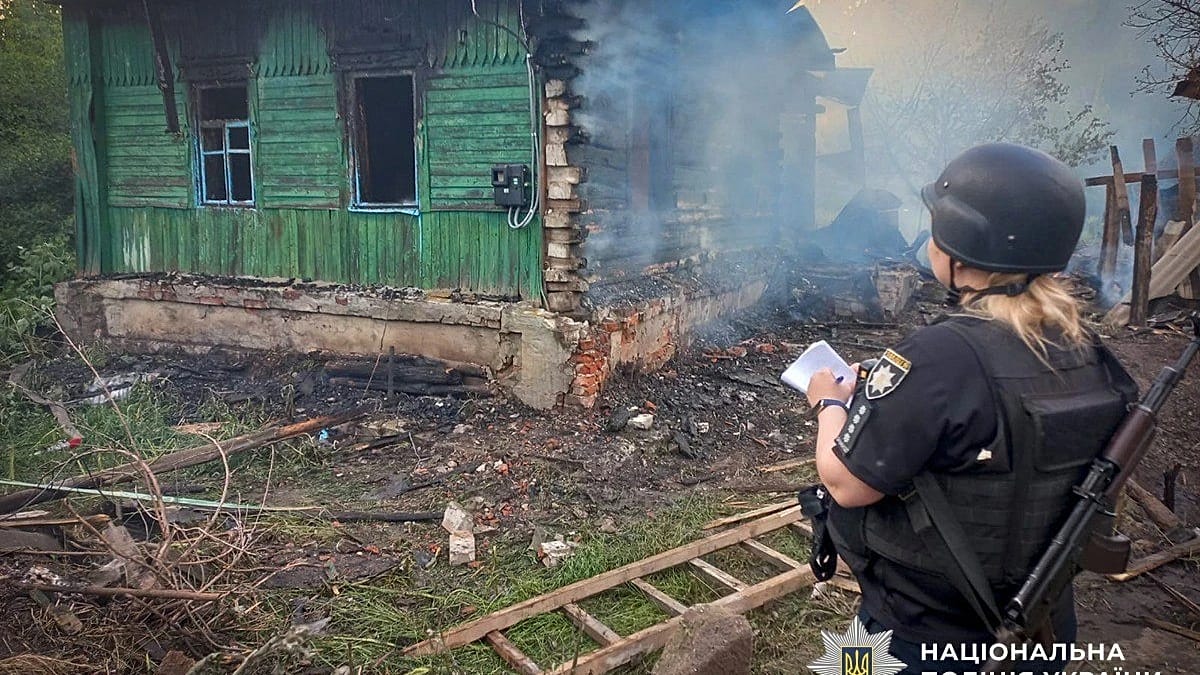
Overnight Russian attacks on Ukraine's Sumy Oblast killed two civilians and wounded four others, according to Ukraine's national police. A 64-year-old woman died in the Bilopol community from a drone strike, while a 57-year-old woman was killed in the Seredino-Budsk community. The wounded included men aged 51 and 66.
Police reported that Russian forces used guided aerial bombs, attack UAVs, FPV drones, artillery, and mortars across 17 communities in the Sumy region. The attacks underscore the continued intensity of Russian strikes on border areas, even as Ukraine pursues its own long-range campaign.
Ukrainian Strikes Hit Strategic Russian Industrial Targets
On the same night, Ukrainian drones struck multiple industrial facilities deep inside Russia. The Azot chemical plant in Novomoskovsk, Tula Oblast, was set ablaze, according to the independent Telegram monitoring channel Exilenova Plus. Located 200 kilometres south of Moscow, Azot is Russia's largest producer of ammonia and nitrogen fertiliser, according to the plant's website.
An oil depot in Rybinsk, Yaroslavl Oblast, was also hit and caught fire. Rybinsk lies approximately 700 kilometres from the Ukrainian border, while Novomoskovsk is about 395 kilometres away. These strikes are part of Ukraine's ongoing effort to disrupt Russian logistics and industrial capacity, a strategy that has included previous attacks on facilities such as the Afipsky Oil Refinery in Krasnodar region on June 11.
Russian authorities confirmed that Novomoskovsk was targeted overnight. Tula Oblast Governor Dmitriy Milayev stated that fragments of downed Ukrainian drones fell onto the territory of an industrial enterprise, but he did not specifically address the Azot plant. The Kremlin has generally downplayed the effectiveness of Ukrainian strikes, though independent monitors have documented significant damage.
Ukraine's long-range drone campaign has increasingly targeted Russian energy and chemical infrastructure, aiming to reduce Moscow's ability to sustain its war effort. This approach mirrors similar tactics used by Russia against Ukrainian power grids and industrial sites. For context on the broader pattern of attacks, see our coverage of Ukraine's drone campaign strangling Russian supply lines to Crimea.
The strikes come as diplomatic efforts continue, with EU accession talks for Ukraine advancing. The bloc recently unlocked the first cluster of negotiations, a step that underscores Kyiv's integration into European structures even as the war grinds on. Read more about EU ambassadors unlocking accession talks for Ukraine and Moldova.
Meanwhile, the human toll on Ukrainian civilians remains severe. The Sumy region, which borders Russia, has been subjected to near-daily shelling since the full-scale invasion began in February 2022. The use of guided bombs and drones has made evacuation and defence increasingly difficult for local communities.
European observers have condemned the attacks on civilian areas. The EU has provided substantial military and humanitarian aid to Ukraine, but questions persist about the sustainability of support as the war enters its third year. For a broader view of the exchange of strikes, see Ukraine and Russia exchange strikes as EU accession talks advance.
As both sides continue to escalate, the conflict shows no signs of de-escalation. Ukraine's ability to strike deep into Russian territory has shifted the tactical landscape, but Russia's advantage in artillery and air power remains significant. The coming weeks will test whether Ukraine can sustain its drone offensive while defending against Russian advances in the east.