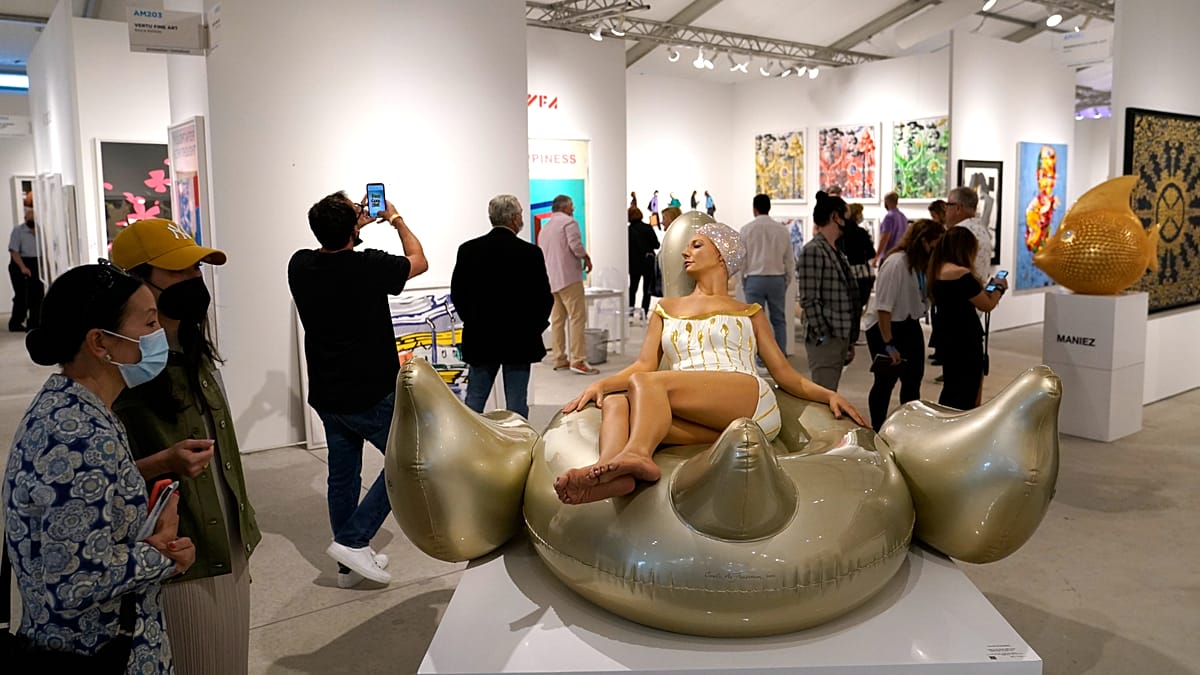
Chicago has long been a city of grand architecture and bold public art, but a new wave of oversized, hyperrealistic sculptures is changing how residents and visitors experience the urban landscape. These larger-than-life figures, often depicting swimmers, dancers, and everyday people in moments of quiet intensity, are not confined to museum halls. Instead, they occupy plazas, parks, and sidewalks, turning chance encounters into intimate artistic dialogues.
Among the artists leading this movement is Carole Feuerman, an American sculptor known for her uncannily lifelike figures. Her works, often cast in bronze and painted with layers of translucent color, capture the glistening effect of water on skin or the subtle tension of a body in motion. In Chicago, several of her pieces have been installed in high-traffic areas, where they draw crowds not just to look, but to touch, photograph, and even pose with them.
Art Without Barriers
The appeal of these sculptures lies in their accessibility. Unlike traditional gallery exhibitions, which can feel exclusive or intimidating, public sculptures invite spontaneous engagement. A child might mimic the pose of a bronze swimmer; a passerby might pause to examine the realistic texture of a hand or the glint in an eye. This direct interaction is precisely what Feuerman and her peers intend. As she has said, "Art should not be a distant object of reverence, but a companion in daily life."
Chicago's embrace of monumental figurative sculpture is part of a broader trend across American cities, but it resonates particularly strongly in a city with a rich tradition of public art, from the iconic Cloud Gate to the murals of the Loop. The new pieces, however, offer something different: a human scale within an urban scale, a reminder of individual presence amid the crowd.
For European audiences, this approach to public art may feel familiar. Cities like Paris, Berlin, and Copenhagen have long integrated sculpture into their streetscapes, often with a more classical or abstract bent. But the hyperrealism of Feuerman and her contemporaries—rooted in the Pop Art tradition of Duane Hanson and George Segal—brings a distinctly American sensibility to the genre. It is bold, unapologetic, and deeply accessible.
The installations have also sparked conversations about the role of art in public spaces. Some critics argue that such crowd-pleasing works risk pandering to popular taste, while others see them as a vital bridge between the art world and the general public. In Chicago, the response has been overwhelmingly positive, with social media buzzing with images of the sculptures and visitors traveling from across the region to see them.
One of the most talked-about pieces is Feuerman's "Swimmer," a life-size figure poised on a diving block, her body tensed for the leap. Installed near the lakefront, it has become a favorite spot for selfies and a quiet place for contemplation. Another work, "Dancer," captures a ballerina mid-pirouette, her tutu frozen in motion, drawing parallels to the grace of the nearby Joffrey Ballet.
The trend is not limited to Chicago. Similar installations have appeared in New York, Miami, and Los Angeles, but the Windy City's commitment to placing these works in everyday settings—outside train stations, in community gardens, along riverwalks—sets it apart. It is a model that European cities might well study, especially as they seek to revitalize public spaces in the post-pandemic era.
For those who cannot travel to Chicago, the sculptures have a digital afterlife. High-resolution photos and videos circulate widely, allowing a global audience to appreciate the craftsmanship. Yet, as with all public art, the true experience is in the physical encounter—the way the light catches a bronze shoulder, the unexpected scale of a hand, the silent dialogue between the artwork and the city around it.
As Chicago continues to expand its public art program, the oversized sculptures are likely to remain a defining feature of the city's cultural landscape. They are a testament to the power of art to surprise, delight, and connect—one giant step at a time.