China has launched its Shenzhou 24 spacecraft carrying the first foreign astronaut to its Tiangong space station, a milestone that underscores Beijing's growing ambitions in crewed spaceflight and its expanding partnerships beyond its borders.
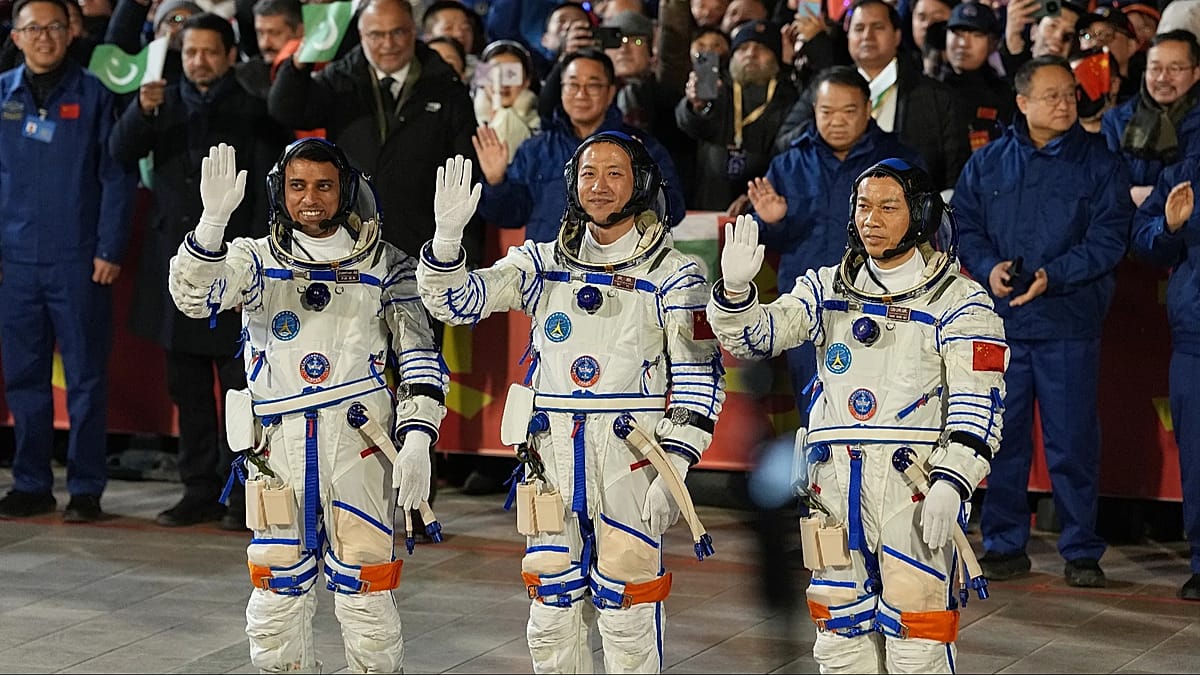
Muhammad Zeeshan Ali, a 40-year-old Pakistani, lifted off with Chinese astronauts Tang Hongbo, 51, and Wu Yi, 39, from the Jiuquan Satellite Launch Center in northwestern China on Wednesday morning. The capsule separated from its rocket as planned and entered its designated orbit shortly after launch.
The mission is the first joint flight of Chinese and foreign astronauts in the history of China's crewed space programme. For Pakistan, it is a moment of national pride, with Prime Minister Shehbaz Sharif describing the launch as "the journey of 240 million Pakistanis" in a post on X. He thanked Beijing for including a Pakistani astronaut and said the flight extended the two countries' close ties into space.
Thousands of kilometres away, Pakistanis gathered in homes and restaurants to watch the ascent live on television, chanting slogans in praise of God and of Pakistan-China friendship. Scientists at the national space agency's headquarters followed the launch in real time. Planning Minister Ahsan Iqbal, speaking to reporters at the agency, thanked President Xi Jinping and China's leadership and engineers, and expressed hope that the flight would pave the way for broader cooperation. Asked whether Pakistan might one day send its own astronauts, he replied: "Certainly that day will come."
Ali, who wore the Pakistani flag on his uniform, is on a short-term mission. He will conduct an experiment on photosynthetic cyanobacteria before returning to Earth aboard Shenzhou 23. Both Ali and Wu are making their first spaceflight, while Tang, who has flown twice before, is set to become the first astronaut to board Tiangong three times, according to state broadcaster CCTV.
The flight stems from an agreement signed between China and Pakistan in February 2025. According to Xinhua, the crew will carry out more than 90 scientific experiments and technology tests during their stay aboard the station.
Training across languages and cultures
At a press conference on Tuesday, Tang acknowledged the challenges of preparing for the mission with an international crewmate. "Differences in language, culture and psychology made training together harder," he said, but added that the effort was paying off.
Ali demonstrated his integration by speaking Mandarin and quoting a line of Chinese poetry about climbing higher to see farther. "It's like my daily training. Day after day, reaching new heights," he said. Switching to English, he expressed hope that cooperation would grow from a single astronaut on one flight to multiple joint missions, and eventually to the Moon, Mars and beyond.
The mission comes as China prepares to land astronauts on the Moon by 2030, positioning itself as a rival to the United States, whose NASA aims to return astronauts to the lunar surface by 2028. The Shenzhou 24 launch also highlights China's broader strategy of building alliances in space, particularly with countries in the Global South.
For Europe, the development carries implications beyond the Asia-Pacific. As China expands its crewed space programme and deepens partnerships with countries like Pakistan, European space agencies and policymakers are watching closely, particularly in light of recent concerns about cybersecurity threats linked to Chinese actors. The European Space Agency has its own long-term goals, including lunar exploration, and the growing presence of Chinese and American missions may reshape the international landscape of space cooperation.
Pakistan's inclusion in the Shenzhou 24 mission is also a reminder of the shifting dynamics in space diplomacy, where traditional alliances are being tested and new ones forged. As Ali's flight demonstrates, the sky is no longer the limit for nations seeking to expand their technological and strategic reach.