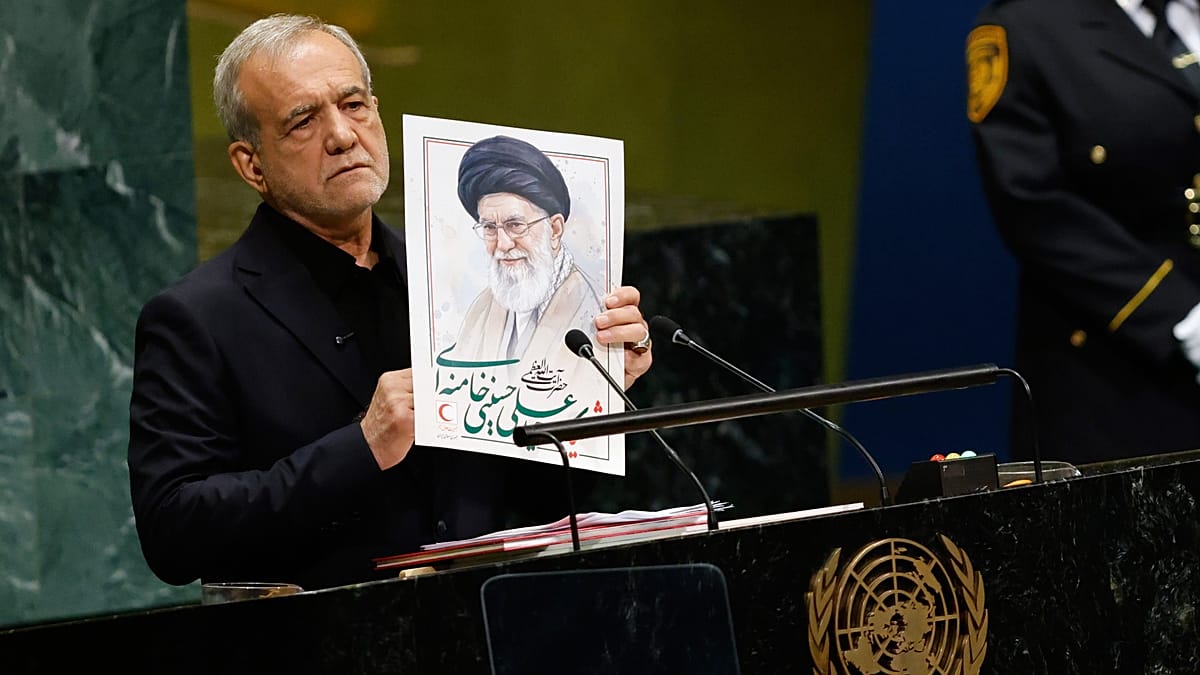
In a sharply worded address to the UN General Assembly on Wednesday, Iranian President Masoud Pezeshkian rejected accusations of terrorism and insisted his country was the victim of aggression, not its perpetrator. The speech came a day after US President Donald Trump threatened to "annihilate" the Islamic Republic, and as the US delegation conspicuously left the chamber.
Pezeshkian opened by holding up photographs of children killed in a missile strike on a school in Minab on the first day of the war, which claimed 156 lives, and of the late Ayatollah Ali Khamenei, who died in the same opening salvo. He also referenced a US strike on a sports hall that same day.
"The US president described us as terrorists. We have been the victims of terrorism," Pezeshkian said. "We only seek to live independently. Are we the sources of instability? Those who are committing terrorism and committing crimes, are they the protectors of peace and stability?"
He accused Washington and Tel Aviv of launching illegal attacks on Iranian civilians and infrastructure, asserting that Iran's military capabilities were purely defensive and that it had no intention of attacking other states.
Nuclear dispute and regional security
On the nuclear file, Pezeshkian argued that "nuclear knowledge should not be the exclusive preserve of a few countries" and insisted there was no military solution to the standoff. He addressed Israel directly: "The atomic bomb is in Israel, but the inspectors are in Iran. Israel kills, but Iran is sanctioned."
He also warned that Iran would not allow its right to navigation in the Strait of Hormuz—"even in our own waters"—to be taken away. Turning to the wider Middle East, he said, "No one in this region will enjoy security alone. Either we will build security together, or we will endure insecurity together."
His closing message was aimed squarely at Trump. "It must be understood by Mr Trump and those who seek to bully us that we are ready for dialogue and diplomacy and negotiations without accepting the language of force," he said. "Yes they did hit us, but we did not bend the knee."
Pezeshkian claimed Iran had not struck civilian populations, a statement contradicted by documented deaths among mariners and civilians in Iranian attacks across the region since the war began.
US and Israeli officials dismissed the speech as hypocritical. Secretary of State Marco Rubio told reporters, "I don't know what standing Iran has to lecture anyone on human rights or the international system when they habitually violate it."
On Tuesday, Trump had told the same assembly, "Will a deal be made with Iran... or do I annihilate the Islamic Republic and do it quickly?" After the speech, he described a meeting between his envoys and Iranian counterparts as "a very good meeting," though he noted the Iranian side was "not the highest level, but it's something."
Iran's foreign ministry spokesman Esmail Baghaei dismissed the talks, saying there had been "nothing new" in the exchange. Rubio echoed that sentiment, calling it "a continuation of conversations that have occurred in the past." He added, "If there's an opportunity to exchange ideas and messages, we will. And that's what largely yesterday was, it was positive in that regard. But ultimately, I don't want to mischaracterise this as a major breakthrough."
The confrontation at the UN comes as European capitals watch closely, with Trump's advisers signalling he wants to end the war soon. Meanwhile, the broader geopolitical landscape remains tense, with Romania's president warning the Ukraine war could last another two years. The EU has been seeking to play a mediating role, but the deep divisions between Washington and Tehran leave little room for optimism.