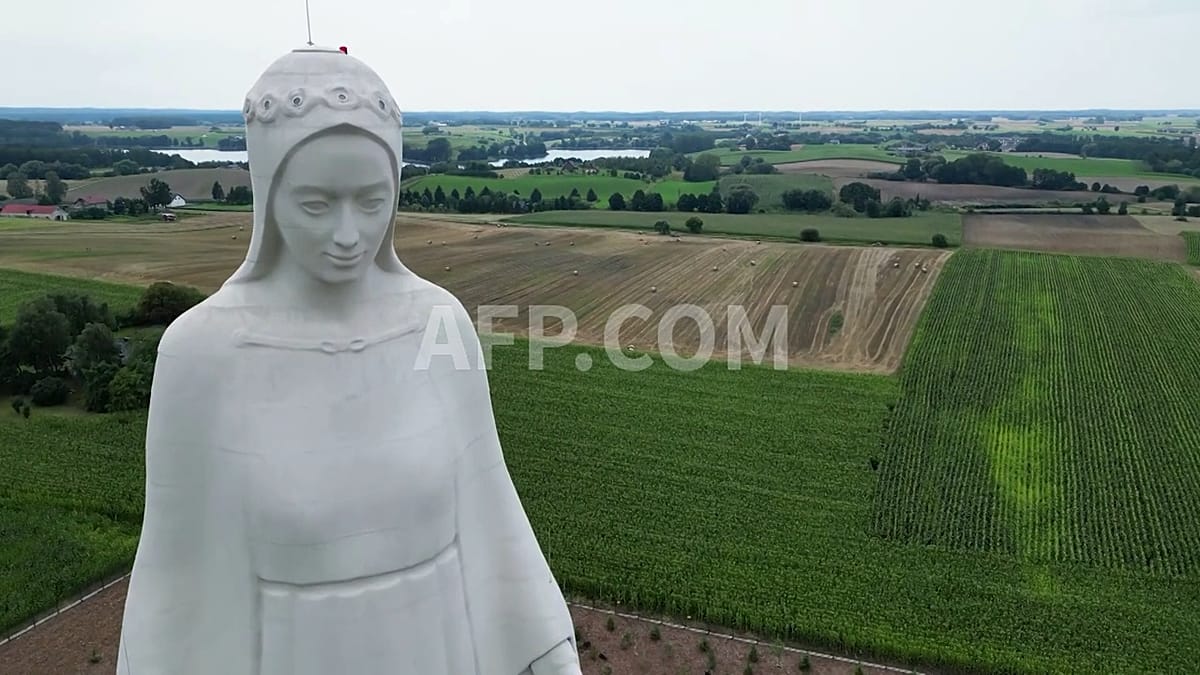
In the small Polish village of Konotopie, a new landmark now dominates the skyline: a 55-metre statue of the Virgin Mary, the tallest Marian monument in Europe and the second tallest in the world, after the Mother of All Asia effigy in the Philippines. The concrete-and-steel figure, perched on a hill, is visible from kilometres away, a striking addition to the flat Kuyavian landscape.
The statue is scheduled to be blessed on 15 August, the Catholic feast of the Assumption, though the site is still a work in progress. Debris litters the muddy car park, and scaffolding remains in place around parts of the monument. Despite the unfinished state, coaches have already begun arriving, according to a site guard, suggesting that the draw of the towering figure is already taking effect.
A billionaire's gift with a local purpose
The project was funded by Roman Karkosik, a Polish billionaire and industrialist, at an estimated cost of 100 million zlotys (around $26 million), according to local media. Karkosik, who made his fortune in metals and recycling, has roots in the region, and the statue is seen by some as a personal act of devotion. Officials in nearby Kikol, one of the poorest municipalities in the area, hope the monument will attract pilgrims and create much-needed jobs in a region that has struggled economically.
Local authorities are betting on religious tourism as a catalyst for development. The statue could draw visitors from across Poland and beyond, potentially boosting small businesses such as guesthouses, restaurants, and souvenir shops. In a country where Catholicism remains deeply woven into public life, the monument is likely to become a pilgrimage site, especially on Marian feast days.
Mixed reactions in the community
Not everyone in the area is enthusiastic. Some residents told AFP that the money would have been better spent on a hospital or an orphanage. The debate reflects a broader tension in rural Poland, where infrastructure and social services are often underfunded, and where large religious projects can seem out of step with pressing local needs.
"We have no hospital, no proper roads, and young people are leaving," one resident said. "A statue won't change that." Others, however, see the monument as a source of pride and a potential economic engine. The village of Konotopie, with a population of just a few hundred, is now on the map in a way it never was before.
The statue's height is not its only notable feature. It is designed to be visible from the nearby national road, and its white figure against the green fields is intended to evoke a sense of spiritual guardianship. The choice of 15 August for the blessing is significant: the Assumption of Mary is one of the most important Marian feasts in the Catholic calendar, and the ceremony is expected to draw thousands of pilgrims.
This is not the first time Poland has seen a large religious monument. The country is home to the Christ the King statue in Świebodzin, which, at 33 metres, was once the tallest Jesus statue in the world. The new Marian statue in Konotopie now joins that tradition, but its scale is unprecedented in Europe. It also comes at a time when the Catholic Church in Poland is facing challenges, including declining attendance and internal scandals, making the monument a symbol of both faith and controversy.
For now, the statue stands as a testament to one man's vision and a community's hopes. Whether it will deliver the economic boost that officials anticipate remains to be seen. But for the faithful, it is a beacon of devotion; for critics, a reminder of misplaced priorities. As the blessing ceremony approaches, the debate is likely to intensify, with the eyes of the region—and perhaps the continent—fixed on this small Polish village.