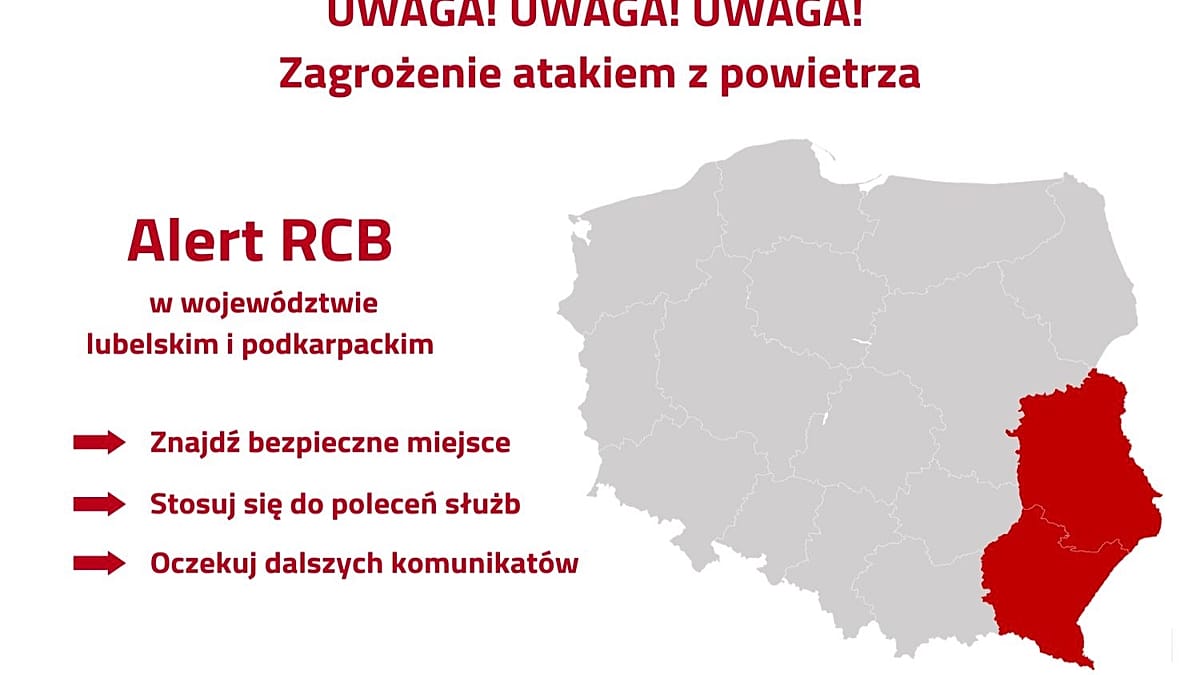
Residents in parts of eastern Poland received urgent alerts on Thursday afternoon as Polish authorities responded to a Russian missile and drone attack on western Ukraine, just kilometres from the Polish border. The Government Security Centre (RCB) sent SMS warnings to people in the Lublin and Podkarpackie provinces, urging them to seek shelter and follow instructions from emergency services.
The alert, which was lifted around 12:50 local time, came after the Operational Command of the Armed Forces reported that Polish military aviation had been activated in response to the strikes. Air raid sirens were heard in Lublin and Rzeszów, and both cities' airports temporarily suspended operations to allow military aircraft freedom of movement.
Precautionary measures, no threat to Poland
Officials were quick to stress that the measures were purely preventive. "There is no threat on Polish territory," the RCB declared after the alert was lifted. The Operational Command explained that the deployment of Polish jets was a reaction to Russian use of jet-powered unmanned aerial vehicles against targets in western Ukraine, and that the goal was to safeguard Polish airspace, particularly near areas under threat.
Defence Minister Władysław Kosiniak-Kamysz wrote on X: "Russia is not letting up in its aggressive actions. Today it carried out an attack just a few kilometres from the Polish border. There was no violation of our airspace. That is why in recent weeks I decided to strengthen the protection of Polish skies – we have increased the activity of F-16s and helicopters and are reinforcing air-defence and rapid-reaction systems."
The incident echoes recent tensions along NATO's eastern flank, where airspace violations and drone incursions have become more frequent.
Tusk condemns 'massive, extremely brutal' attack
Prime Minister Donald Tusk addressed the situation at a press conference following a meeting with Austrian Chancellor Christian Stocker. He described the Russian strike as "massive, extremely brutal" and noted that it occurred very close to the Polish border.
"Near Yahodyn, which is by Dorohusk, a petrol station was apparently hit again, there was a very powerful explosion, and our aircraft were also scrambled," Tusk said. He added that a similar Russian air raid had taken place two days earlier, as well as during the night from Wednesday to Thursday.
Tusk also drew a sombre parallel with history, noting that 17 September marks the anniversary of the Soviet Union's aggression against Poland in 1939. "Unfortunately, this is an exceptional day also in terms of today's security situation," he said.
The attack near the border crossing at Dorohusk is part of a pattern of escalating Russian strikes on Ukrainian infrastructure close to Poland. Polish and Ukrainian officials have previously condemned such strikes as deliberate provocations, and a drone strike near the same border crossing earlier this year ignited a fuel depot fire.
The Polish Air Navigation Services Agency (PANSA) confirmed that both Lublin and Rzeszów airports were temporarily restricted to ensure safety for military operations. The airports have since resumed normal operations.
As Russia continues to target western Ukraine, Poland remains on high alert, balancing its role as a key logistical hub for military aid with the need to protect its own citizens and airspace. The incident underscores the fragile security situation on NATO's eastern border, where even a single missile or drone can trigger a rapid, coordinated response.