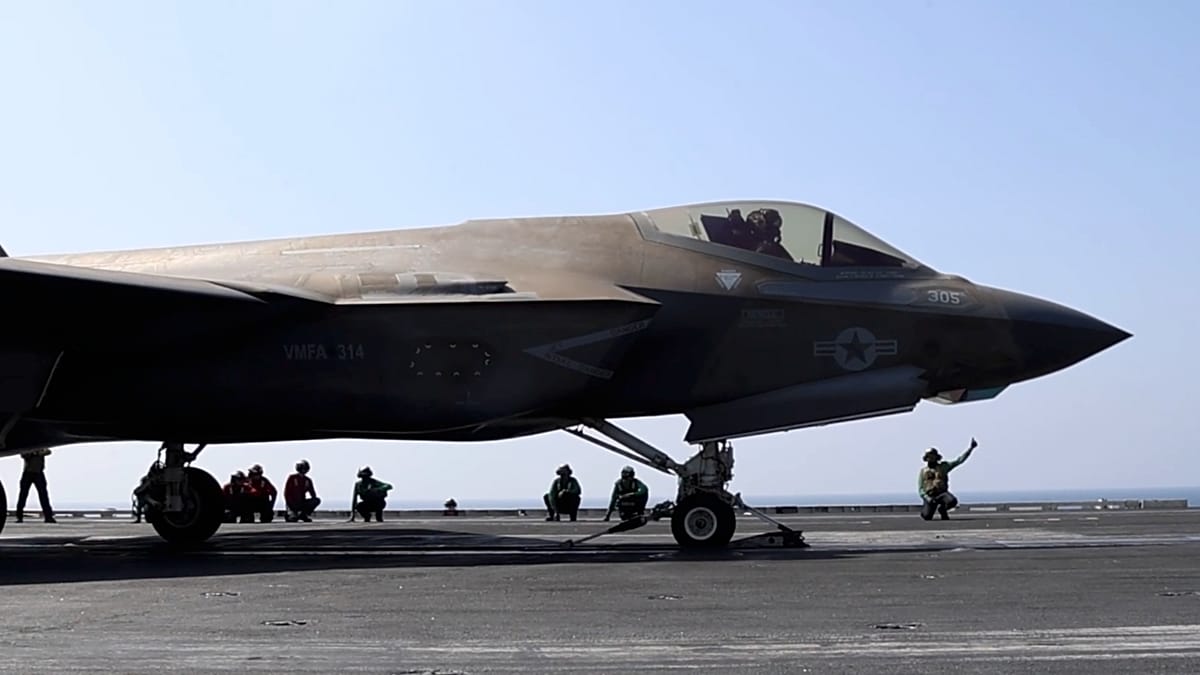
Poland marked a significant milestone in its military modernisation this week as the first three F-35 Lightning II fighter jets touched down at Łask air base, 130 kilometres southwest of Warsaw. The arrival signals Warsaw's deepening commitment to bolstering NATO's eastern flank amid ongoing tensions with Russia.
Polish Defence Minister Władysław Kosiniak-Kamysz welcomed the aircraft on Friday, describing them as the "new guardians of Polish skies." In a post on X, he emphasised the strategic leap: "These are the first 5th-generation fighters on NATO's eastern flank capable of detecting threats before they themselves are spotted. For Poland, this is not just new equipment, but a step into the elite global league of modern air forces."
The three jets are the first tranche of a 32-aircraft order placed with US defence contractor Lockheed Martin. The F-35 is widely regarded as one of the most advanced multirole combat platforms in service with NATO states. Its stealth capabilities, sensor fusion, and networked warfare systems give pilots a decisive edge in contested airspace.
Poland joins a growing club of European nations operating the F-35. The aircraft is already in service with the United Kingdom, Germany, Norway, the Netherlands, Belgium, Italy, and Denmark. For Warsaw, the acquisition is part of a broader defence buildup that has seen defence spending rise to over 4% of GDP, the highest in NATO.
A Strategic Shift for Poland's Air Force
The arrival of the F-35s comes at a time when Poland is also hosting an increased US military presence. Earlier this year, Washington announced the deployment of 5,000 additional troops to Poland, a move that underscored the country's role as a key staging ground for allied forces. However, questions remain about the long-term reliability of US commitments, particularly given political shifts in Washington. As Poland welcomed 5,000 extra US troops, some analysts warned that unilateral decisions by future administrations could alter the security landscape.
The F-35 programme is not without its critics. The jets are expensive to operate and maintain, and Poland will need to invest heavily in infrastructure, pilot training, and logistics. The Łask base is being upgraded to accommodate the new aircraft, with hangars, simulators, and maintenance facilities. Poland has also ordered a suite of advanced munitions, including AIM-120 AMRAAM and Joint Direct Attack Munitions, to equip the fleet.
Despite these costs, the strategic calculus is clear. Poland shares a 210-kilometre border with Russia's Kaliningrad exclave and a 530-kilometre border with Belarus, a key ally of Moscow. The F-35s will provide a potent deterrent, capable of penetrating sophisticated air defences and striking targets deep behind enemy lines. They will also integrate seamlessly with NATO's broader command-and-control networks, enhancing alliance-wide situational awareness.
The delivery also has implications for European defence industrial cooperation. While the F-35 is an American platform, European firms such as BAE Systems and Leonardo are involved in its production. Poland's purchase strengthens transatlantic ties but also raises questions about the EU's ambition to develop its own next-generation fighter under the Future Combat Air System (FCAS) programme, led by France, Germany, and Spain.
For now, Poland is focused on integrating the F-35 into its existing fleet of F-16s and MiG-29s. The first Polish pilots and ground crews have completed training in the United States, and the air force expects to achieve initial operational capability by 2026. The full order of 32 jets is scheduled for delivery by 2030.
As Europe's security architecture continues to evolve, Poland's investment in fifth-generation air power sends a clear message: the eastern flank is no longer a soft underbelly but a hardened frontier. Whether other NATO allies will follow suit remains to be seen, but for Warsaw, the F-35 is a cornerstone of its vision for a more capable and credible European defence.