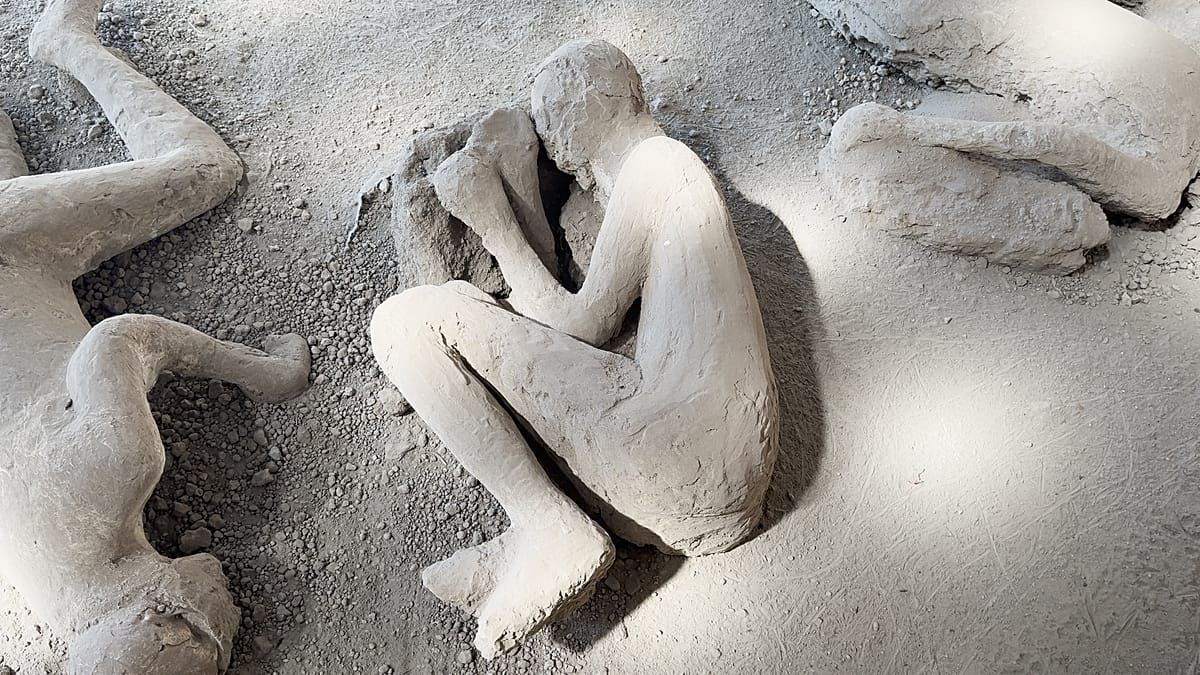
An extraordinary find at the Archaeological Park of Pompeii has identified a doctor among the victims of the 79 AD eruption of Mount Vesuvius. The discovery, announced this week, comes from a plaster cast excavated in 1961 in the area known as the Orto dei Fuggiaschi (Garden of the Fugitives), where fourteen individuals were caught by the pyroclastic cloud while attempting to flee through Porta Nocera.
Recent interdisciplinary research, combining archaeology, radiology, and digital modelling, has revealed a small case hidden within the plaster of one cast. The case, made of organic material with metal fittings, contained a fabric bag with bronze and silver coins, a slate plate likely used for preparing medicinal or cosmetic substances, and several small metal instruments consistent with a surgical kit. These findings strongly suggest that the victim was a physician, carrying the tools of his trade as he tried to escape.
Advanced Technology Unlocks Ancient Secrets
Diagnostic investigations using X-rays and computed tomography (CT) scans, performed at the Maria Rosaria Nursing Home in Pompeii, allowed researchers to examine the contents without damaging the fragile cast. The use of artificial intelligence and 3D reconstructions further enhanced the analysis, revealing previously unknown details of the case's mechanical design, including a toothed-wheel locking system. This non-invasive approach opens new possibilities for studying other Pompeian casts, which often contain hidden artefacts.
The research team included archaeologists, restorers, physical anthropologists, archaeobotanists, numismatists, radiologists, and digital modelling specialists. Their collaborative effort not only restored an object but also reconstructed an interrupted life story, as Park Director Gabriel Zuchtriegel noted.
"Already two thousand years ago, there were those who were not just doctors during set hours, but doctors at all times—even in the moment of their escape from the eruption, cut short by the pyroclastic cloud that engulfed a group of fugitives attempting to leave the city through Porta Nocera," Zuchtriegel said.
He added: "This man brought his tools with him to be ready to rebuild his life elsewhere, thanks to his profession, but perhaps also to help others. We dedicate this small but significant discovery to all the women and men who today continue to carry out this profession with a very high sense of responsibility and service to the community."
The find is part of a broader trend in Pompeian archaeology, where modern technology is being used to extract new information from old excavations. Earlier this year, AI reconstructed the final moments of another victim who used a mortar as a shield, demonstrating the potential of digital tools to deepen our understanding of ancient life and death.
The identification of the doctor also underscores the sophistication of Roman medicine. The surgical instruments, though small, are similar to those described by ancient authors like Celsus and Galen, including scalpels, forceps, and probes. The slate plate may have been used for mixing ointments or grinding ingredients, suggesting the doctor was prepared to treat a range of ailments.
For European readers, this discovery resonates beyond archaeology. It highlights the continent's rich cultural heritage and the ongoing efforts to preserve and interpret it. The use of AI and CT scans in Pompeii mirrors similar advances in medical diagnostics across Europe, where AI models now match or beat doctors in complex medical reasoning, showing how technology bridges past and present.
The doctor's story also evokes the human dimension of natural disasters, a theme that remains relevant today. As climate change increases the frequency of extreme events, the resilience of communities—ancient and modern—offers lessons. In a continent where tourism and heritage are vital economic drivers, discoveries like this also attract visitors to sites like Pompeii, which drew millions before the pandemic.
The case and its contents will be displayed in a future exhibition at the Archaeological Park of Pompeii, offering the public a rare glimpse into the life of a Roman physician. For now, the find stands as a testament to the power of interdisciplinary science and the enduring human spirit.