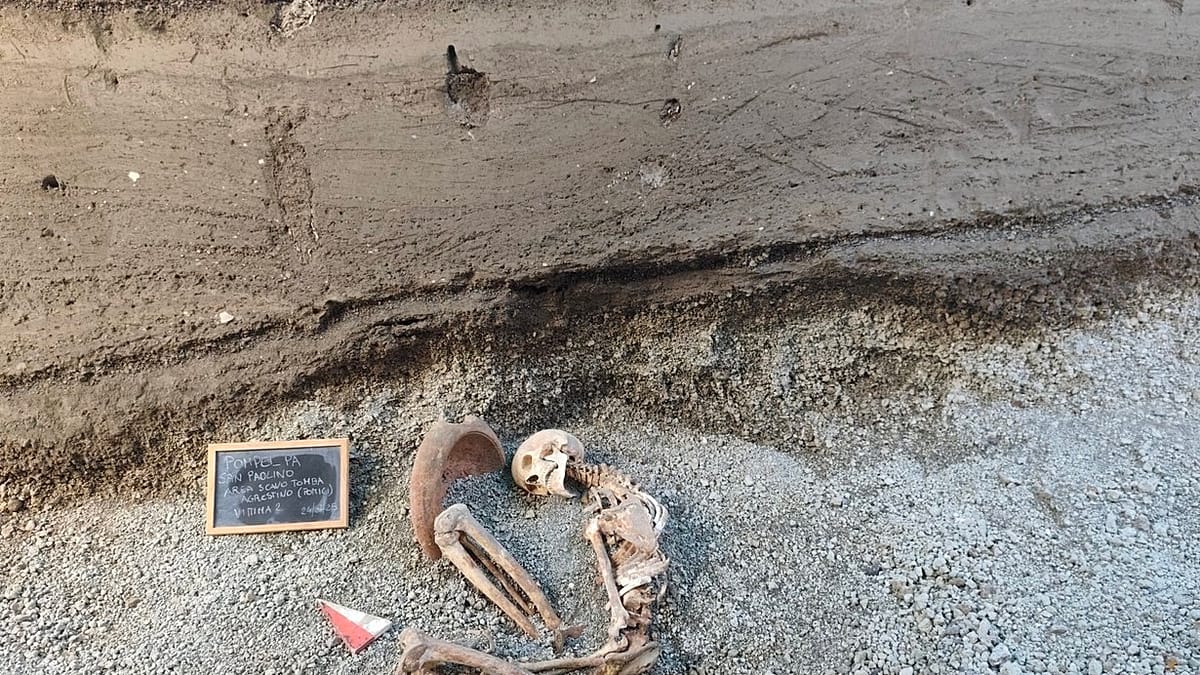
In the necropolis of Porta Stabia, just outside the ancient walls of Pompeii, a new excavation has brought to light the remains of two men who perished during the eruption of Vesuvius in 79 AD. Their bodies, preserved in the ash that buried the city, tell a story of two distinct moments of death — and of a desperate, almost primal gesture of self-preservation.
The younger victim was likely swept away by a pyroclastic surge, a superheated cloud of gas and ash that can kill instantly. The older man died a few hours earlier, under a relentless rain of lapilli — the small pumice stones that fell from the sky as the volcano erupted. Next to his body, archaeologists found an earthenware mortar with clear signs of fracture. Everything suggests he lifted it above his head to shield himself from the fiery hail.
This instinctive act, captured in the archaeological record, echoes a description by Pliny the Younger, who witnessed the eruption from across the Bay of Naples. He wrote of people tying pillows over their heads for protection. Now, for the first time, that written account has a physical counterpart.
Everyday Objects as Clues
Alongside the mortar, the older man carried a ceramic oil lamp — likely to navigate the darkness caused by the ash cloud — an iron ring on his left little finger, and ten bronze coins. These are not random artifacts; they are the tools of a lucid, organized escape attempt in the midst of chaos. The coins suggest he was prepared to pay for passage or supplies; the lamp, to find his way through the blackened streets.
The excavation took place near the monumental tomb of Numerius Agrestinus Equitius Pulcher, a prominent local figure. The site has yielded a wealth of data that archaeologists are now analyzing with modern technology.
AI Enters the Excavation
The Archaeological Park of Pompeii, in collaboration with the University of Padua, has created a digital reconstruction of the older victim using artificial intelligence. The model combines algorithms with photo-retouching techniques to produce a scientifically grounded image that is accessible to the public. It is an experimental tool, but one that points to a future where AI becomes a standard part of archaeological practice.
Italian Culture Minister Alessandro Giuli said: "Italy has historically always made classical culture a key ingredient of innovation. In Pompeii, artificial intelligence helps not only in the protection of the immense archaeological heritage, but also in the engaging and accessible narration of ancient life."
Park director Gabriel Zuchtriegel added: "The vastness of archaeological data is now such that only with the help of artificial intelligence will we be able to adequately protect and enhance them. If used well, AI can contribute to a renewal of classical studies."
Luciano Floridi, founding director of the Digital Ethics Center at Yale, commented: "The man from Pompeii fled with a mortar on his head, an oil lamp in his hand, and ten coins: he carried what he thought was useful for finding his way in the dark. Two thousand years later, AI helps us reconstruct his last moments. The case speaks to all humanities disciplines. AI does not replace the archaeologist. Under its control, it broadens and deepens its potential; and it makes accessible to many what was previously only legible to a few."
Professor Jacopo Bonetto of the University of Padua stressed that AI is "a technology that can contribute to the production of interpretative models and to the improvement of communication tools, but which requires a controlled and methodologically founded use, always in integration with the work of specialists."
The Belgian-born French novelist Marguerite Yourcenar, in her notebooks for Memoirs of Hadrian, described her craft as "one foot in erudition, the other in magic." That magic — the ability to transport oneself into another person's experience — is what archaeology has always aimed for. AI accelerates the rendering of that reconstruction, but the human element remains central.
This is not the first time Pompeii has embraced cutting-edge technology. The site has long been a laboratory for innovation in conservation and storytelling. The use of AI here is part of a broader trend across Europe, where digital tools are reshaping how we understand the past. For more on how technology is being applied to humanitarian crises, see our coverage of Lithuanian Exhibition in Baku Highlights Ukrainian Refugee Stories Through Photography.
The challenge, as Floridi and Bonetto both note, is to use technology without losing rigour — to make the past accessible without betraying it. In Pompeii, that man with his mortar raised against the ashes continues to speak to us: not as an abstract symbol, but as a real individual, caught in the most human moment of all — fighting to survive. No matter the odds.