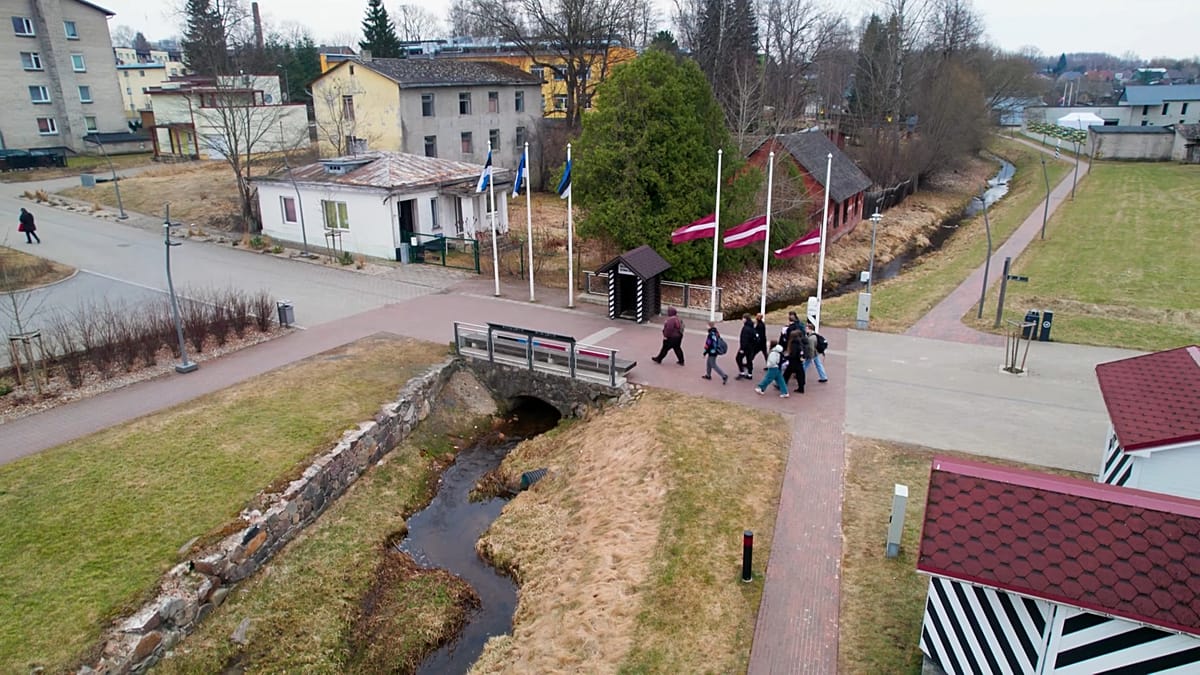
In the centre of Valga, southern Estonia, a few steps can take you into Latvia. Cross the street and you are in Valka. The two towns share a river, a history, and roughly twenty thousand residents — yet for most people here, the neighbour on the other side remains a stranger.
Valga and Valka were once a single settlement known by its German name, Walk. When Estonia and Latvia both declared independence in 1918, each claimed the town. An international commission resolved the dispute by drawing a border along a small stream through the centre. That line became an international frontier, with border posts appearing in the middle of residential streets.
Even during the Soviet era, the towns remained in separate republics — the Estonian SSR and the Latvian SSR. After both countries regained independence in 1991, they kept their distinct languages and identities. In 2007, when Estonia and Latvia joined the Schengen Zone, the physical border crossing disappeared. But nearly twenty years later, the two communities still live largely parallel lives: different languages, different administrative systems, different schools. The barrier is gone, but the invisible one remains.
Hacking the invisible barrier
In September 2025, a project called Hack the Border set out to change that — starting with the generation that has the most to gain. Backed by the European Union’s Interreg VI-A Estonia-Latvia programme and led by Tallinn-based hackathon organiser Garage48, the initiative brought together school students aged 15 to 20 from both towns. The idea was simple: put young Estonians and Latvians in the same room, give them real problems to solve, and see what happens.
“They live across the street from one another but rarely talk,” said Laura Gredzens, project manager at Garage48. “We brought Estonians and Latvians together to find solutions as to how to improve life in the twin town of Valga-Valka. The youth know the challenges best. Now it’s time to make their voices heard.”
The project kicked off with an opening event at the Valka cultural house, followed by a two-and-a-half-day hackathon at Kääriku, a sports centre in the Estonian countryside. Mixed Estonian-Latvian teams worked through the night on ideas for their shared town. The hackathon was only the beginning: it was followed by months of workshops, mentoring sessions, and study trips on both sides of the border.
What surprised the mentors was not just the quality of the ideas, but how quickly the social, cultural, and linguistic barriers began to dissolve. Thomas Danquah, a mental health trainer who mentors the student teams, saw it happen in real time. “Bringing them together showed them how similar they actually are, how much they’ve got in common. And they all had some amazing ideas of how they could improve the city.”
The proposals that emerged included student exchange programmes between Estonian and Latvian schools, joint youth centres, and shared cultural events. English, spoken by most participants, became the working language, bridging the linguistic divide.
For Jiří Tintěra, a former Valga architect who worked on the urban future of the twin town, this youth-driven energy is exactly what the region needs. “Valga and Valka are both depopulating, but their population is also aging,” he said. “We need to provide the young generation with something special that they cannot get anywhere else. The border is this niche which provides a competitive possibility — because this is a really unique place.”
The project has a total budget of €83,775, with €67,020 — just over 80% — contributed by the European Regional Development Fund through the Interreg Estonia-Latvia programme. The partners are Garage48, the Valga County Vocational Training Centre in Estonia, and the Valka Jānis Cimze Gymnasium in Latvia.
For Marta Anna Krūmiņa, a student at the Valka Jānis Cimze Gymnasium, the decision to join was immediate. “If we don’t talk, we will not grow as a town — and we need to grow. So when they offered this project, I said yes, and I also said to my friends: let’s go, let’s do it!”
This kind of cross-border collaboration is a model for other divided communities across Europe. For more on how hackathons are rebuilding community across the Estonia-Latvia border, see our earlier coverage. And for a broader look at how EU funding supports regional integration, read about how member states are pushing back against Brussels' housing deregulation plans.