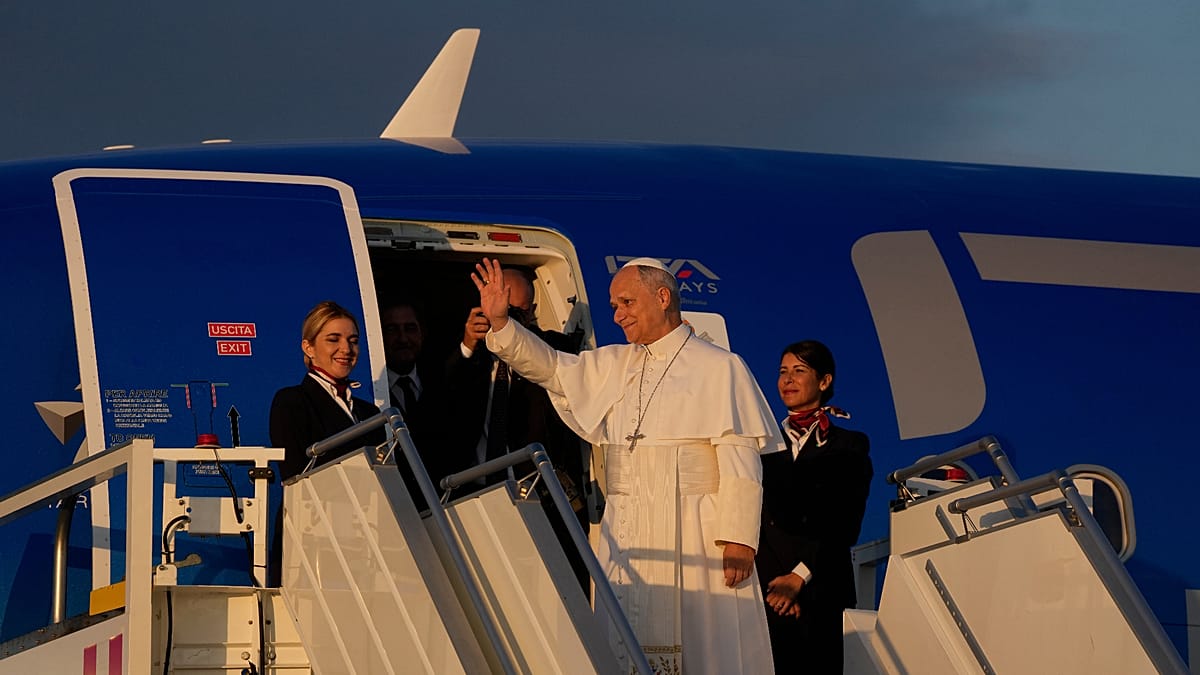
Pope Leo XIV departed for Rome on Monday evening, concluding a four-day apostolic journey to France that combined official engagements in Paris with a pilgrimage to Lourdes and a final stop in the eastern city of Metz. President Emmanuel Macron accompanied the pontiff to the airport, marking the end of a visit that drew significant public attention and, according to observers, underscored the enduring resonance of the Catholic Church in a country defined by its strict separation of church and state.
Macron, who had initially declined to attend the Pope's final Mass at Metz Cathedral on Sunday evening, reversed that decision and was present for the liturgy. His attendance revived a long-running debate in France over laïcité, the constitutional principle that enshrines a strict division between religious institutions and the state. Critics had questioned whether the head of state should participate in a religious ceremony, while supporters argued that the President's presence was a matter of protocol and respect for the country's cultural heritage.
A journey across France
The Pope's itinerary reflected a deliberate effort to engage with both the institutional and popular dimensions of French Catholicism. In Paris, he celebrated a Mass that drew an estimated 600,000 people, one of the largest religious gatherings in the capital in recent years. He also visited Lourdes, the Marian shrine in the foothills of the Pyrenees that attracts millions of pilgrims annually. The final leg in Metz, a city in the Grand Est region near the borders with Luxembourg and Germany, provided a more intimate conclusion to the trip.
For many of the faithful who travelled to see him, the visit carried deep personal significance. Inès, who drove five hours from Rouen in Normandy to attend the events in Metz, described the experience as profoundly moving. "I felt so emotional, it was truly touching," she said. "The fact that we were all able to come together in this shared experience, creating a sense of community, is very special."
Two sisters, Antonia and Marie, who came from the surrounding area to watch the Pope's motorcade, highlighted the messages of peace he delivered during his time in France. "In the times that the world is facing, it made us feel heard and gave us hope to keep going," they said, referring to the pontiff's appeals for unity across the European continent.
Unity and peace in focus
Pope Leo XIV, the first American to lead the Catholic Church, has made European cohesion a recurring theme of his early pontificate. His remarks in France echoed those he has made elsewhere on the continent, urging leaders and citizens alike to resist division and to uphold the values of solidarity and dialogue. The visit came at a moment when Europe faces pressing challenges, from the war in Ukraine to economic uncertainty and rising political fragmentation.
The Pope's presence in France also highlighted the complex relationship between the Church and the French Republic. While laïcité remains a cornerstone of French identity, the enthusiastic reception he received suggests that the country's Catholic heritage continues to shape its public life in ways that transcend strict legal boundaries. Macron's decision to attend the Metz Mass, despite earlier hesitation, may be seen as an acknowledgment of that reality.
As the papal plane left Metz for Rome, the mood among those who had gathered to see him was one of gratitude mixed with sadness. "We're sad that he's leaving, but happy that everything went well," Macron said, summing up the sentiments of many. For the faithful who had travelled from across France and beyond, the four days offered a rare moment of collective hope and spiritual renewal.
The visit also drew attention to broader questions about the role of religion in contemporary Europe. As the continent grapples with secularisation, migration, and questions of identity, the Pope's call for unity resonated with those who see the Church as a source of moral guidance. Whether that message will translate into lasting impact remains to be seen, but for now, the images of crowds lining the streets of Paris, Lourdes, and Metz stand as a testament to the enduring appeal of a pontiff who has chosen to engage directly with the faithful.
Pope Leo XIV's journey to France was his first official visit to the country, and it followed a tradition of papal trips that have marked significant moments in the relationship between the Vatican and the French state. From the medieval papacy's influence on French kings to the modern era of separation, the bond has been both contentious and deeply intertwined. This visit, with its mix of solemn liturgy and popular celebration, added a new chapter to that long history.