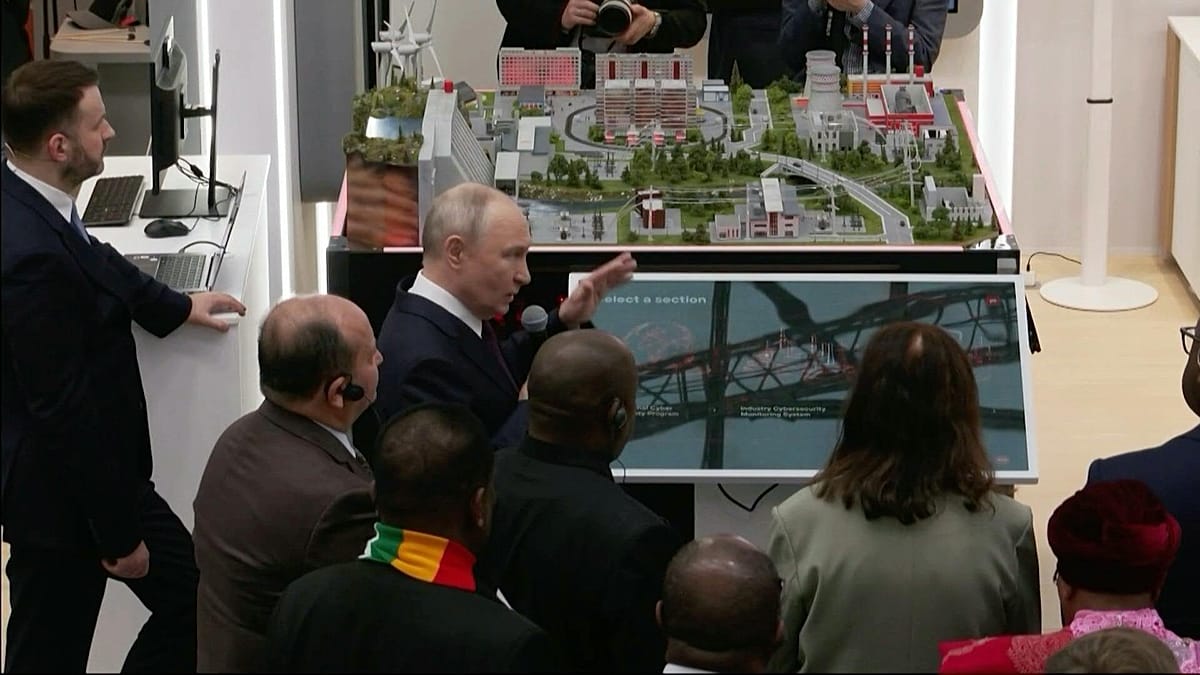
Russian President Vladimir Putin has described Elon Musk as a “genius” for his satellite deployment, even as Moscow accelerates its own efforts to build a competing internet-from-space network. The remarks came during an exhibition on the sidelines of the Russia–Africa summit in Moscow, where Putin was briefed on the scale of Musk's Starlink constellation.
According to the Russian leader, Musk has more than 5,000 satellites in orbit. “Elon Musk is a genius, truly a genius,” Putin said, adding that Russia was proud to have begun developing its own system. The compliment is notable given the strained relations between Moscow and Washington, but Putin also stressed that Russia remains in close contact with American partners, including Musk himself.
“Because in orbit, it is very important not to get in each other's way and to maintain a certain level of discipline and order,” he said, hinting at the practical need for coordination in increasingly crowded space lanes.
Russia's Starlink alternative
Moscow's push to create a homegrown satellite internet service is part of a broader strategy to reduce dependence on foreign technology, particularly in sectors deemed critical for national security. The Kremlin has long viewed Starlink as a strategic asset for Ukraine, where it has provided reliable connectivity for military communications and drone operations. Ukraine's reliance on Starlink has been a persistent concern for Kyiv's allies, who worry about the vulnerability of such a dependency.
Russia's own project, often referred to as a “Russian Starlink,” is still in its early stages. State-owned enterprises and private firms have been tasked with developing the constellation, but experts note that the country faces significant technical and financial hurdles. Sanctions and export controls have limited access to advanced microelectronics, which are essential for building and launching large numbers of satellites.
Despite these challenges, Putin's comments suggest a determination to compete. The praise for Musk may also be an attempt to signal that Russia is open to cooperation in space, even as tensions on the ground remain high. In recent months, Moscow has shown a willingness to engage in dialogue with Western counterparts on issues like arms control and space safety.
Orbital diplomacy and security concerns
The need for coordination in orbit is not merely rhetorical. With thousands of satellites now circling the Earth, the risk of collisions and interference has grown. Both Russia and the United States have an interest in maintaining predictable behavior in space, even when their geopolitical interests clash. Putin's reference to “discipline and order” reflects that shared concern.
However, the broader context is one of deepening rivalry. Russia's invasion of Ukraine has led to a breakdown in many areas of cooperation, and space is no exception. The European Union and its member states have imposed sanctions on Russian space programs, while Moscow has retaliated by ending joint projects with Western partners.
For Europe, the development of a Russian satellite network carries implications beyond the immediate military balance. European companies, including those in France, Germany, and Italy, are also investing in their own low-Earth-orbit constellations, such as the EU's IRIS² project. The competition for orbital slots and spectrum is intensifying, and Russia's entry could complicate the picture.
Putin's praise for Musk may also be a calculated move to sow discord among Western allies. By highlighting Musk's achievements, he implicitly contrasts the success of a private American entrepreneur with the slower, more bureaucratic efforts of European governments. Yet European officials are likely to view Russia's satellite ambitions with suspicion, given Moscow's track record of using technology for military purposes.
As Russia pushes ahead with its Starlink rival, the international community will be watching closely. The outcome will depend not only on technical progress but also on the political will to maintain a stable and secure space environment. For now, Putin's compliment to Musk serves as a reminder that even in an era of confrontation, the heavens remain a domain where cooperation and competition coexist.