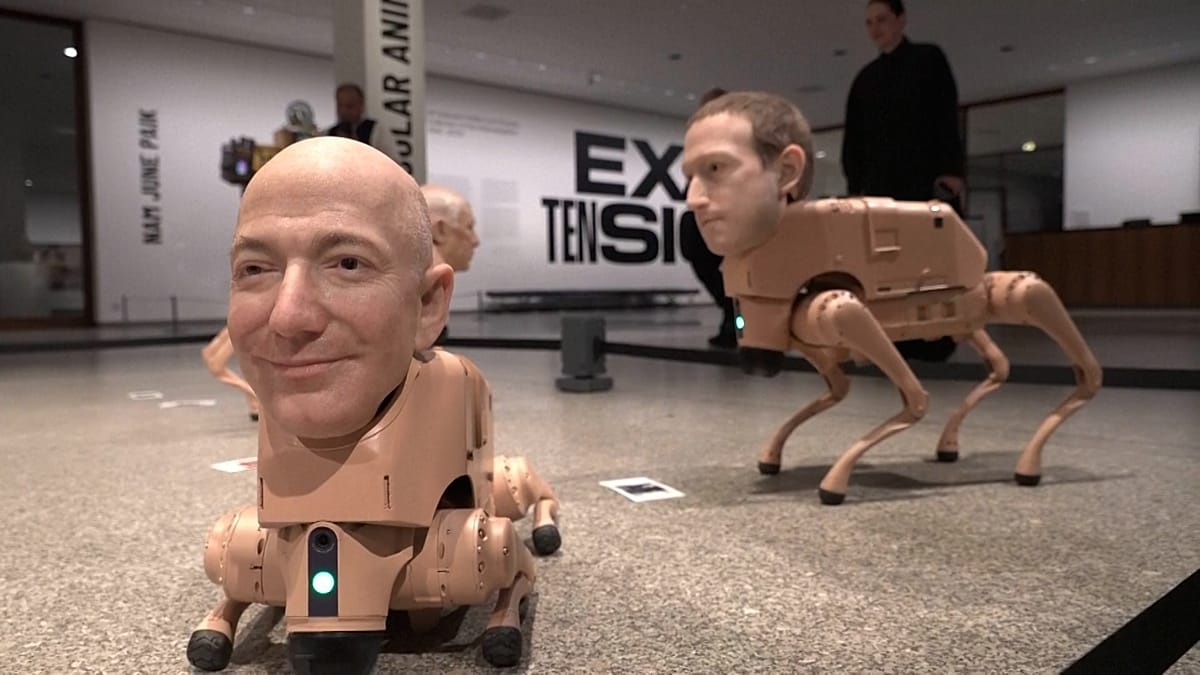
At Berlin's Neue Nationalgalerie, a pack of robot dogs fitted with hyper-realistic silicone heads of Elon Musk, Jeff Bezos, and Mark Zuckerberg is roaming the gallery floor, excreting AI-generated art. The installation, titled Regular Animals, is the work of American digital artist Mike Winkelmann, better known as Beeple, and it offers a biting critique of how tech billionaires now shape public perception.
The robots, which also include heads modelled on Andy Warhol, Pablo Picasso, and Beeple himself, are equipped with cameras that capture their surroundings. Each image is then processed through an algorithm and printed on paper, which the machine ejects in a gesture mimicking digestion. The Picasso dog, for instance, produces cubist-style prints, while the Warhol dog outputs pop-art images.
According to Winkelmann, the work is a commentary on the shift from artists to algorithms as the primary shapers of how we see the world. "In the past our view of the world was shaped in part by how artists saw the world, how Picasso painted changed how we saw the world, how Warhol talked about consumerism, pop culture, changed how we saw those things," he said. "Now our view of the world is shaped by tech billionaires who own powerful algorithms that decide what we see and what we don't see, how much we see of it."
Winkelmann emphasized the unchecked power of these figures: "That's an immense amount of power that I don't think we've fully understood, especially because when they want to make a change, they don't need to lobby the U.N. They don't need to get something through Congress or the EU, they just wake up and change these algorithms."
Art as a Mirror for Technological Change
Lisa Botti, the curator of the Berlin exhibition, said that artificial intelligence is one of the most impactful phenomena of our time and that "museums are the places where society can reflect" on such transformations. The show, which debuted at Art Basel Miami Beach in 2025, is part of a broader trend of European institutions engaging with the intersection of art and technology. For example, Turin's Palazzo Madama recently deployed a robot guide to lead visitors through centuries of art, highlighting how museums are adapting to the digital age.
Beeple, a pioneer of the "everyday" movement in 3D graphics, has been creating and posting a new digital artwork online every day for years without missing a single day. His work often satirizes consumer culture and the influence of tech giants. The robot dogs themselves are a spectacle: restless machines that wander the gallery, their silicone faces eerily lifelike, part satire and part spectacle.
The installation raises questions about the role of AI in art and the concentration of power in the hands of a few tech billionaires. As the European Union debates regulations on artificial intelligence and algorithmic transparency, works like Regular Animals serve as a timely reminder of the stakes involved. The exhibition runs at the Neue Nationalgalerie, a modernist icon designed by Ludwig Mies van der Rohe, which itself stands as a monument to the 20th-century belief in rational design—a stark contrast to the chaotic, algorithm-driven outputs of Beeple's machines.
For visitors, the experience is both playful and unsettling. The dogs' movements are unpredictable, and their outputs vary, creating a sense of unease about who—or what—is in control. As one observer noted, the installation forces viewers to confront the idea that reality itself is being curated by algorithms owned by a handful of individuals. In a city like Berlin, which has a rich history of political and artistic dissent, the message resonates deeply.