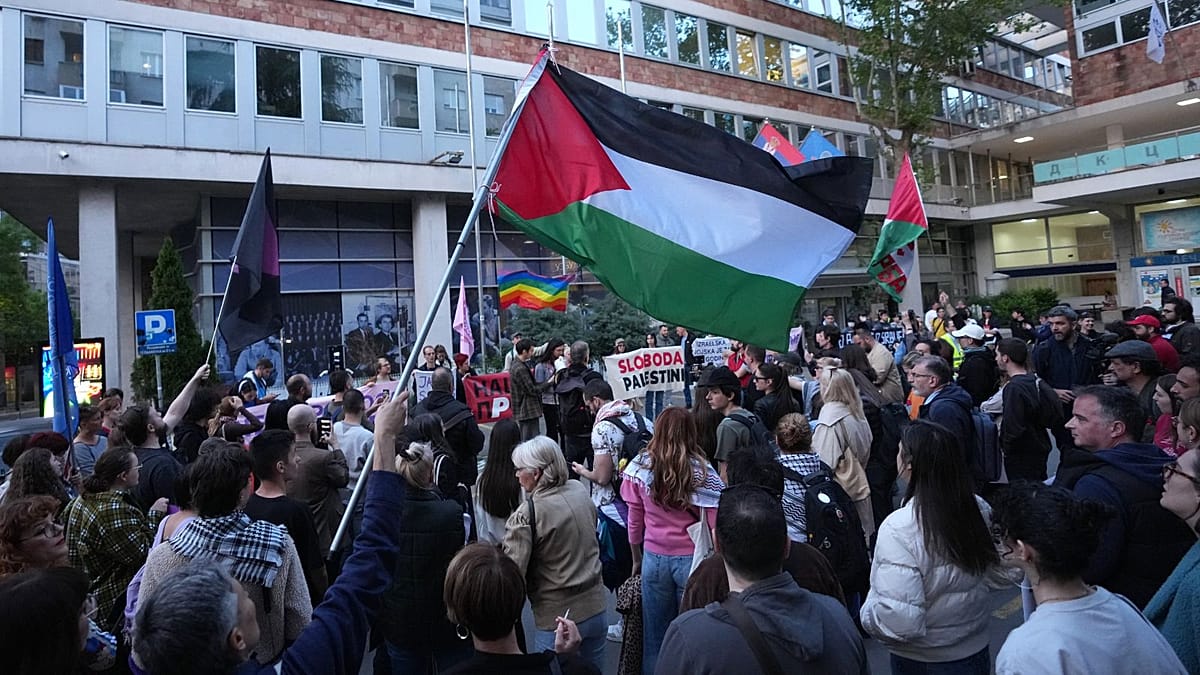
Hundreds of protesters gathered outside the headquarters of Serbia's public broadcaster RTS in central Belgrade on Monday, demanding the country withdraw from this year's Eurovision Song Contest over Israel's participation. Waving Palestinian flags and accusing Israel of genocide, the demonstrators called on RTS to refrain from broadcasting the event and urged Serbians to boycott it entirely—even as Serbia is represented by the metal band Lavina.
“A Eurovision without Israel would mean defending the ideals that this event proclaims,” the protest organizers said in a statement. The rally is the latest in a series of actions across Europe challenging the European Broadcasting Union's (EBU) decision to allow Israel to compete in the 70th anniversary edition, scheduled for 12–16 May in Vienna.
Growing Boycott Movement
The protest in Belgrade mirrors a broader backlash that has already led several countries to withdraw. Slovenia's RTV Slovenia confirmed last week it will not air the contest, instead showing a film series titled Voices of Palestine, featuring Palestinian documentaries and feature films. “We will not be broadcasting the Eurovision Song Contest,” Ksenija Horvat, RTV Slovenia director, told the Associated Press. Ireland's RTÉ announced in December it would neither broadcast nor participate, and Spain's RTVE will not air Eurovision for the first time since 1961.
The Netherlands and Iceland, however, will broadcast the event via their public broadcasters NPO and RÚV, respectively. The EBU has defended its decision, arguing that Israel, unlike Russia—barred since 2022 after its full-scale invasion of Ukraine—has not violated the contest's rules. Critics call this hypocrisy, pointing to the slogan “United by Music” as hollow amid ongoing conflict.
Thousands of artists, including Massive Attack, Kneecap, Mogwai, Brian Eno, Sigur Rós, and Nadine Shah, have signed an open letter urging fans to boycott the event. “As musicians and cultural workers, many living within the reaches of the [EBU], we reject Eurovision being used to whitewash and normalise Israel's genocide, siege and brutal military occupation against Palestinians,” the letter, organized by No Music for Genocide and the BDS movement, stated. It called on public broadcasters, performers, and fans to boycott until the EBU bans Israeli broadcaster KAN.
Israel has consistently denied committing genocide in Gaza. However, in September 2025, a UN inquiry concluded that Israel is committing genocide, a finding that has fueled the boycott movement. The controversy also intersects with broader geopolitical tensions, including clashes between Ukraine and Israel over Russian shipments of stolen grain and EU warnings of potential sanctions.
This year's Eurovision will feature 35 competing countries, down from 37 in 2024, reflecting the deepening rift. The contest, once a celebration of European unity, now stands as a flashpoint for political protest, with Serbia's rally adding to the pressure on the EBU to reconsider its stance.