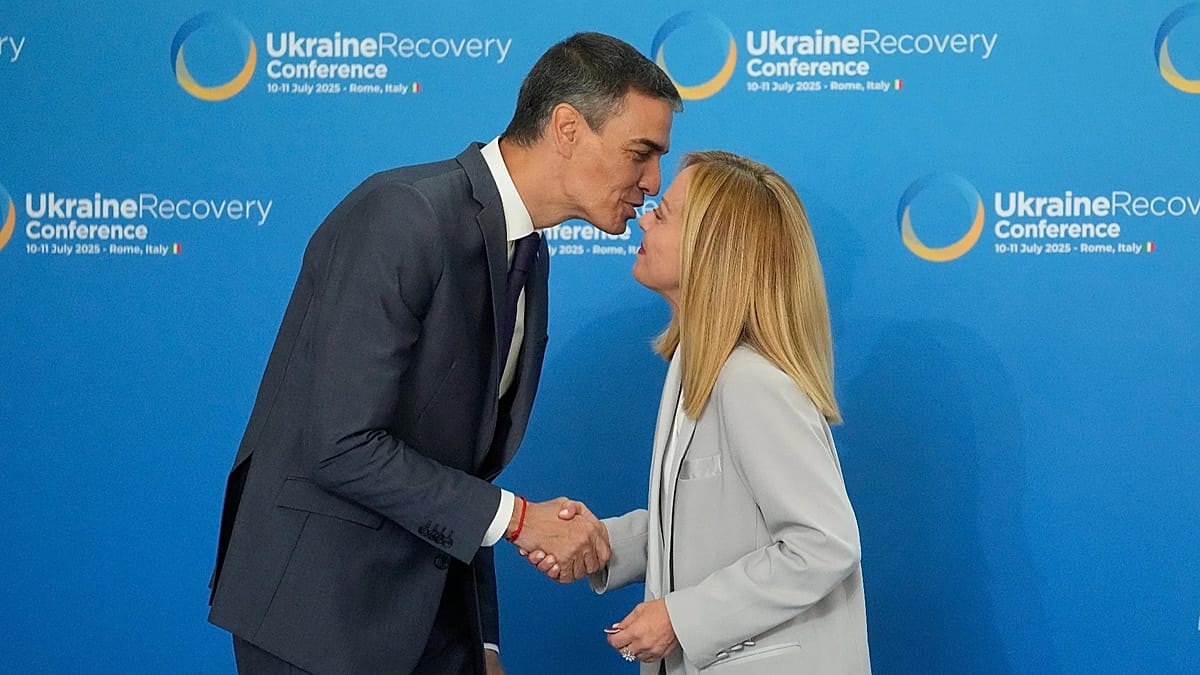
Italy and Spain have taken a small but significant step toward easing a border dispute that has strained relations between the two Mediterranean neighbours. On Friday, Rome extended its temporary checks on arrivals from Spain by just seven days, aligning the measure with Madrid's reciprocal controls. The decision came after a one-on-one meeting between Italian Prime Minister Giorgia Meloni and her Spanish counterpart, Pedro Sánchez, on the sidelines of the EU summit in Brussels, according to a diplomat familiar with the talks.
The border checks were first introduced on 1 August for one month, following the arrival of nearly 90,000 irregular migrants in the Spanish exclave of Ceuta. Italy subsequently renewed the controls three times, each for 15 days, effectively suspending the free-circulation rules of the Schengen area with Spain. In response, Madrid imposed its own reciprocal checks, which it considered unjustified, and renewed them in tandem. The latest Spanish extension was due to expire on 22 October, and now both countries' measures will end on the same day.
A fragile thaw
The alignment is a sign of thawing relations after weeks of public friction over migration policy. Meloni, who leads a far-right government, and Sánchez, a centre-left leader, have repeatedly clashed on how to handle irregular migration. Their meeting in Brussels, though brief, was seen as an attempt to lower the temperature. Italian and Spanish diplomatic sources say the interior ministers of both countries are expected to meet next week to work out alternative measures that could replace the border checks.
The checks are currently carried out at airports and ports, as the two countries share no land border. According to the Italian Interior Minister, nearly 500,000 people were screened in the first month of the controls. Of those, 31 were refused entry, including eight Moroccan citizens. The minister did not specify whether those individuals had entered Spain during the mass influx to Ceuta. The Spanish government maintains that no irregular migrants have moved from Ceuta to mainland Spain.
The dispute has highlighted the broader challenges facing the European Union over migration, a topic that remains high on the agenda. At Friday's summit, EU leaders were scheduled to hold a strategic discussion on migration over lunch, with Meloni and Sánchez expected to be on opposite sides of the debate once again. Italy has pushed for a more robust external border enforcement and burden-sharing among member states, while Spain has emphasised the need for legal pathways and cooperation with origin countries.
The temporary nature of the border checks has drawn criticism from some EU officials, who argue that such measures undermine the Schengen area's principle of free movement. However, both Rome and Madrid have framed their actions as necessary security measures, and the short extension suggests a willingness to de-escalate. The upcoming meeting of interior ministers will be crucial in determining whether the two countries can find a more permanent solution.
Observers note that the personal rapport between Meloni and Sánchez, though often strained, may have helped facilitate this modest breakthrough. Both leaders are pragmatic politicians who understand the domestic pressures of migration politics. Yet the underlying disagreements remain unresolved, and the risk of future flare-ups persists.
For now, the alignment of the border checks offers a temporary reprieve. Travellers between Italy and Spain can expect the controls to remain in place until the end of October, but the hope is that next week's talks will produce a more durable arrangement. As the EU grapples with migration reform, the Italy-Spain episode serves as a reminder of how quickly bilateral tensions can spill over into the bloc's internal dynamics.