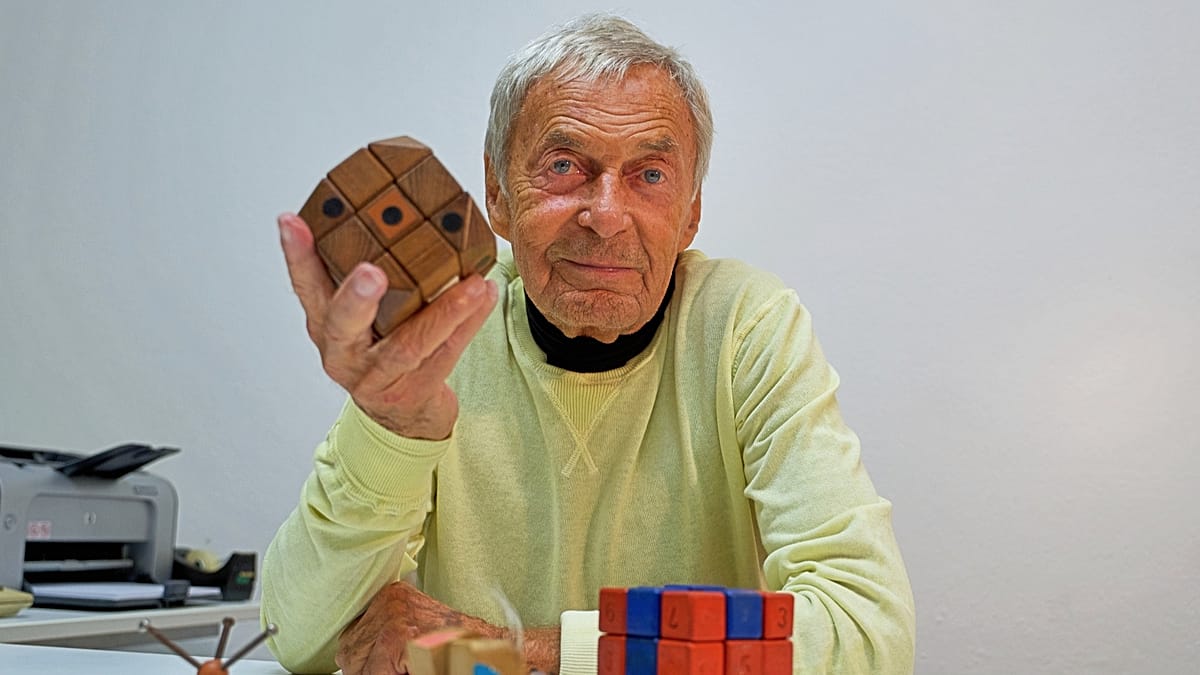
Half a century after Ernő Rubik first twisted his prototype in a Budapest classroom, the iconic puzzle is once again rolling off Hungarian production lines. A new automated factory in Jászberény, about 80 kilometres east of the capital, was unveiled this week by the 82-year-old inventor, marking a homecoming for a toy that became a global phenomenon.
The facility will use robotic arms to assemble and test the cubes, with an annual capacity of up to one million units. It is a modest scale compared with the hundreds of millions sold during the puzzle's heyday, but the symbolic weight is considerable: the Rubik's Cube was born in Hungary, and for decades its manufacture was outsourced to low-cost centres in Asia.
From wooden blocks to world domination
Rubik, then a lecturer in interior design at the Budapest College of Applied Arts, created the cube in 1974 as a way to help students understand three-dimensional geometry. He carved 27 small wooden blocks and connected them with an internal mechanism that allowed the faces to rotate independently. The result was a deceptively simple puzzle that resisted easy solutions.
First sold locally as the Magic Cube in 1977, it caught the attention of international toy companies, and by 1980 it was rebranded as the Rubik's Cube. The initial boom between 1980 and 1983 saw roughly 200 million cubes sold worldwide, making it one of the best-selling toys in history. Speedcubing competitions, online tutorials, and a dedicated fan base have kept the puzzle relevant long after its first wave of popularity.
The return of production to Hungary is not just a nostalgic gesture. It reflects a broader trend of reshoring manufacturing in Europe, driven by rising labour costs in Asia, supply chain disruptions, and a growing consumer appetite for products with a clear provenance. For a country that has often been seen as an assembly hub for foreign automakers, the Jászberény plant offers a rare example of a home-grown brand reclaiming its industrial roots.
Local officials hailed the investment as a boost for the region's economy. Jászberény, a town of about 30,000, has a long industrial history, but like many Hungarian towns it has faced factory closures and job losses in recent decades. The new plant is expected to create dozens of skilled positions, with potential for expansion if demand grows.
The timing is also notable given Hungary's current political climate. Prime Minister Viktor Orbán has made economic nationalism a central theme, and the government has pushed for greater self-reliance in strategic sectors. While a toy factory is hardly a matter of national security, the symbolic resonance of a Hungarian invention returning home fits neatly into that narrative. Hungary's recent EU defence loan shows the government's willingness to engage with European funding for industrial projects, even as it clashes with Brussels on other fronts.
For Rubik himself, the return to production is a personal milestone. In interviews, he has often spoken of the cube as a "symbol of human ingenuity" and a bridge between art and science. He has also been careful to distance himself from the commercial excesses of the toy industry, preferring to focus on education and design. The Jászberény plant, with its emphasis on automation and quality control, seems to reflect his belief that the cube should be made with care.
The puzzle's enduring appeal is not hard to understand. It is a test of patience and logic, a tactile object that rewards persistence. And now, for the first time in decades, a new generation of European consumers can buy a cube that was made in the same country where it was conceived. Whether that will translate into a commercial revival remains to be seen, but for Hungarians, the return of the Rubik's Cube is a point of pride.
As the factory begins its work, one thing is certain: the little cube that started as a classroom exercise has come full circle. From Budapest to the world, and now back to Hungary.