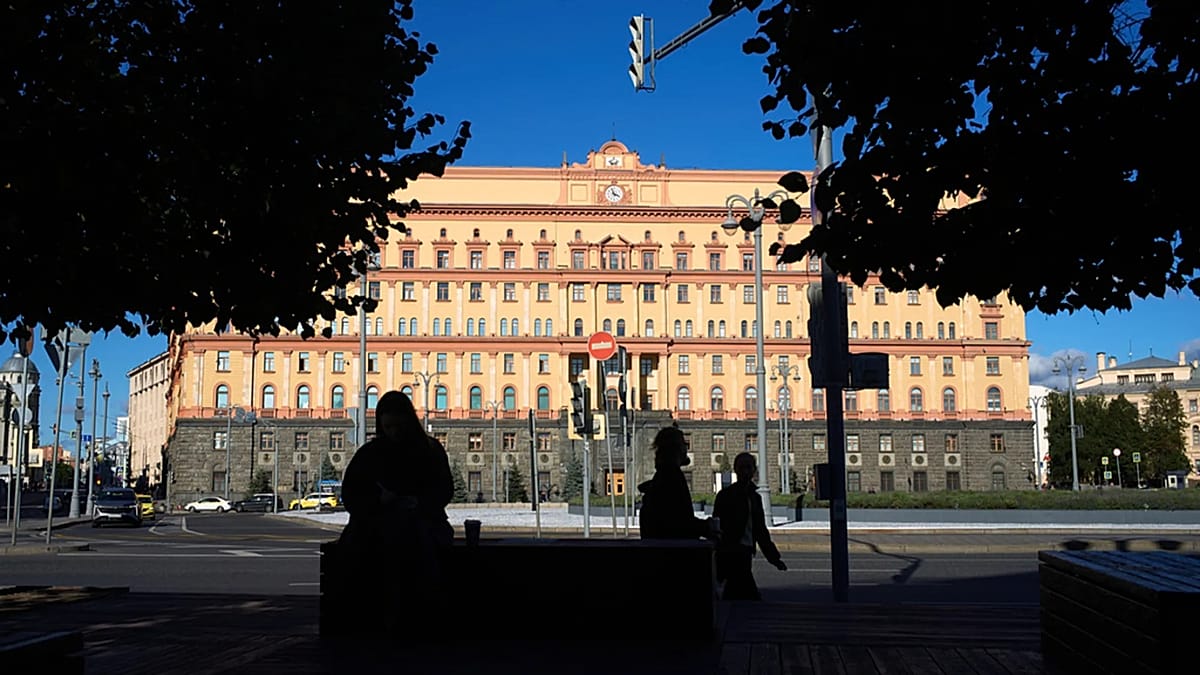
Russia has detained a Swedish citizen and a Japanese journalist within days of each other, as former president Dmitry Medvedev openly suggests Moscow should expand its roster of Western detainees to trade for Russians held abroad.
The Federal Security Service (FSB) announced on Wednesday that it had arrested the Swedish national in the Sebezh district of Pskov region, near the borders with Belarus and Latvia. The agency claims the man entered Russia under the guise of joining the Russian military, but actually intended to carry out "sabotage and terrorist attacks" against military sites.
According to the FSB, the detainee served from February to June as commander of a drone section in the 24th separate assault battalion of Ukraine's Aidar unit—a volunteer formation that emerged during Russia's initial invasion of Ukraine in 2014 and which the Kremlin has designated a "terrorist organisation," a label routinely applied to Ukrainian units. The FSB says he admitted to serving in the unit and that documents confirm his participation in combat against Russian forces. He faces charges of illegal border crossing, organising the activities of a terrorist organisation, and serving as a mercenary. His name has not been released, and Sweden's government has not commented. Moscow's claims could not be independently verified.
Second arrest on Sakhalin
The second arrest involves Yuki Imai, a journalist for Japan's Hokkaido Shimbun newspaper, who was detained on Sakhalin Island as he prepared to leave the country. The FSB accuses him of gathering information on Russia's defence capabilities at the direction of Japanese intelligence services.
Japan summoned Russia's ambassador in Tokyo, Nikolai Nozdrev, on Wednesday. Kimitake Nakamura, head of the foreign ministry's European affairs department, lodged a protest both over the arrest and Moscow's decision to announce it without first informing the Japanese government. Tokyo has demanded consular access to Imai and assurances of humane treatment.
The Committee to Protect Journalists called for his immediate release, warning that journalists "must not be used as a bargaining chip in broader geopolitical disputes." The organisation estimates that at least 30 journalists are currently held in Russia in connection with their work.
Medvedev's 'exchange pool' rhetoric
The arrests followed a Telegram post by Dmitry Medvedev on 9 October, in which he called for Russia to increase its "exchange pool" of foreign nationals it uses to negotiate the release of its citizens deemed useful to the regime. Writing after the arrest in Montenegro of Mikhail Zvinchuk, a Kremlin propagandist and founder of Rybar—a Telegram channel close to Russia's military and security services—Medvedev said Moscow might need to detain more Western nationals to secure the release of Russians held abroad.
"Now, quite likely, we will have to fill up the exchange pool with European and American idiots in order to pull our own people out," he wrote. "There is no other way: if you live with wolves, you have to howl like a wolf."
Zvinchuk has since been returned to Russia.
Using people as bargaining chips
Russia has for years detained foreign nationals on charges including espionage and drug smuggling, a practice its critics describe as the taking of hostages for exchange. The most recent large-scale swap took place in August 2024, when 26 people were freed in a multinational exchange: Russia released 16 detainees, and Western countries handed back 10.
Among those Russia released were Wall Street Journal journalist Evan Gershkovich, sentenced to 16 years in a high-security prison on espionage charges, and former US Marine Paul Whelan, convicted on the same charges and given the same sentence. Germany obtained the release of Rico Krieger, who had been sentenced to death in Belarus, and Patrick Schabel, detained at Moscow's Sheremetyevo airport over cannabis-infused gummy sweets.
Russia received back, among others, Vadim Krasikov, who was serving a life sentence in Germany for the assassination of Georgian national Zelimkhan Khangoshvili in a Berlin park in 2019, Artem and Anna Dulcev, accused of spying in Slovenia under the guise of South American art dealers, and Pablo González aka Pavel Rubtsov, a Russian-born Spanish journalist who had been held in Poland on espionage charges since February 2022.
The latest detentions signal that Moscow is willing to continue using foreign nationals as leverage, a tactic that has drawn sharp criticism from European governments and press freedom groups. As European leaders weigh their response, the question of how to counter such practices—without endangering their own citizens—remains a pressing challenge. A European Security Council could offer a coordinated approach to hybrid threats, but the immediate priority is securing the release of those unjustly held.