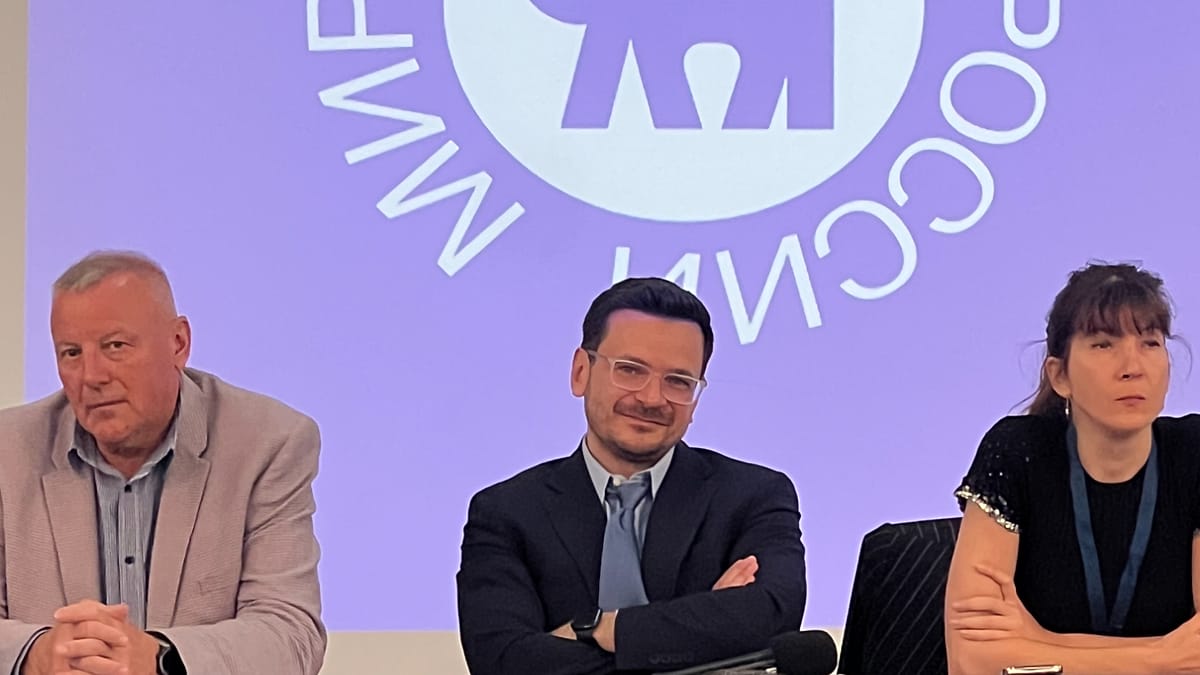
Delegates of the newly formed Russian opposition party Peaceful Russia gathered in Berlin on June 12 and 13 to adopt its program and elect a leader. The congress, which lasted roughly twelve hours, saw 126 invited delegates debate fiercely before choosing Ilya Yashin as chairman with approximately 60 percent of the vote, according to Igor Kachetkov, a human rights activist and member of the organizing committee.
The party, originally named Peaceful Forces of Russia, dropped the word 'Forces' to avoid associations with state repression and the war in Ukraine. Yashin, a former political prisoner and prominent Kremlin critic, now leads an organization that aims to operate from exile while targeting its message at Russians inside the country.
High Hopes and Early Tensions
Many delegates place considerable hope in Yashin's ability to unite a fragmented opposition. Alexander Archagov, a party delegate, told Euronews: 'Ilya is an experienced politician. He is a gifted speaker. That is very important because a politician who cannot communicate will not be able to work with others.' Archagov added that Yashin has a clear roadmap and ideological principles, but stressed that 'the ability to inspire people is the most important thing—in Russia and abroad.'
Yashin acknowledged the challenges of leading from exile. 'We have taken on this challenge,' he said. 'It is very difficult because we are based in Europe. But we plan to work in Russia in the future, and that is very risky.' He emphasized that the party's primary audience remains inside Russia: 'Our party program and political message are aimed first and foremost at people in Russia who have no voice. We want to be their voice.'
Yashin pointed to historical precedents of opposition movements that emerged from exile, notably Lenin's Bolshevik Party before the 1917 Russian Revolution. However, that example ended in an authoritarian one-party state under Lenin and Stalin, and no democratic opposition party has ever returned from exile to govern Russia.
Internal tensions have already surfaced. Maxim Reznik, a veteran liberal opposition politician and former member of the St. Petersburg Legislative Assembly, has worked alongside Yashin for years but now voices serious concerns. 'I do not want Yashin to turn into a mini-Putin,' Reznik told Euronews. 'Unfortunately, I see my hope fading that he will not prove to be a self-centered Moscow political boss. The opposition already has too many of those.'
Reznik argued that Yashin is replicating a flawed model. 'I think Ilya has chosen the wrong formula. Essentially, he is trying to recreate a party modeled on the Communist Party of the Soviet Union. We should stop making the same mistakes.' He called for a leader who can unite people across regions and treat them as equals, something he does not currently see in Yashin.
The Russian opposition in exile has long struggled with fragmentation and personal rivalries. Andreas Heinemann-Grüder, a Russia expert at the University of Bonn, noted that competition and ambition have repeatedly prevented unity. He suggested the new party should learn from the experience of Yabloko, the liberal opposition party founded in 1993.
As the party prepares to operate from European capitals, its ability to maintain cohesion and avoid internal authoritarian tendencies will be closely watched. The congress in Berlin marks a significant step, but the path ahead remains uncertain. For more on the broader context of Russian opposition efforts, see our coverage of Russia's Opposition in Exile Seeks Unity as New Party Launches in Berlin.