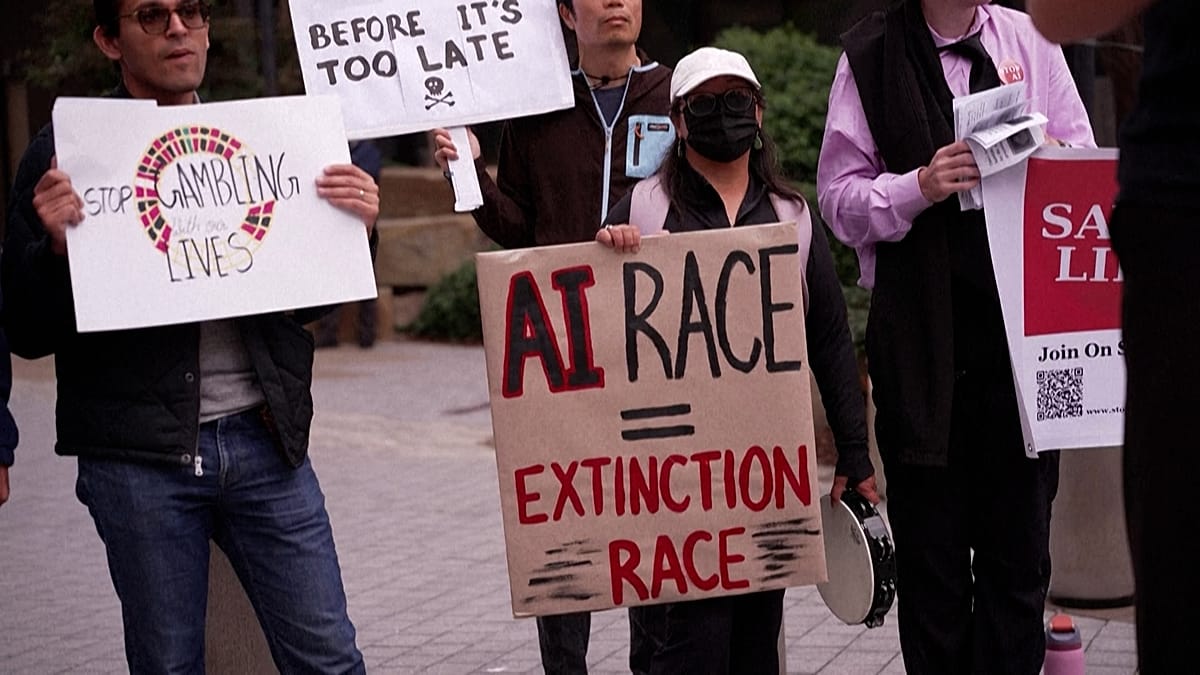
Dozens of protesters gathered outside the San Francisco headquarters of OpenAI and Anthropic on [date], urging the two leading AI labs to halt development of increasingly powerful systems. The demonstration, organized by a coalition of advocacy groups, highlighted growing public unease about the pace of artificial intelligence advancement and its potential societal and environmental consequences.
Chanting slogans such as "Pause AI, save the planet" and holding signs that read "AI Emergency Now," the protesters called for an immediate moratorium on training models that exceed current capabilities. They also demanded that governments, particularly in Europe and the United States, enact binding regulations to govern the technology's deployment.
Global rules and an 'AI emergency'
One of the central demands was the declaration of an "AI emergency," a formal recognition that the risks posed by advanced AI—ranging from job displacement to potential existential threats—require urgent, coordinated action. The protesters argued that voluntary commitments by companies are insufficient and that only legally enforceable international treaties can ensure safety.
"We are sleepwalking into a future where a handful of corporations decide the fate of billions," said Marta Keller, a spokesperson for the protest organizers. "Europe has been a leader in digital regulation with the AI Act, but we need global rules, not just regional ones."
The demonstration comes amid heightened scrutiny of AI labs. Anthropic, in particular, has been in the spotlight after its CEO publicly urged other labs to slow down, citing fears of superintelligence. That call, however, has not translated into concrete action, according to critics.
Climate concerns and energy consumption
Beyond safety, protesters pointed to the environmental footprint of AI. Training large models consumes vast amounts of electricity, and data centers are increasingly straining energy grids across Europe and the US. The groups argued that the AI industry's growth is incompatible with climate goals, especially as the EU pushes for carbon neutrality by 2050.
"Every time a company like OpenAI or Anthropic trains a new model, it burns through energy equivalent to a small city," said environmental activist Jonas Weber, who traveled from Berlin to join the protest. "We cannot allow this unregulated expansion to undermine our climate commitments."
The protesters also drew parallels to the ongoing energy crisis, noting that oil prices have surged due to geopolitical tensions, making the need for sustainable technology even more urgent.
Industry response and regulatory landscape
Neither OpenAI nor Anthropic issued an official statement in response to the protest. However, both companies have previously emphasized their commitment to safety and their support for regulation. Anthropic, which is reportedly preparing for a landmark listing with a market value exceeding $2 trillion, has positioned itself as a safety-first company.
In Europe, the AI Act is set to become the world's first comprehensive AI law, with provisions for high-risk systems. Yet, as EU capitals debate the next budget, some member states are wary of over-regulation that could stifle innovation. The protesters argue that such concerns are misplaced.
"The EU AI Act is a good start, but it has loopholes," said Keller. "We need a global body, like the IAEA for nuclear energy, to oversee AI development."
Broader implications for Europe
The protest in San Francisco resonates across the Atlantic, where European tech hubs like Berlin, Paris, and Amsterdam are also witnessing grassroots movements demanding stricter AI oversight. The debate is particularly acute in Brussels, where policymakers are balancing innovation with public safety.
Some observers note that the AI industry's rapid growth has parallels to the financial sector before the 2008 crisis. "We are seeing a bubble of hype and investment, but the underlying risks are real," said Dr. Elena Rossi, a technology policy analyst at the Centre for European Policy Studies in Brussels. "If we don't act now, we may face a backlash that could set back the entire field."
The protesters have vowed to continue their campaign, with plans for similar demonstrations in European capitals in the coming months. They are also calling on European leaders to push for an international AI treaty at the next UN summit.
As the sun set over the Bay Area, the crowd dispersed, but the questions they raised remain unanswered. Will the AI labs heed the call to pause? Will governments step in? For now, the future of AI—and its impact on our planet—hangs in the balance.