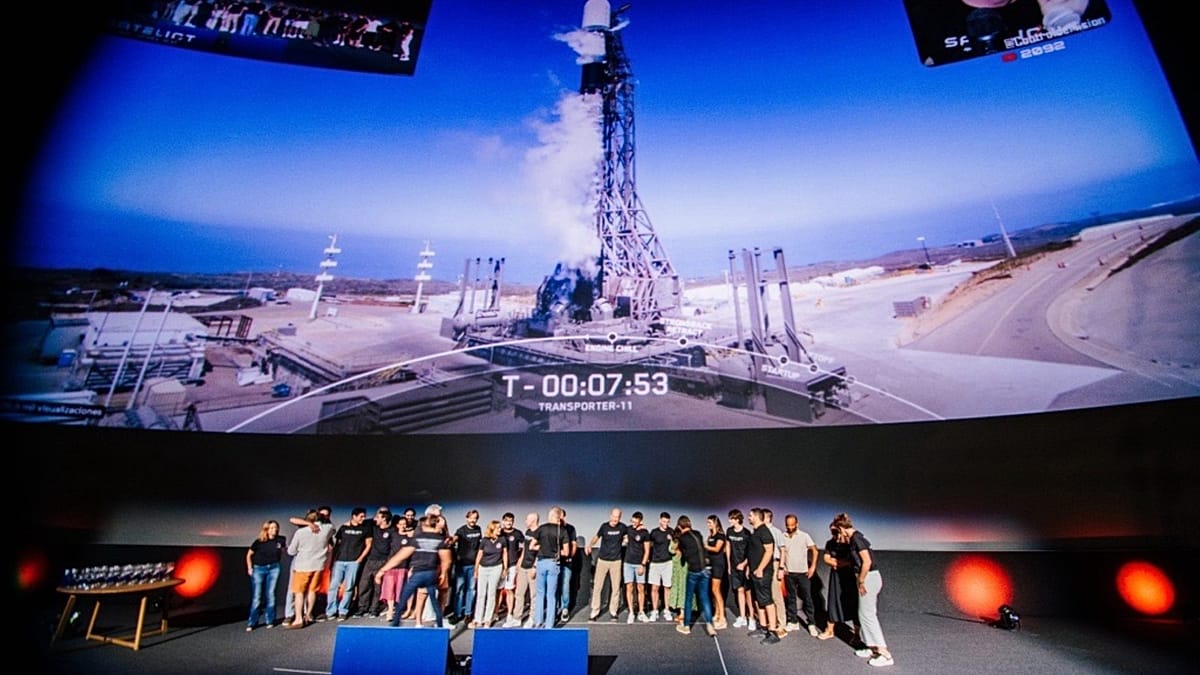
Sateliot, a Barcelona-based company, is set to launch five new satellites aboard a SpaceX Falcon 9 rocket on Thursday, expanding its constellation to 11 spacecraft. The mission, dubbed Draconis, will lift off from Vandenberg Space Force Base in California at 20:18 Central European Summer Time, as part of SpaceX's Transporter-18 rideshare flight. The launch window could shift, but the company plans to stream it live from its Espai Diagonal headquarters.
Sateliot's core business is essentially placing mobile phone masts in orbit. Its satellites extend the coverage of terrestrial mobile networks, allowing operators to offer Internet of Things (IoT) connectivity in areas where ground infrastructure is absent. The technology, based on the 5G Non-Terrestrial Network (NTN) standard, has already been validated, according to the company.
The five new satellites, built by Spanish firm Alén Space, are compact cubesats measuring 20 x 10 x 35 centimetres and weighing just 10 kilograms each. They are designed for a service life of more than five years and will operate in orbits up to 600 kilometres above Earth.
Compared with the four satellites Sateliot launched in 2024, the new units feature an optimised payload, a more reliable onboard data storage system, upgraded main computer and attitude-control hardware for improved stability and manoeuvrability, and radiation-resistant memory components. The company says the design has matured to the point where these satellites were engineered and built in half the time required for the previous batch.
The launch and deployment are supported by Exolaunch, which handles integration and logistics; KSAT and Leaf Space, which operate ground tracking and control stations; and Comfone, which provides IPX connectivity services to link Sateliot's network with mobile operators.
Scaling up for the future
These five satellites are part of a much larger ambition. Sateliot plans to grow its constellation to more than 500 satellites, evolving from massive IoT services to higher-capacity, more critical applications, including direct-to-device (D2D) connections.
The next major step comes in 2027 with the Tritó generation, which will debut 5G NR NTN technology, store-and-forward communications based on the 3GPP Release 19 standard, and a digital multibeam phased-array antenna capable of dynamically managing multiple coverage beams. Sateliot has already signed an agreement with Spanish launch provider PLD Space for a dedicated mission on its Miura 5 rocket.
To finance this expansion, Sateliot is working on a €100 million Series C funding round. The company has already raised roughly €100 million to date and projects revenues of €500 million by 2030.
"We have validated the technology and we are now increasing capacity and regularity so we can scale up the service together with mobile operators," said Jaume Sanpera, CEO and co-founder of Sateliot. "Our goal is to turn the satellite into a natural extension of their networks wherever they do not reach."
The launch comes amid broader European interest in space-based connectivity. While Sateliot focuses on IoT, other initiatives are exploring satellite broadband and direct-to-mobile services. The company's progress also highlights the growing role of private European firms in the global space economy, even as they rely on US launch providers like SpaceX.
For European businesses and governments, the expansion of satellite IoT could have significant implications, from agriculture and logistics to environmental monitoring and infrastructure management. As Sateliot scales up, it aims to make seamless connectivity a reality across the continent and beyond.