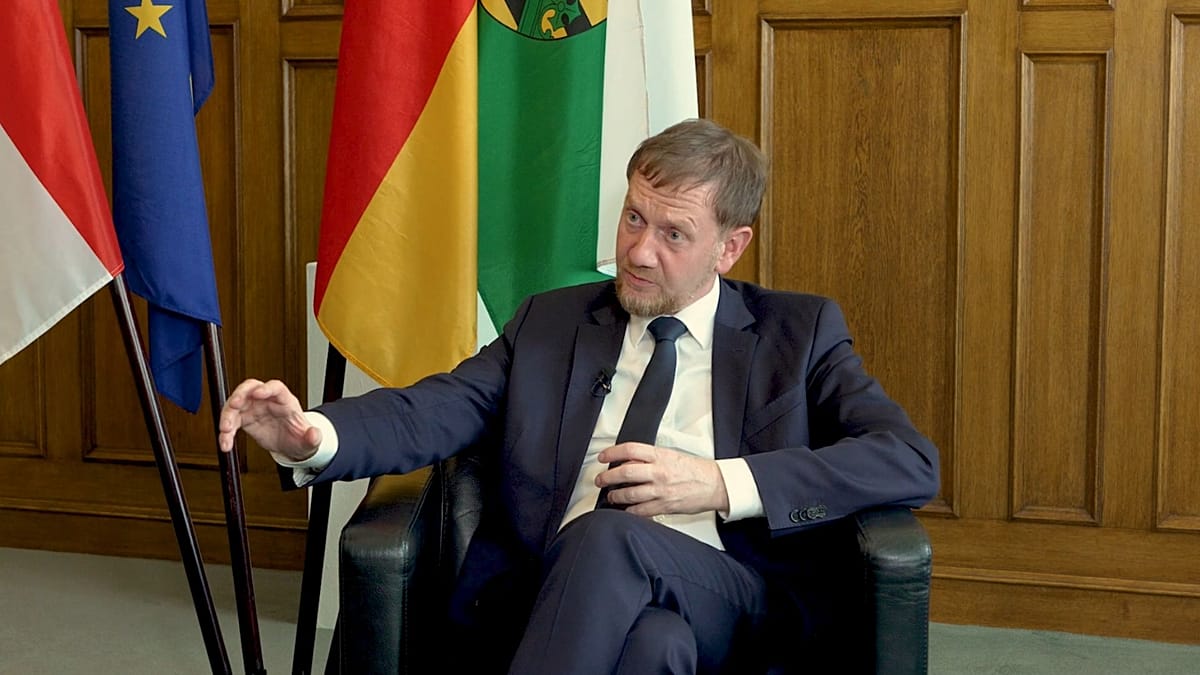
Michael Kretschmer, the Minister-President of Saxony and vice-chair of the CDU, has sparked debate by suggesting that Germany should consider resuming gas imports from Russia once a peace deal with Ukraine is reached. In an interview with Euronews at the Free State of Saxony's Berlin representation, Kretschmer argued that diplomatic engagement must eventually include energy ties.
"Once there is peace, we can, should, and must talk about such matters," Kretschmer said. He expressed hope that a ceasefire or peace agreement would come swiftly, citing the daily loss of life on both sides of the front. His comments come amid ongoing Russian drone attacks on Ukrainian cities like Kharkiv, which have intensified civilian casualties.
Diplomacy Over Escalation
Kretschmer has long advocated for negotiations with Moscow, arguing that the conflict cannot be resolved solely through military means. He reiterated his skepticism about supplying Ukraine with German-made Taurus cruise missiles, warning that Berlin must avoid becoming a party to the war. "In my view, Germany must not become a party to the war, and from my perspective it has already gone far too far," he stated.
The CDU politician criticized the moral condemnation of those who oppose further military aid, calling such accusations "morally completely over the top and, in my view, also unacceptable." He stressed the need to build diplomatic alliances involving China, India, and other global powers.
Sanctions Must Be 'Smart'
While Kretschmer affirmed that Russia's invasion of Ukraine cannot go unpunished, he insisted that sanctions must be carefully calibrated. "The attack on a sovereign state cannot be allowed to go unpunished. If that sets a precedent, we are finished," he said. However, he emphasized that measures must not jeopardize Germany's economic strength. "That is why I have always said, in terms of international law and also quite clearly as our own position, not a single square metre of Ukraine, not even Crimea, has become Russian. And in that respect, a response with a smart selection of sanctions is of course the right thing to do."
He argued that Europe's defense capabilities, including missile defense systems, must remain financially sustainable, which requires a robust economy. "For that, you first need a willingness to negotiate, and secondly you have to consider which measures hit us particularly hard and may, in case of doubt, also put our legitimate interests at risk, for example the country's economic strength," Kretschmer added.
Welfare Policy Under Fire
Kretschmer was sharply critical of Germany's decision to grant Ukrainian refugees access to the citizens' allowance (Bürgergeld), calling it "a big mistake." He contrasted Germany's low employment rate among Ukrainian refugees—around 20-30%—with higher rates in France, Poland, the Czech Republic, and the Netherlands, where 70-80% of refugees are employed. "That is the citizens' allowance, that is a big mistake," he said, attributing the disparity to welfare policy rather than the refugees themselves.
He praised the EU's Temporary Protection Directive for providing swift, unbureaucratic assistance but noted that it is set to expire next year. Kretschmer believes the directive should not be extended, arguing that "large parts of Ukraine are places where people can live well and safely" and that Ukraine needs support for reconstruction. "We can see how our capacity to provide support here is limited. And that applies to Germany, but it also applies to many other countries," he said.
Municipal Funding and Defense
During recent coalition negotiations, Kretschmer joined counterparts from Bavaria, Mecklenburg-Western Pomerania, and Saarland in demanding €100 billion from a special fund for municipalities. "For us minister-presidents, it was clear at the time that we cannot provide funding for armaments or even equipment for Ukraine while hospitals, schools, nurseries, sports facilities, fire brigades and similar infrastructure in the municipalities are being left behind," he explained. "That is why we said we would agree to this on the condition that municipalities and states were supported on that scale. From my point of view, that was absolutely the right decision."
Kretschmer's stance reflects a broader tension within Germany and the EU over balancing support for Ukraine with domestic economic and social priorities. As the war continues, his call for a pragmatic, diplomacy-first approach—including potential energy deals—is likely to remain controversial.