As Serbia's new political leadership takes shape, a representative of the Students' List has urged Brussels to be patient, saying the country needs time to demonstrate where it is heading. In an interview on Euronews' Europe Today, Sara el Sarag acknowledged that the new administration is still finding its footing, even as expectations grow for clarity on European integration, relations with Russia, and the Kosovo issue.
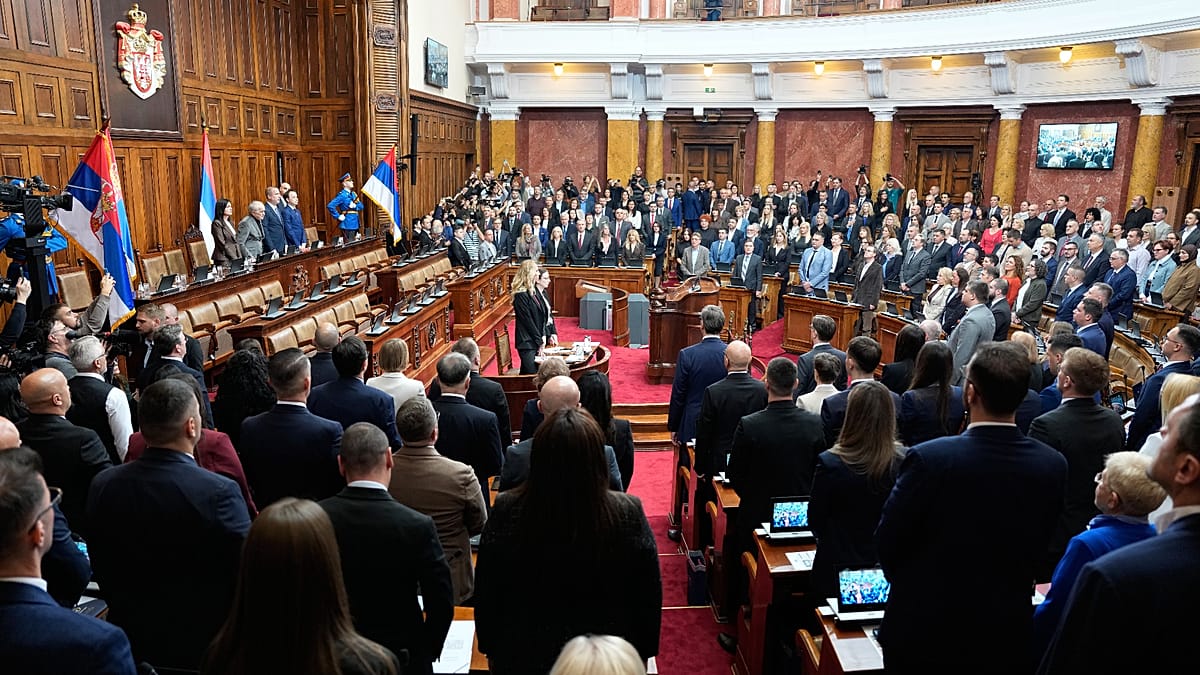
The interview coincided with the EU-Western Balkans summit, a gathering that Serbia's acting president and parliament speaker, Aleksandar Čupić, was expected to attend but ultimately missed. His absence, attributed to the need to complete a constitutive session of the new parliament, raised questions about Belgrade's commitment to the European path. El Sarag defended the decision, explaining that parliamentary procedures had to take priority. "Because today we have to finish a constitutive session and that is our priority right now," she said, adding that the invitation would likely be repeated.
The logistical constraints were real: Čupić is currently the only official in the new administration who has been formally elected to a position, serving as both speaker and acting president after Aleksandar Vučić's resignation in September. With no other senior figure available to travel, the absence was more a matter of protocol than politics.
A shift in mindset, but not yet in policy
When asked whether the EU was genuinely committed to enlargement or merely paying lip service, el Sarag argued that political change is already underway in Serbia, even if it is not yet visible in concrete policy shifts. "I think that we changed something, we changed the mind in the people's head in Serbia, which is something new in the political scene," she said. "And I think we need a little time to prove where we are going."
That sentiment reflects the broader uncertainty surrounding the Students' List, a movement that emerged from months of protests and has now entered parliament. The movement's rise has been seen as a historic shift, but its foreign policy positions remain vague.
Pressed on whether Serbia would align its foreign policy with Brussels, including imposing sanctions on Russia, el Sarag rejected the premise of the question. "I think that question is not correct, because we don't want to make enemies. We want to be friends with all countries, if it's possible, of course," she said.
When the interviewer pointed out that Russia's actions, including alleged airspace violations and hybrid attacks, have made it a threat to European security, el Sarag questioned why EU membership should require choosing sides. "I'm a lawyer, you know, and that kind of question, I don't know why we must be enemies with somebody if we are including in European Union. Why we must take the side," she responded. She later clarified that she had not advocated maintaining close ties with Putin, but offered no concrete alternative.
Kosovo: a question for the people
The interview also highlighted the lack of a clear position on Kosovo, a central issue in Serbia's EU accession talks. Asked whether Serbia would be prepared to fundamentally change its stance on Kosovo as part of normalisation efforts, el Sarag deferred to the public. "I think that people from Serbia are going to give that kind of answer, not me or nobody from the Student's list," she said. When pressed on what that answer might be, she added: "I don't know, we are in the parliament for five days, but I think Kosovo is Serbia."
Confronted with the fact that both Pristina and EU institutions hold a different view, el Sarag urged patience. "We will see, don't hurry, we are not in hurry now," she concluded.
The exchange underscores the challenges facing Serbia's new political representatives as they navigate a complex geopolitical landscape. While el Sarag expressed confidence that attitudes in Serbia are changing, her answers left key questions unresolved—particularly on aligning with EU foreign policy, managing relations with Moscow, and the future of the Kosovo dialogue.
The road ahead for Serbia-EU relations is likely to be bumpy, regardless of the political changes in Belgrade. Two issues remain the proverbial elephants in the room: Kosovo and sanctions on Russia. On Kosovo, there is no indication that Serbia is prepared to recognise its independence, while Brussels continues to insist on substantial progress towards normalisation. On Russia, Serbia's refusal to align with EU sanctions following the invasion of Ukraine remains a serious obstacle, especially as the EU increasingly expects candidate countries to demonstrate clear geopolitical commitment.
But the difficulties are not limited to foreign policy. The student movement, which has become a significant political force, is itself deeply suspicious of the EU, particularly of Brussels' previous relationship with Aleksandar Vučić and his government. Many in the movement believe that EU institutions, especially the European Commission, were willing to overlook the nature of Vučić's rule in the interest of stability. For nearly 14 years, Brussels maintained close political ties with Belgrade, a relationship that the new leadership will have to reckon with as it seeks to redefine Serbia's place in Europe.
As the new parliament settles in, the coming months will be crucial. The Students' List has already made history by securing the speaker's position, but translating that into a coherent foreign policy will require more than good intentions. For now, Serbia is asking for time—and Brussels will have to decide whether to grant it.