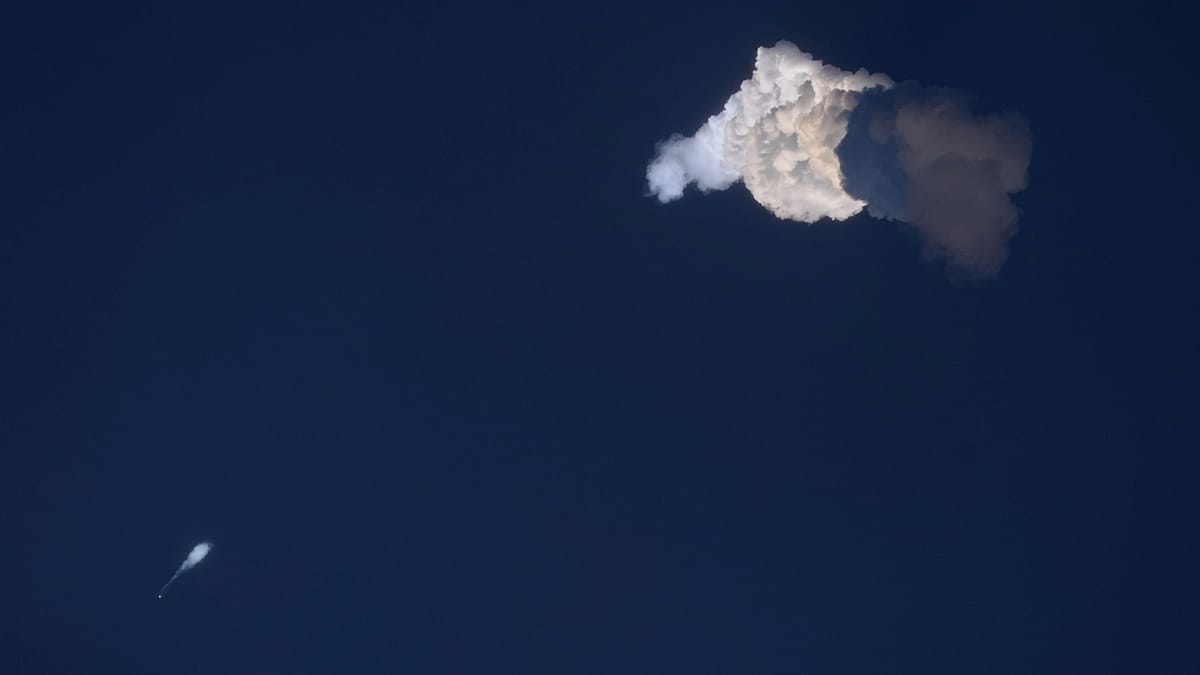
NATO Secretary General Mark Rutte has pledged that the alliance will respond to any threats in space, following reports that Russia is preparing to launch a satellite carrying a nuclear device. The warning comes after intelligence shared among NATO allies indicated a possible launch within the next 60 days.
The prospect of a nuclear weapon in orbit has reignited concerns about the weaponisation of space, a domain that underpins modern communications, navigation, and military operations. Speaking on Euronews' new evening programme Europe Tonight, Jamie Shea, a former NATO spokesperson and now a senior fellow at the Friends of Europe think tank in Brussels, outlined the potential fallout.
What would a nuclear satellite mean?
Shea explained that a nuclear detonation in space would not only destroy the satellite itself but could generate an electromagnetic pulse capable of disabling other satellites in the vicinity. "The blast would create a radiation belt that could fry the electronics of any satellite passing through it," he said, adding that the effects could persist for months or even years.
Such an attack would be indiscriminate, affecting both military and civilian infrastructure. GPS navigation, weather forecasting, financial transactions, and even airline communications rely on satellites. A single nuclear burst could disrupt services across Europe and beyond, with economic losses running into billions of euros.
Shea also drew on historical precedent. During the Cold War, both the United States and the Soviet Union conducted high-altitude nuclear tests, including the 1962 Starfish Prime test, which knocked out several satellites and caused auroras visible from Hawaii. "We have seen the damage these weapons can do," he noted. "The difference today is that the technology is more advanced, and our dependence on space is far greater."
NATO's response and European concerns
Mark Rutte's statement signals a shift in NATO's posture, which has traditionally focused on terrestrial defence. The alliance has already established a space centre in Luxembourg and designated space as an operational domain, but a nuclear threat raises the stakes considerably.
European capitals are watching closely. The prospect of a Russian nuclear satellite comes amid heightened tensions over Moscow's actions in Ukraine, where Russian drones have killed civilians and Kyiv has struck oil refineries in retaliation. The EU has also been tightening sanctions, including scrutiny of Irish alumina exports that could feed Russia's military-industrial complex.
For Europe, the threat is not abstract. The continent is home to some of the world's most advanced satellite manufacturers, including a megafactory in Charleroi that is set to become Europe's largest satellite plant. A nuclear event in orbit would jeopardise billions in investment and set back European space ambitions.
Shea stressed that NATO must be prepared to respond. "We need to develop counter-space capabilities and also resilience in our satellite networks," he said. "But we also need to send a clear message to Moscow that such a move would be met with severe consequences."
The intelligence reports have not been made public in detail, but they have been shared among allies, including the UK, France, and Germany. The UK has already warned defence firms about Russian sabotage, and the Czech Republic has pledged support to Poland after Russian airspace violations.
Diplomatic channels remain open, but the window for action is narrow. If Russia does launch a nuclear-armed satellite, it would mark a dangerous escalation in the use of space for warfare, with implications for every nation on Earth.
As Shea put it, "This is not just about satellites. It's about the rules of the road in space. If we allow this to happen, we are setting a precedent that could lead to a new arms race in orbit."