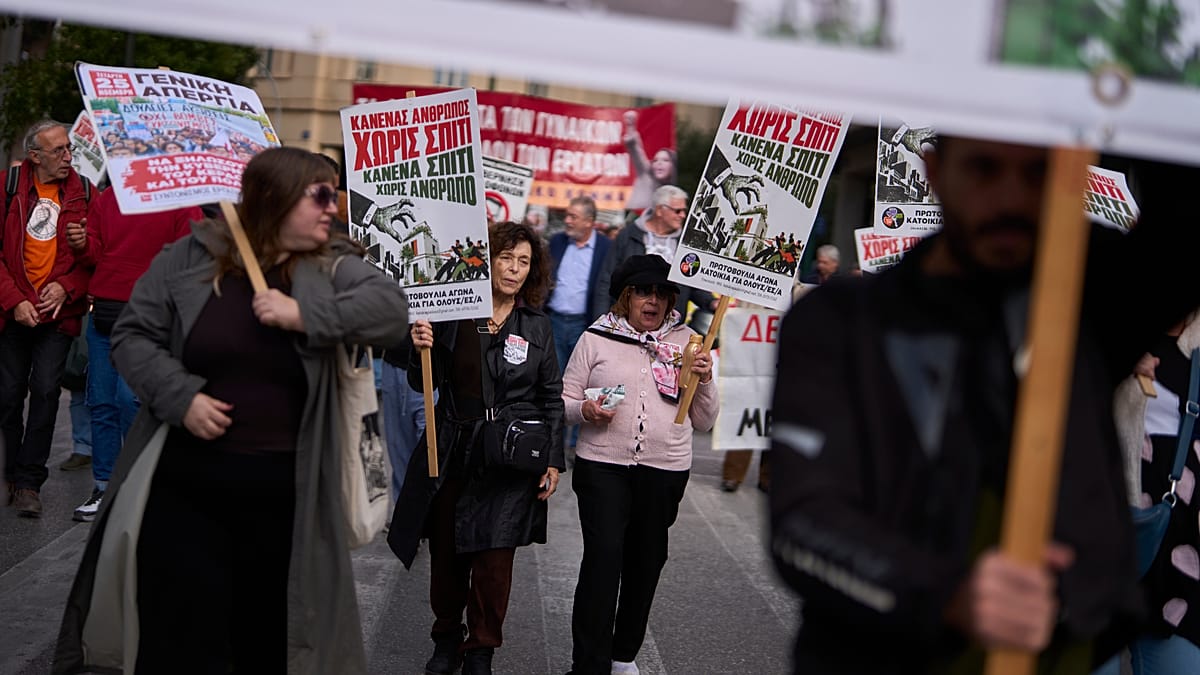
ATHENS — Tens of thousands of Greeks took to the streets on Wednesday, 25 November 2026, as a 24-hour general strike brought much of the country to a standstill. In Athens alone, police estimated that 14,000 people marched to Syntagma Square, while smaller protests were held in Thessaloniki, Patras, and Heraklion. The action was called by the country's two largest labour confederations, GSEE and ADEDY, to demand immediate relief from soaring living costs and a meaningful increase in wages that have failed to keep pace with inflation.
The strike had an immediate impact on daily life. Metro and tram services in the capital were suspended for most of the day, forcing commuters onto buses and taxis. Air traffic controllers joined the walkout, leading to the cancellation of dozens of domestic and international flights at Athens International Airport and regional airports. Ferry operators also kept their vessels in port, stranding travellers on the islands and the mainland. Schools and public hospitals operated with reduced staff, and many government offices closed their doors.
Wages lag behind prices
At the heart of the protest is a growing gap between household incomes and the cost of essentials. Greece has experienced one of the sharpest increases in food and energy prices in the eurozone over the past two years, while the minimum wage, though raised several times, remains among the lowest in Western Europe. According to Eurostat, the Greek minimum wage stands at €830 per month, compared with €1,700 in France and €1,600 in Germany. Meanwhile, the average monthly salary in Greece is roughly €1,200, a figure that has barely moved in real terms since the debt crisis of the 2010s.
“We are not asking for charity; we are asking for a living wage,” said Yannis Panagopoulos, president of GSEE, addressing the crowd in Athens. “The government has to understand that the current situation is unsustainable. People are choosing between heating and eating, and that is not a choice any European should have to make.”
The protest comes at a politically sensitive time. Prime Minister Kyriakos Mitsotakis, who has staked his government’s reputation on economic recovery, faces growing public discontent ahead of national elections scheduled for 2027. His centre-right administration has pointed to falling unemployment and a rebound in tourism as signs of progress, but critics argue that the benefits have not reached ordinary households.
Government defends record
In a statement released on Wednesday, the labour ministry defended the government’s record, noting that the minimum wage has been increased four times since 2019 and that pensioners received a one-off payment earlier this year. “We understand the pressures on households, but we are also committed to fiscal responsibility,” the statement read. “Further wage increases must be matched by productivity gains, or we risk undoing the hard-won stability of recent years.”
Economists, however, are divided. Some argue that Greece’s recovery is still fragile and that excessive wage demands could reignite inflation. Others point out that the country’s productivity has been rising steadily, and that the share of national income going to workers has actually declined over the past decade. “The real problem is not that Greek workers are lazy or unproductive; it is that the economic model relies on low wages and precarious work,” said Maria Karamessini, a labour economist at the Panteion University of Social and Political Sciences in Athens.
The strike also highlighted broader concerns about the cost of living across Europe. In recent months, similar protests have taken place in Portugal, Spain, and Italy, where wages have also lagged behind inflation. The European Central Bank has raised interest rates repeatedly to combat price pressures, but that has made borrowing more expensive for households and businesses, adding to the strain.
For many Greeks, the strike was a reminder that the scars of the debt crisis have not fully healed. “We lost a decade to austerity, and now we are being asked to accept another decade of stagnation,” said Eleni Vlachou, a 45-year-old nurse who joined the march in Athens. “I earn less than I did in 2009, but everything costs more. Something has to give.”
The government has promised to unveil a new package of measures in December, including targeted subsidies for low-income households and a reduction in the solidarity tax. But union leaders have dismissed these as insufficient, and have threatened further action if their demands are not met. “We are not going away,” Panagopoulos warned. “If the government does not listen, we will be back on the streets, and we will be even more numerous.”
As the sun set over Syntagma Square, the crowd began to disperse, but the mood remained defiant. The strike may have ended, but the underlying grievances are unlikely to disappear. For Greece, the challenge of balancing economic recovery with social justice remains as pressing as ever.



