Ukraine's slow march toward European Union membership has gained modest momentum in recent weeks, with Kyiv opening two of the six negotiating clusters needed to advance its candidacy. But a new complication is emerging: Serbia's own stalled accession bid, which some EU member states are now using to demand equal treatment for the Western Balkans.
The breakthrough for Ukraine and Moldova came only after Viktor Orbán's crushing electoral defeat in April. Hungary's new prime minister, Péter Magyar, moved quickly to resolve bilateral disputes with Kyiv over the treatment of the Hungarian minority in Transcarpathia, clearing the way for the opening of clusters on the rule of law and foreign policy. Yet Budapest has resisted pressure to open all six clusters at once, preferring a step-by-step approach to ease domestic tensions after years of anti-Ukrainian propaganda under Orbán.
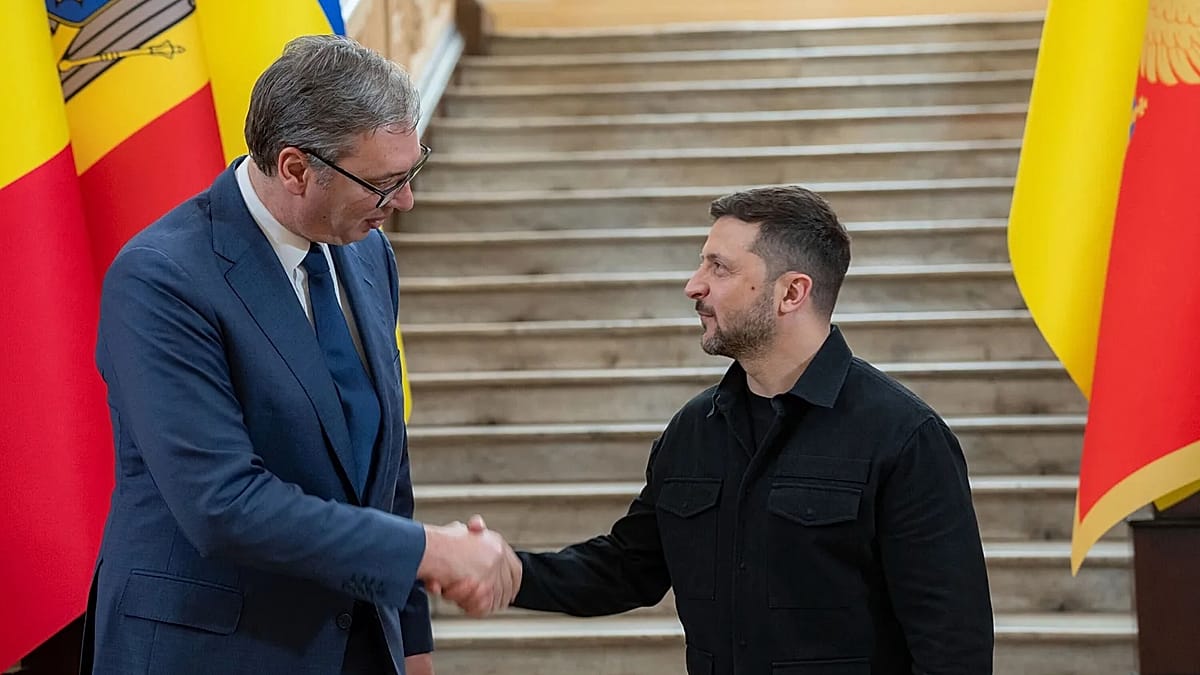
Now, however, Kyiv's progress is colliding with a push from a group of EU member states—dubbed the "Friends of the Western Balkans"—who insist that enlargement must proceed on a geographically balanced basis. Italy, Greece, Slovakia, Austria, Czechia, Croatia, and Slovenia are among those arguing that Serbia's accession should not be left behind while Ukraine advances.
"There is a thin line between saying that all candidate countries should be treated equally, and starting to link up progress with one geographical area with another one," an EU diplomat told Euronews on condition of anonymity.
The Serbian stalemate
Serbia's accession process has been frozen since December 2021. Earlier this month, the European Commission again proposed opening Cluster 3—covering competitiveness and inclusive growth—but eight member states blocked the move. Their objections are familiar: Belgrade's record on the rule of law remains insufficient, and the country has shown little alignment with EU sanctions against Russia, maintaining an ambiguous relationship with Moscow.
By contrast, the Commission, under pressure from France, Spain, and the Friends of the Western Balkans, argues that Serbia has already made significant progress on a range of reforms that justify moving its bid forward. The country is widely seen as the most influential in the region, with the largest population and economy in the Western Balkans.
Progress elsewhere in the region—Montenegro and Albania are regarded as next in line to join—puts additional pressure on the Serbian government to explain to its own citizens why its own accession remains dead in the water. At the same time, most Friends of the Western Balkans, with the notable exception of Croatia, argue that geopolitical considerations are creating a double standard for Serbia compared to Ukraine.
"There is a concern that the Friends of the Western Balkans might couple the accession process of Ukraine and Moldova with opening cluster 3 for Serbia," a second diplomat said. "Moving forward on one front creates pressure to also move on another front."
Linking tracks, risking gridlock
Member states broadly agree that enlargement works best when politics stays out of the way and lets technical work proceed. But the more connections are drawn between files, the more complicated the picture becomes. Under Orbán, Hungary appeared to draw a link between Serbia and Ukraine, but the issue of Ukrainian accession was too ideologically charged for any exchange to take place. Now that Budapest is shifting position, that coupling could resurface.
"The Commission is saying a geographical balance should be respected, but Serbia is not helping us [with its domestic reforms]," a third diplomat told Euronews, adding that there was still hope for Cluster 3 to be opened in the autumn.
The risk is that Ukraine's accession—already slowed by the war and the need for deep reforms—could become entangled in a broader bargaining process over the Western Balkans. For Kyiv, which has faced repeated Russian strikes and continues to fight for its survival, any delay in EU integration is a strategic setback. For Serbia, the calculus is different: maintaining ties with Moscow while keeping the EU door ajar has long been a balancing act, but one that may now be harder to sustain as the bloc's enlargement dynamics shift.