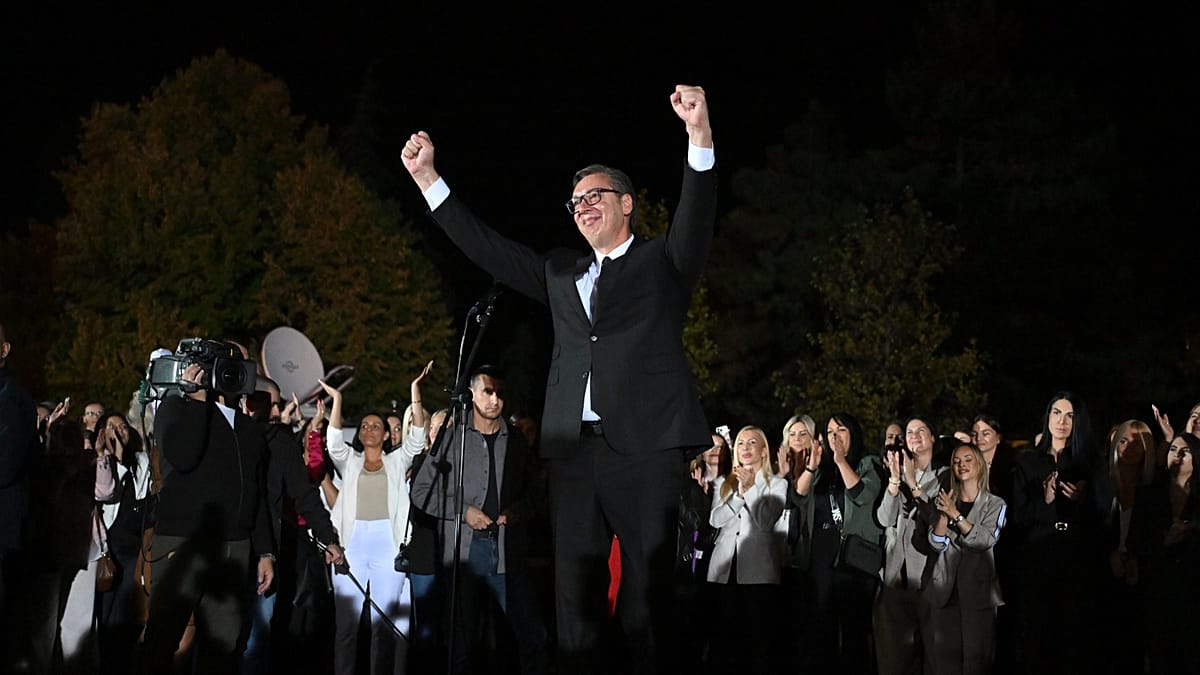
Serbian President Aleksandar Vučić formally resigned on Sunday, clearing the way for his bid to become prime minister in snap parliamentary elections scheduled for 25 October. The move, announced in a televised address in Belgrade, ends his second presidential term a year early and sets up a high-stakes test for the right-wing Serbian Progressive Party (SNS), which has dominated the country's politics for over a decade.
Vučić, who has served as either prime minister or president for the past twelve years, is barred by the Serbian Constitution from seeking a third presidential term. By stepping down now, he aims to retain power by shifting to the premiership, a position that formally holds greater executive authority in Serbia's political system.
“I am resigning the duty of the President of the Republic,” Vučić said, reading from a prepared statement. Speaking to supporters outside the presidency building, he called the evening “my last evening in this beautiful building” but added, “I look to the future with joy, new victories await us. Let’s beat them more convincingly than ever before.”
A movement born from tragedy
The snap election comes after nearly two years of protests triggered by the collapse of a train station canopy in Novi Sad on 1 November 2024, which killed sixteen people. University students, who led the demonstrations, have demanded accountability for the disaster and a broader crackdown on corruption. Their movement has evolved into a significant political force, fielding a candidate list of experts, professors, and activists under the slogan of the rule of law.
Analysts say the student-backed list is polling close to Vučić's SNS, making the October ballot a de facto referendum on his rule. The campaign has been tense, with authorities using police force against protesters and detaining activists. Vučić has accused opponents and critical media of plotting to “destroy the state” under foreign influence, without providing evidence.
In recent weeks, Vučić has crisscrossed the country, inaugurating infrastructure projects, distributing financial aid, and visiting voters in their homes. His decision to run for prime minister is widely seen as a strategic move to boost his party's chances and retain a central role in government.
The Independent Bureau for Social Research (BIRODI) has filed a complaint alleging that Vučić abused his presidential office to promote his party, a charge he dismissed. The anti-corruption authorities, which are under government control, have not responded.
After Vučić's resignation, Ana Brnabić, the outgoing speaker of parliament and a close ally, becomes acting president. A presidential election must be held within 90 days, likely before the end of the year.
Vučić's party has been accused of rampant corruption, links to organised crime, and curbs on democratic freedoms, including media independence. The SNS has gradually consolidated control over state institutions since taking power in 2012, while denying any abuse of office.
The student movement has been touring the country on bicycles as part of its campaign, calling for an end to corruption and the establishment of the rule of law. Their list includes little-known figures from various walks of life, aiming to offer a credible alternative to the established political class.
Also contesting the election are Vučić's allies, the Socialist Party, a pro-EU opposition alliance, and several smaller groups. The campaign has been marked by rare televised clashes between ruling and opposition figures, reflecting the heightened political tensions.
Vučić said he had pardoned 49 people before leaving office, including 23 prosecuted for alleged offences during the protests. Among them are anti-government activists who had fled Serbia after being accused of anti-state activities.
In an interview with state-run RTS Television earlier on Sunday, Vučić warned that foreign powers and unidentified individuals planned to stir unrest on election night. He has repeatedly claimed, without evidence, that his opponents intend to destabilise the country.
The election will be closely watched across Europe, as Serbia seeks EU membership while maintaining close ties with Russia and China. The outcome could reshape the political landscape in the Western Balkans, with implications for regional stability and EU enlargement efforts.