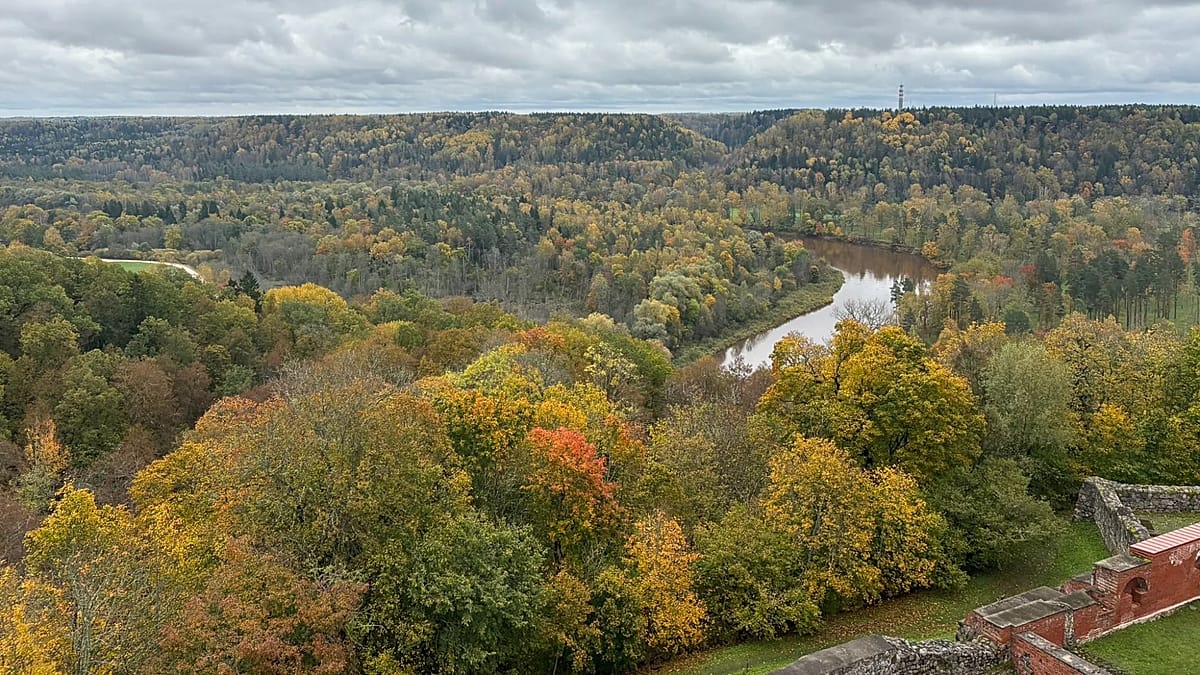
For many travellers, autumn foliage means New England. But with political turmoil south of the border, Europeans might prefer a closer, calmer alternative. Enter Sigulda, a town in Latvia that locals proudly call the autumn capital. It sits on the edge of Gauja National Park, about an hour by train from Riga, and its hillsides explode into shades of amber, rust, and crimson as the days shorten.
Unlike the packed leaf-peeping hotspots of North America, Sigulda remains blissfully quiet. You can wander through forests of oak, maple, and birch without jostling for a view. The town itself is charming, but the real spectacle lies along the Gauja River, which has carved a deep valley through the sandstone. A cable car crosses the river in seven minutes, offering a bird's-eye view of the valley and its medieval fortresses.
Castles, caves, and a tragic legend
On the far bank, a short woodland walk leads to Gutman's Cave, the largest in the Baltics. Its sandstone walls are etched with centuries of inscriptions, including the names of lovers who have visited since the 17th century. The cave is tied to the legend of the Rose of Turaida, a young woman named Maija who was orphaned during the Swedish-Polish war and raised at Turaida Castle. She fell in love with the castle gardener, Victor, but a deserter named Jakubowsky became obsessed with her. He lured her to the cave, and when she refused him, he killed her—after she claimed a magic scarf would protect her from harm, a ruse to make him strike her with a sword.
From the cave, a path climbs to Turaida Castle, a red-brick fortress dating to 1214. Climb the main tower and you'll be rewarded with panoramic views over the valley, each window framing a different autumnal masterpiece. The castle grounds also host a sculpture garden by Latvian artist Indulis Ranka, blending art with history.
Sigulda itself has several castles, including the New Castle, a 19th-century manor now housing creative businesses. Here you can buy a traditional Sigulda walking stick, a carved cane with colourful patterns that has become a symbol of the town. These sticks are not just souvenirs; they're practical for the many hiking trails that fan out from the town into the national park. The official tourism site, Enter Gauja, is the best resource for route planning.
If you have time, continue by train to Cēsis, another Gauja valley town with a medieval castle from the 13th century. Both towns are easily reached from Riga, with trains taking just over an hour. Tickets can be bought at the station or via the Vivi app.
Sigulda may not have the fame of Vermont or the Alps, but that's precisely its appeal. It offers a quintessential European autumn—quiet, historic, and deeply atmospheric—without the crowds. As Latvia continues to strengthen its ties with NATO and the EU, the country is also opening up to travellers seeking something beyond the usual capitals. For a dose of golden foliage and medieval charm, Sigulda is hard to beat.