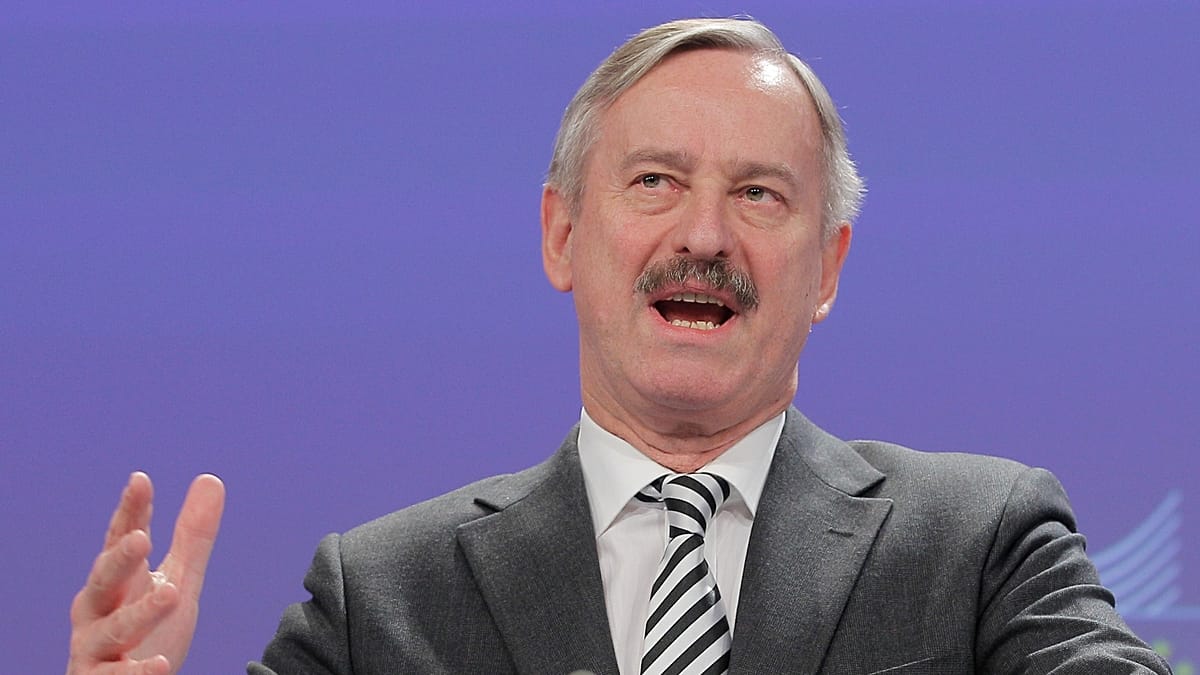
Siim Kallas, a pivotal figure in Estonia's post-Soviet transformation and the country's first European commissioner, has died at the age of 77. His daughter, Kaja Kallas, the European Union's foreign affairs chief, announced the news on Saturday via Instagram, writing: “It is with sadness that I must announce that my dear father, Siim Kallas, passed away last night.”
Kallas's career spanned Estonia's independence, its monetary reform, and its integration into the European Union. He served as prime minister from 2002 to 2003, and later as European commissioner for transport and vice-president of the European Commission from 2010 to 2014. Before that, he was Estonia's first commissioner in Brussels, taking up the post in 2004.
European Parliament President Roberta Metsola was among the first to pay tribute. In a post on X, she wrote: “I was saddened to learn of the passing of former Prime Minister and EU Commission Vice-President Siim Kallas.” She highlighted the scale of his achievements: “I am thinking of the courage it took to build the state and introduce our own currency in the early 1990s, and the quiet conviction he brought with him to Brussels years later. Estonia and Europe are better off because of his life's work.”
Metsola also expressed deep sympathy to the Kallas family, addressing Kaja Kallas directly: “Kaja Kallas and the whole family: I am deeply sorry for your loss. I wish you strength and warmth during this difficult time.” The European Commission also issued a statement of condolence on X, paying tribute to the Kallas family.
An architect of Estonia's modern state
Born in 1948, Siim Kallas trained as an economist. His political career began in the late 1980s, during the Singing Revolution that led to Estonia's independence from the Soviet Union. He served as president of the Bank of Estonia (Eesti Pank) from 1991 to 1995, where he played a central role in introducing the national currency, the kroon, in 1992. That move was a cornerstone of Estonia's economic stabilisation and its later accession to the EU.
Kallas later held several ministerial posts, including foreign minister and finance minister, before becoming prime minister. His government oversaw Estonia's final negotiations for EU membership, which culminated in accession in 2004. That same year, he moved to Brussels as the country's first European commissioner, taking the transport portfolio.
His tenure in Brussels was marked by efforts to liberalise European transport markets and to strengthen the single market. He also served as vice-president of the European Commission under José Manuel Barroso, with responsibility for administrative affairs, audit, and anti-fraud. Colleagues remembered him as a pragmatic, low-key reformer who brought a Baltic perspective to EU policy-making.
Kaja Kallas, who has been the EU's High Representative for Foreign Affairs and Security Policy since 2024, has followed in her father's footsteps as a prominent Estonian politician. She previously served as Estonia's prime minister from 2021 to 2024. Her recent statements have focused on tougher Russia sanctions, a policy area where her father's experience in the Soviet era gave the family a particular perspective.
The news of Siim Kallas's death comes at a time when Estonia and the wider Baltic region are again at the forefront of European security concerns. His legacy as a bridge-builder between the former Soviet republics and Western institutions is likely to be remembered in the coming days by leaders across the continent.
Beyond his political roles, Kallas was also a prolific writer and commentator on economic and political affairs. He remained active in public life after retiring from the European Commission, offering analyses on European integration and the challenges facing the Baltic states.
His death has prompted an outpouring of tributes from across the political spectrum in Estonia and beyond. Many have noted the symmetry of a father who helped bring Estonia into the EU and a daughter who now represents the bloc on the world stage. As Metsola put it, “Estonia and Europe are better off because of his life's work.”