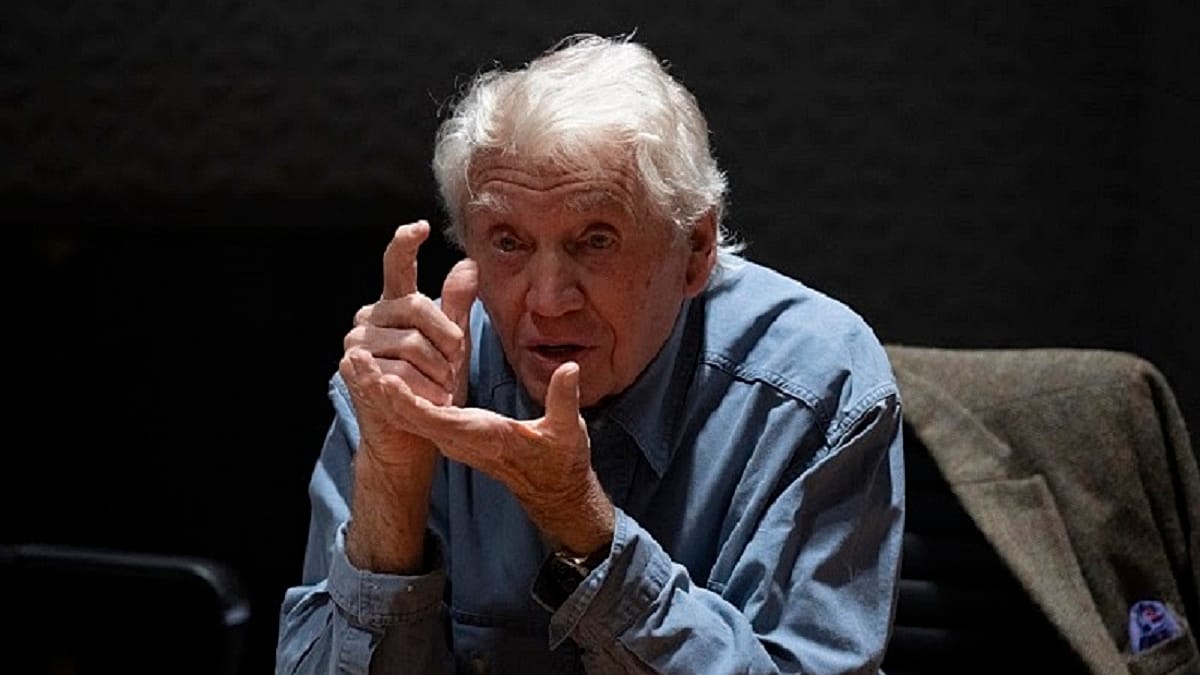
Sir Don McCullin, one of the most revered figures in war photojournalism, has spent the past seven decades bearing witness to humanity's darkest moments. Speaking in Athens during the 8th Athens Photo World International Festival of Photojournalism, the 91-year-old Briton reflected on a career that took him from the construction of the Berlin Wall to the killing fields of Vietnam, Cambodia, Lebanon, Biafra, Northern Ireland, Congo, and Uganda.
McCullin, who was awarded a CBE in 1993 — the first photojournalist to receive the honour — told Euronews that photography chose him, not the other way around. Growing up in a working-class neighbourhood in North London with little formal education, he bought a camera during his military service in the Royal Air Force. After returning to England, he began photographing the people in his community. 'I realised I loved doing it,' he said. 'I thought this could be the life I wanted to have. It turned out to be exactly the right career choice for me.'
A Career Defined by Conflict and Compassion
McCullin's professional career began at The Observer in 1959 when he was 23. He won the British Press Award in 1961 for his coverage of the Berlin Wall's construction. His first war assignment came in 1964 in Cyprus, where he documented the eruption of ethnic and nationalist tensions, earning the World Press Photo Award. In 1966, he joined The Sunday Times, where he spent 18 years covering conflicts across the globe.
His work has been defined by a rare combination of proximity to violence and deep empathy for its victims. McCullin has been injured, witnessed the deaths of colleagues, and carried the psychological weight of what he has seen. Yet he also sought balance, travelling to Africa, India, and Indonesia to capture the poetry of everyday life, and photographing the English landscape with an intensity that rivals his war imagery.
'I have been involved in photography for 70 years,' McCullin said. 'It has rewarded me. I reached a point where I learned more and more about humanity, about photography, about the tragedy of the human species. I suddenly felt that my life, thanks to photography, had a purpose, a meaning.'
His exhibition in Athens, titled Life, Death and Everything in Between, draws from his book of the same name and showcases the breadth of his career — from war zones to pastoral scenes. The festival, now in its eighth edition, has become a key event for photojournalism in Europe, drawing practitioners and audiences from across the continent.
Photojournalism as a Political Act
McCullin sees his work as inherently political. 'I studied the work of other photographers who called themselves photojournalists,' he explained. 'I thought that this profession had a purpose and a meaning. It wasn't just about taking pictures, but about creating photographs that have something to say.' He remains a voracious consumer of international news, a habit he developed early in his career. 'I'm passionate about international news and I want to know what's going on around the world right now.'
Despite his legendary status, McCullin is candid about his weariness. 'I must confess that I have reached the point today where I am quite tired of talking about it,' he said. 'I'm tired of talking about my life and photography. I've talked too much over the years. So I'm looking forward to completing my photography journey. I am now 91 years old. I want to have a quieter life. The only thing is that I will no longer go to cover any more wars.'
His decision to step back from conflict zones marks the end of an era for a photographer who has been a witness to some of the most harrowing events of the 20th and early 21st centuries. Yet his legacy is secure: his images remain a powerful testament to the cost of war and the resilience of the human spirit. For McCullin, the reward was never financial. 'I was looking for personal dignity,' he said. 'You have to enjoy what you're doing and that's the reward.'
As Europe continues to grapple with its own conflicts and humanitarian crises, McCullin's work serves as a reminder of the role photojournalism plays in holding power to account. His career, spanning seven decades, has left an indelible mark on the field — and on the collective memory of the continent he helped document.



