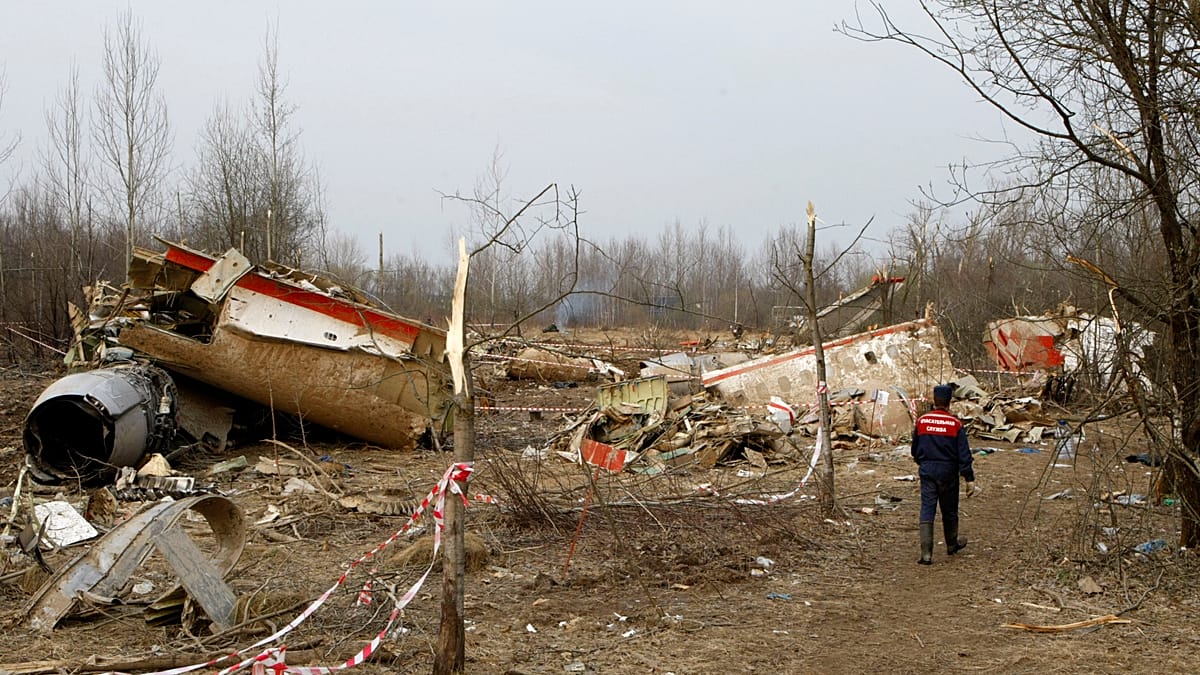
More than sixteen years after the plane crash near Smolensk that killed Polish President Lech Kaczyński and 95 others, an international team of experts has concluded that the disaster was caused by a chain of errors during the final approach to landing, not by an explosion. The findings, presented on Friday by Poland's National Prosecutor's Office, mark a significant step in one of the country's most politically charged investigations.
The experts identified four key factors: an unstable approach, an incorrect assessment of the aircraft's actual altitude, a continued descent below the minimum safe altitude, and a delayed decision to abort the landing. They also ruled out an explosion as the cause, based on a range of tests and analyses.
What the experts found
Przemysław Nowak, spokesperson for the National Prosecutor's Office, presented the report, stressing that the conclusions reflect the experts' views, not the prosecutors' own assessment. "These are the findings and assessments of the experts. So they are not the findings and assessments of the prosecution or the prosecutors," he said.
The team comprised 22 specialists from the United States, the United Kingdom, Ireland, and Hungary. They spent five years examining evidence and answering 66 questions posed by Polish investigators. Their work covered aviation, medicine, chemistry, engineering, computational mathematics, and photogrammetry.
According to Nowak, the experts deemed the continued descent below the minimum altitude, despite the absence of conditions for a safe landing, as "an absolutely key circumstance" of the crash. They also analysed cockpit voice recordings, which contained no sound consistent with an explosion, and examined structural damage, computer simulations, injuries to victims, and the distribution of wreckage and bodies.
The first report was delivered in August 2024, but prosecutors found it incomplete and unclear, prompting the supplementary report issued in May 2026. After translation, investigators considered the overall document "complete and clear."
The experts included specialists who had previously worked on other major aviation disasters, such as the Lockerbie bombing, the emergency landing of an Airbus on the Hudson River, and the Space Shuttle Columbia disaster.
Political fallout
The findings have reignited political tensions in Poland. Former Defence Minister Antoni Macierewicz, who has long promoted the theory that the crash was caused by an explosion and possible Russian involvement, rejected the experts' conclusions. He questioned their authority and noted that none of them had visited Smolensk in person. He also reiterated claims about explosive materials, arguing that the experts ignored evidence from the wreckage and earlier tests.
Prime Minister Donald Tusk, speaking in Brussels, said the causes of the crash had already been established by a commission in 2011, and that those findings were later challenged "for purely political reasons." He added: "There is nothing worse than making such cynical political fuel out of death, especially the death of loved ones. I will never forgive them for that."
The investigation, which began on 10 April 2010 and was transferred to the National Prosecutor's Office in 2016, remains open. Prosecutors are still considering several scenarios, including errors by Russian air traffic controllers, crew mistakes, potential aircraft malfunction, and various forms of sabotage.
This case echoes other European transport tragedies where technical and human factors have been scrutinised, such as the Spanish train crash and the Bulgaria motorway pile-up. The Smolensk disaster remains a deeply sensitive issue in Polish politics, and the new expert report is unlikely to settle the debate.



