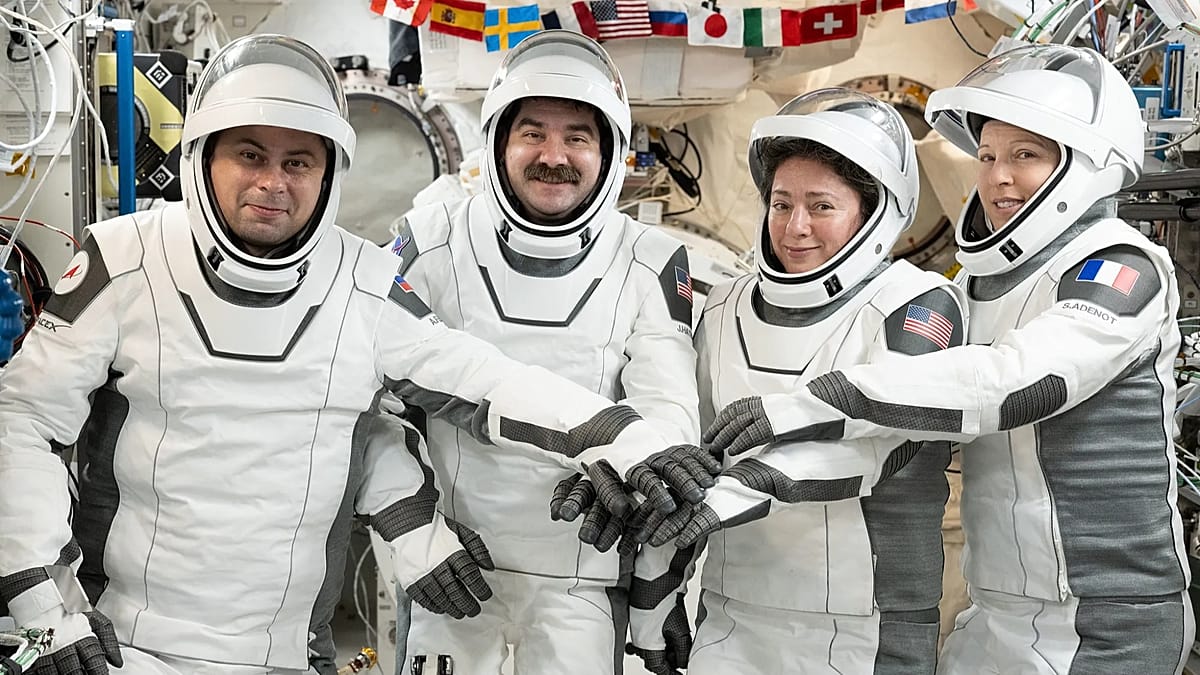
French astronaut Sophie Adenot is back on Earth after spending 235 days aboard the International Space Station (ISS), the longest continuous spaceflight ever by a European. She and three crewmates—Russian cosmonaut Andrei Fediaiev and NASA astronauts Jessica Meir and Jack Hathaway—splashed down in the Pacific Ocean off San Diego, California, on Thursday 8 October at 5:35 p.m. French time.
The descent was a fiery, high-speed plunge through the atmosphere, followed by the deployment of powerful parachutes. During those final minutes, radio communications were cut, leaving the crew in silence as they braced for the impact. After the capsule touched down, the four astronauts were extracted and given a brief medical check-up before being flown to Naval Air Station North Island in San Diego, and later to NASA's Johnson Space Center in Houston, Texas.
A record-breaking mission
Adenot's 237 days in space—including travel time—surpasses the previous European record of 201 days set by Italian astronaut Luca Parmitano in 2019–2020. The 41-year-old from Dijon, a former helicopter test pilot, becomes the eleventh French astronaut and the second Frenchwoman to reach orbit, following Claudie Haigneré in 1996.
During her mission, Adenot conducted three spacewalks on 18 and 25 August and 1 September, making her the first French woman to perform a spacewalk. She also participated in a range of scientific experiments, from fluid physics to biomedical research, contributing to the station's ongoing research programme.
Her return marks a milestone for the European Space Agency (ESA), which has been steadily increasing its astronaut corps' presence in low Earth orbit. ESA Director General Josef Aschbacher praised Adenot's achievement, calling it "a testament to European excellence in human spaceflight."
After her debriefing in Houston, Adenot will be flown to Cologne, Germany, where ESA's medical team will oversee her rehabilitation. The recovery programme, which typically lasts several weeks, is designed to help astronauts readapt to gravity after months in microgravity. She will be reunited with her family and friends in the Rhineland city, where ESA's European Astronaut Centre is based.
The mission comes at a time when Europe is redefining its role in space. With the ISS nearing the end of its operational life, ESA is looking toward commercial space stations and lunar exploration. Adenot's record is likely to inspire a new generation of European astronauts, and her experience will be invaluable as ESA plans future missions.
While her immediate focus is on recovery, Adenot has already hinted at her ambitions. "This is not the end," she said in a pre-flight interview. "It's the beginning of a new chapter for European spaceflight."
Her achievement also highlights the growing collaboration between ESA and its international partners, including NASA and Roscosmos, despite geopolitical tensions on Earth. The successful splashdown and recovery operation underscore the resilience of the ISS programme, which has been in continuous operation since 2000.
As Europe looks ahead, the question is not whether it will return to space, but how. With private companies like SpaceX and Axiom Space developing new orbital platforms, ESA is exploring options to ensure European astronauts continue to fly. Adenot's record is a reminder of what European ingenuity and perseverance can achieve.