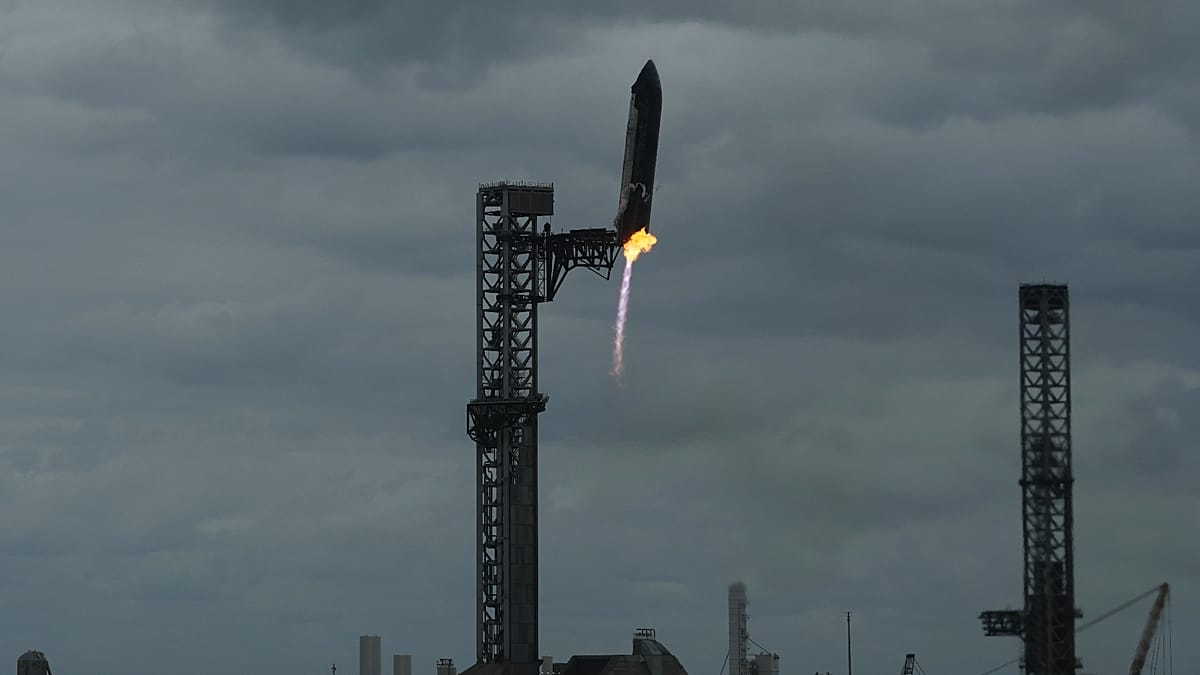
In a milestone for reusable rocketry, SpaceX successfully caught the upper stage of its Starship vehicle with a pair of mechanical arms at its Starbase facility in Texas on Saturday. The maneuver, which the company described as a first-of-its-kind 'catch,' drew cheers from onlookers as the 50-meter spacecraft descended through the clouds and settled into the launch tower's grip.
The upper stage had lifted off from Starbase on Friday, completing 14 orbits of Earth while deploying 26 satellites for Elon Musk's Starlink internet constellation. After a 22-hour mission, the spacecraft re-entered the atmosphere and fired its three Raptor engines to slow its descent before aligning with the tower's 'chopstick' arms.
'Mechazilla catches Starship! Congratulations to the entire SpaceX team on this incredible achievement!' the company posted on social media, alongside footage of the moment. Musk, who has championed the fully reusable design, added: 'I hugged ship 42 upon its return.'
The catch is a significant step toward making spaceflight more economical. Traditionally, rocket stages have been expendable, with each launch requiring a new vehicle. SpaceX has already pioneered booster landings for its Falcon 9, but catching the upper stage—which re-enters from orbital velocity—poses far greater challenges.
NASA Administrator Jared Isaacman called the feat 'almost magic,' adding on X: 'Making more believers by the day.' Starship is slated to serve as the landing system for NASA's Artemis program, which aims to return astronauts to the Moon.
Booster landing attempt fails
The mission was not without setbacks. Shortly after Friday's launch, SpaceX attempted to guide the Super Heavy booster back to the launch site, but the maneuver was aborted. The booster instead splashed down in the Gulf of Mexico, a contingency the company had prepared for.
'The booster's guidance, navigation and control triggered an automated abort during coast and diverted itself successfully to an offshore landing location,' SpaceX said. The company added that the boostback burn had 'ended early due to low fuel mass' and that the root cause was under investigation.
SpaceX has previously succeeded in catching the Super Heavy booster three times, but this latest attempt underscores the complexity of the system. The upper stage catch, however, marks a first for the company and for spaceflight in general.
The success comes amid growing European interest in reusable launch technologies. While Europe's Ariane 6 rocket had its inaugural flight last year, it remains expendable, and the continent is watching SpaceX's progress closely as it seeks to secure independent access to space. The European Space Agency has been exploring reusable concepts, but none have yet reached the stage of catching a returning spacecraft.
For now, SpaceX's achievement is a reminder of the rapid pace of innovation in the private space sector, with implications for satellite deployment, deep-space exploration, and the broader commercial space economy.