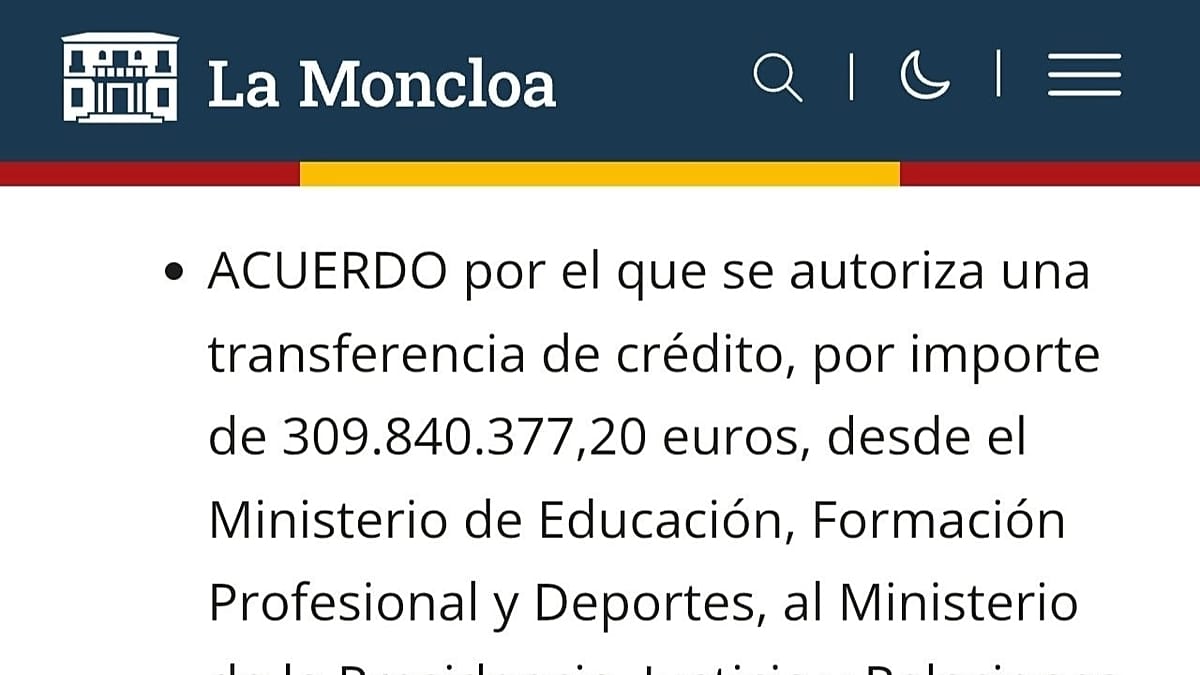
On Tuesday, the Spanish government approved a budget reallocation of €309.8 million from the Ministry of Education, Vocational Training and Sport to the Ministry of the Presidency, Justice and Relations with Parliament. The funds, as stated in the official agreement, are earmarked for Chapter 1 expenditures—essentially covering staff costs such as salaries, social security contributions, seniority increments, and supplementary pay for civil servants in the ministry led by Félix Bolaños.
This is not a one-off adjustment. In April, the same executive diverted nearly €30 million from the education portfolio—then headed by Pilar Alegría—to Justice for digitalisation projects tied to the Recovery Plan. The latest transfer, however, is ten times larger and directed not at modernisation but at routine payroll obligations.
Why Education Bears the Brunt
The official rationale points to Spain's extended budget situation. With the 2023 accounts still in force, the government has gone three financial years without passing a new budget. Any spending that exceeds the allocations inherited from that year must be covered by shifting funds between ministries. The Ministry of the Presidency allocates over 73% of its ordinary budget to staff costs, a share that government sources say has been overwhelmed by rising public-sector wages.
What the agreement does not clarify is why education was chosen to absorb the cut. The text approved by the Council of Ministers does not specify which budget lines—grants, classroom digitalisation, remedial support, or vocational training—will lose room after the €310 million reduction. It merely confirms the amount and its destination.
The contrast with the government's public messaging is stark. The Ministry of Education, now led by Milagros Tolón, recently touted distributing over €31 million to autonomous communities to boost vocational training and highlighted European funds from the Recovery Plan. Yet the same ministry now sees a sum ten times larger leaving its coffers through administrative channels, without public debate or a parliamentary vote.
The Political Cost of Governing Without a Budget
The budget extension is not merely a technical inconvenience. Each such transfer forces the government to make decisions that, under updated accounts, would have been subject to greater scrutiny. Spain's Independent Authority for Fiscal Responsibility has repeatedly warned that the lack of new budgets complicates economic planning and oversight of public finances.
This move opens a predictable political flank. The opposition now has a concrete figure and date to question the gap between the government's narrative of education as a social priority and the budgetary reality that funnels money to the state's administrative machinery. The government indirectly acknowledges the structural tension: without new accounts, staff spending rises while ministries must adapt to a framework designed for a different year.
The outstanding question is how many more such transfers will be needed while negotiations on the 2026 budget remain stalled. For context, Spain's inflation has steadied at 3.2% as of June, adding pressure on public finances. Meanwhile, the government faces other challenges, including a major wildfire in Zaragoza and preparations for the World Cup final, which may further distract from fiscal reform.
This episode also highlights a broader European issue: the tension between political rhetoric on education and actual budget allocations. A recent survey found that Europeans value general education over vocational training, yet governments across the continent often underfund the sector when fiscal pressures mount.