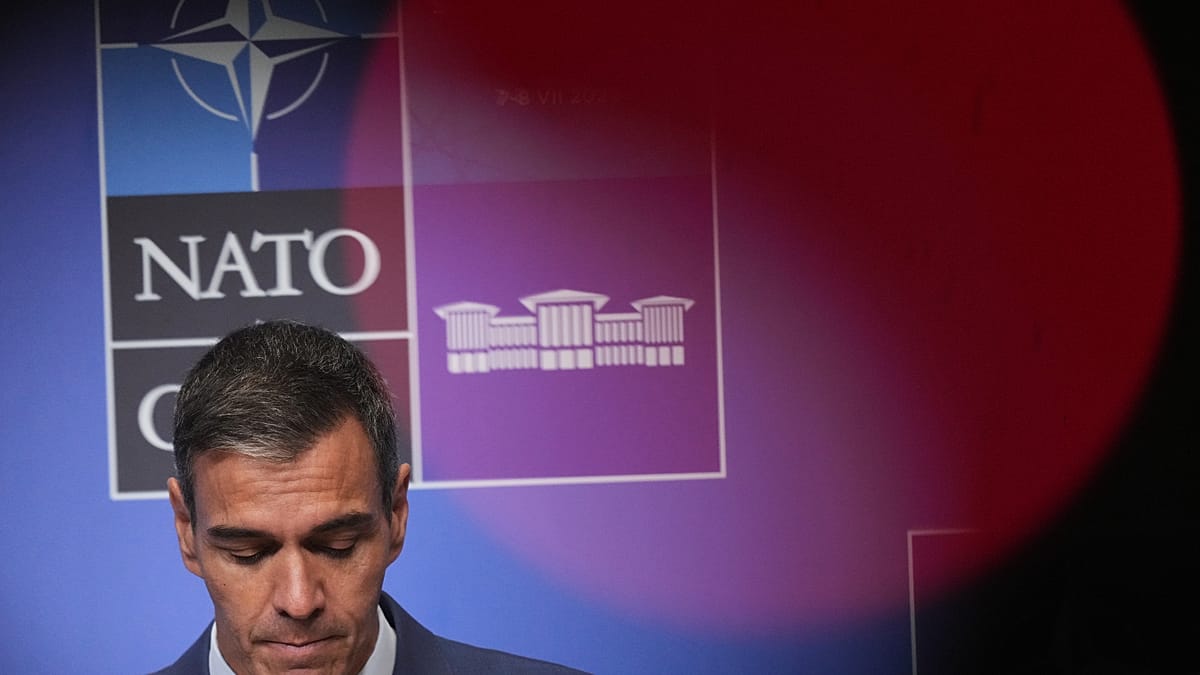
The Spanish government found itself in deepening turmoil on Wednesday after a leaked police report suggested that Moroccan authorities played an active role in the mass crossing into Ceuta, a development that has put Madrid firmly on the defensive.
According to multiple Spanish media outlets citing an internal law enforcement document, Moroccan security forces allegedly helped push migrants by sea, adopted a "passive" stance, and concluded that the influx of around 80,000 people into the Spanish enclave was not accidental. The allegations directly contradict the official government line, which has attributed the crisis to human traffickers and disinformation on social media.
The leak has ignited a political firestorm, placing Interior Minister Fernando Grande-Marlaska under intense scrutiny. He has ordered police to clarify the claims, which come at a time when his handling of what many consider Spain's most serious national security breach in decades is already being questioned. A senior police official later denied that any report directly blaming Morocco exists, but that denial did little to ease tensions as the government of Prime Minister Pedro Sánchez struggles to contain the fallout.
War of leaks and political fallout
The episode has exposed fractures within Spain's security apparatus. The interior ministry, one of the most politically sensitive departments in the government, appears to have lost control of elements within the police force, who may be seeking to embarrass the executive or bring new information to light. Such internal leaks are not uncommon in Spanish politics, where accusations of "lawfare" — the use of courts or police for partisan ends — are frequently traded between the government and the opposition.
The central question now is how much the Spanish government knew in the hours before the border breach. Opposition leader Alberto Núñez Feijóo told reporters that the government "knew it — and covered it up." The stakes are high for Sánchez, who faces his most serious crisis to date ahead of the 2027 general election.
Spain has so far stopped short of directly blaming Morocco, even after describing the events in Ceuta, where more than 150 people died at sea, as a violation of its territorial integrity. Instead, Madrid has pointed to false social media claims linked to a court ruling and to human traffickers as the main drivers of the mass influx — a position echoed by the European Commission, which, even as the border collapsed, continued to describe Morocco as a "trusted partner" in tackling irregular migration. A Commission spokesperson declined to comment on the leaked report, calling it a national matter.
Earlier this week, Sánchez also suggested that Russia and Israel had played a role in amplifying disinformation, a remark that reflects the tense relations between Madrid and Tel Aviv over the war in Gaza.
Questions remain over how Moroccan authorities, who also patrol the border, failed to detect and break up the buildup of migrants. Juan Fernando López Aguilar, a former socialist justice minister and now a member of the European Parliament, told Euronews that "it is only obvious, it couldn't have happened without some overlooking by the Moroccan authorities." He added: "That's common sense. But the government has to act based on facts and evidence."
Spanish ministers have given conflicting accounts of what they knew in the days prior and whether intelligence agencies had passed on critical information. Any failure to act on warnings related to national security would amount to serious negligence and could fuel calls for a vote of no confidence.
Ceuta at breaking point
Beyond the political turmoil, the government faces severe operational challenges on the ground in Ceuta, where around 5,000 migrants — about half of them understood to be minors — remain in the city. Local authorities put the figure closer to 10,000. On Wednesday, Ceuta's president, Juan Jesús Vivas, said the city was at breaking point, directly blaming Morocco and accusing Rabat of harassment.
"Morocco has had and continues to have an unwavering objective: to suffocate, harass and bring down our two cities," he said, referring to Ceuta and its twin city, Melilla, also located in North Africa. "I think no one doubts that what has happened to us is not a migration crisis. What has happened is that Spain's territorial integrity has been violated."
Vivas has demanded that all migrants be returned, describing this as the only way to restore normality in Ceuta. But Spanish authorities face a difficult balancing act. Strict laws protecting minors prevent immediate returns, even if they crossed illegally, while local authorities have yet to facilitate public spaces for migrant identification, leading to more administrative delays.
Facing scrutiny from its European neighbours, Madrid has pledged that the situation in Ceuta will not affect the Schengen area, which allows for free movement of people in the EU. That commitment, however, limits the government's ability to transfer migrants to mainland Spain to provide relief. Spanish authorities have now requested assistance from Frontex, the EU agency responsible for the bloc's external borders.
The crisis has also sparked protests in support of Ceuta across Spain, and has fueled right-wing backlash against Sánchez. Meanwhile, the government has ordered a probe into the leaked report, as detailed in this investigation. The situation remains fluid, with the Sánchez administration under mounting pressure to restore order and clarify its narrative.