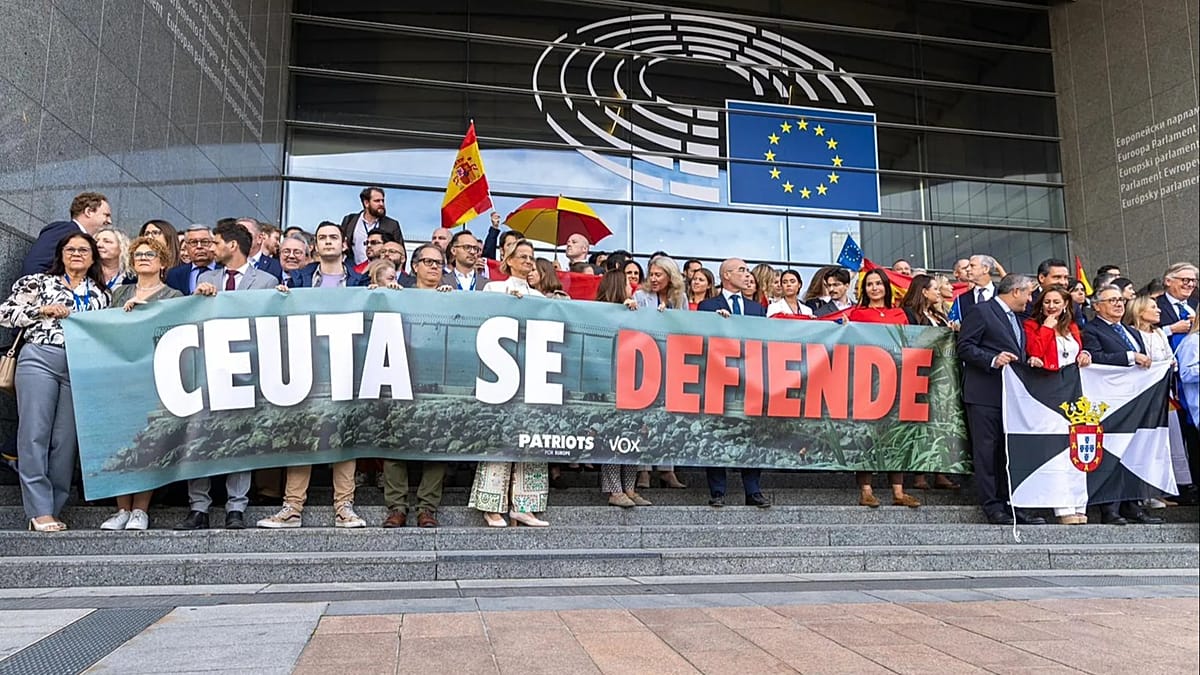
Brussels saw a rare display of unity between the centre-right and the far-right on Wednesday as lawmakers and staffers from the European People’s Party (EPP) and Patriots for Europe (PfE) gathered outside the European Parliament to denounce Spain’s handling of the migration crisis in Ceuta. The protest, held on Ceuta Day, drew around 500 people waving Spanish and Ceutan flags, with speakers accusing Prime Minister Pedro Sánchez of abandoning the North African exclave.
The demonstrations were organised separately by Spain’s Popular Party (PP) and Vox, but they converged in time and place, with EPP vice-president Dolors Montserrat and Vox MEP Jorge Buxadé Villalba standing side by side. Montserrat told reporters that Sánchez had “handed over responsibility for the security of Ceuta to a third country” and was “bowing” to Morocco. Buxadé went further, claiming the situation was “untenable” and that this was Spain’s “hardest hour” since the Catalan secession attempt in 2017.
Moroccan involvement alleged
The protest came as El Español reported that Spain’s National Centre for Immigration and Borders (CENIF) had concluded that the mass entry of migrants on 30 July — when several thousand of more than 70,000 arrivals remained in the exclave — was “guided by Moroccan security forces”. The report contradicts Sánchez’s public stance that there is no proof of Rabat’s involvement. Madrid has avoided blaming Morocco, viewing it as a cooperative partner in migration management.
Interior Minister Fernando Grande-Marlaska has asked police chief Francisco Pardo to verify the CENIF information, which was reportedly sent to a judge investigating the incident. The Spanish government has so far declined to comment on the report, but the opposition has seized on it as evidence of a failure of sovereignty.
Vox is now pushing to activate Article 102 of the Spanish Constitution, which would open a criminal trial against Sánchez and his cabinet. The party’s MEPs have also written to European Commission President Ursula von der Leyen, EU foreign policy chief Kaja Kallas, and Home Affairs Commissioner Magnus Brunner, calling for sanctions on Morocco, a declaration that the mass entry constitutes “an act of hybrid warfare”, and the immediate suspension of all EU-Morocco agreements and visa issuance to Moroccan citizens.
The Ceuta crisis has become a flashpoint in European migration politics, with the EU already struggling to maintain solidarity as Schengen checks spread and member states bicker over burden-sharing. The right-wing backlash in Brussels reflects a broader trend of hardline responses to migration across the continent, from the Baltic states to the Mediterranean.
Spain’s government has responded with a €309 million package for Ceuta, aimed at bolstering border security and social services. But critics argue that such measures do not address the root causes of migration or the alleged role of Moroccan authorities. The interior ministry has not confirmed the CENIF report, but the political fallout is already significant.
The protest in Brussels also highlighted the growing alignment between the EPP and far-right parties on migration, a development that worries pro-European observers. Montserrat’s presence alongside Vox lawmakers was symbolic, even if the EPP has officially distanced itself from far-right groups. The episode underscores how migration continues to reshape political alliances in the European Parliament.
For Sánchez, the crisis is a delicate balancing act. He must maintain a working relationship with Morocco, which has been crucial in curbing irregular migration to Spain’s mainland, while facing domestic pressure from the right. The probe into Moroccan involvement could further strain relations if it yields evidence of state-directed action.
The EU’s response will be closely watched. Von der Leyen has yet to comment publicly, but the letter from Vox MEPs puts the issue on her desk. Any move to sanction Morocco would be a major shift in EU policy, given the bloc’s reliance on Moroccan cooperation in counter-terrorism and migration control. For now, the ball is in Madrid’s court, but the echoes of Ceuta are being felt far beyond the exclave’s shores.