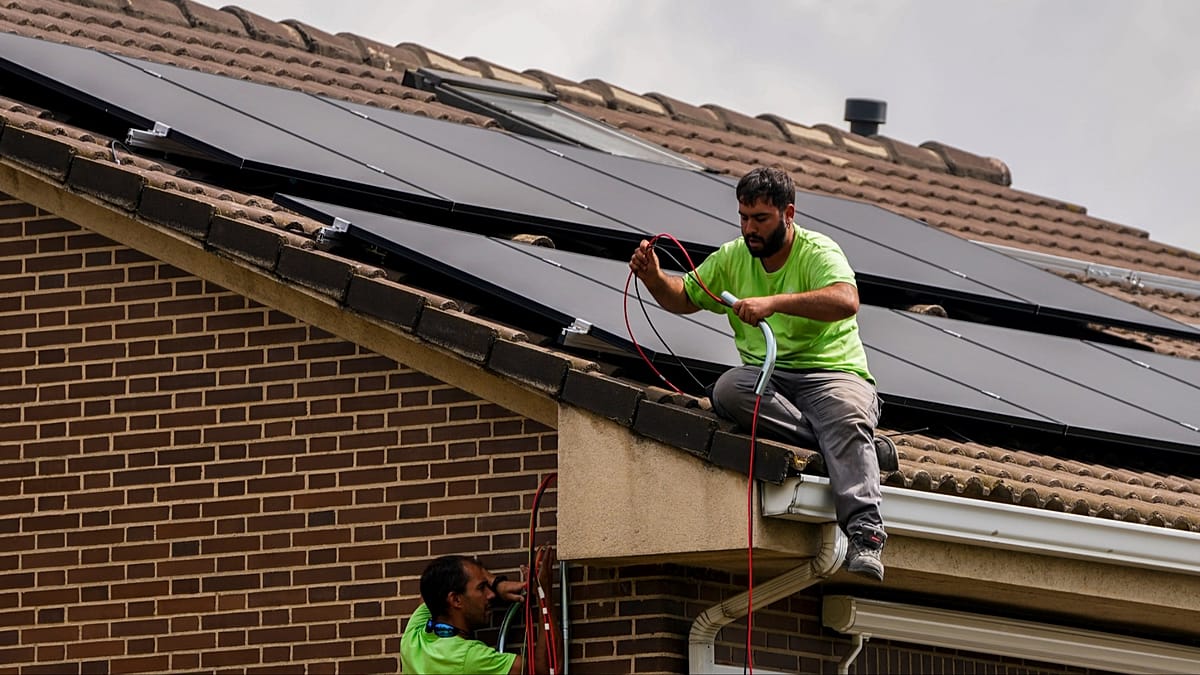
Recent headlines have painted a grim picture of Spain's solar energy sector, suggesting that an oversupply of cheap electricity is driving investors away. But a closer look reveals a more nuanced reality: while challenges exist, the boom is far from a bust.
Renewables Shield Spain from Fossil Fuel Volatility
In 2025, renewables supplied 75% of Spain's electricity, with wind and solar alone accounting for 42% of the mix. According to energy think tank Ember, fossil fuels covered just 25% of the country's power needs, and per capita CO2 emissions stood at 0.9 tonnes—well below the EU average of 1.3 tonnes. This shift has insulated Spanish households and businesses from the price spikes seen elsewhere in Europe. As one analyst put it, "Thanks to the rise of renewable energy, Spanish households and businesses have access to some of the cheapest electricity in Europe."
The merit order principle, which sets electricity prices based on the most expensive power plant needed to meet demand, has historically kept prices high across the continent. However, Ember's recent report found that Spain's strong growth in wind and solar has "significantly weakened the link between gas and electricity prices" since the 2021–2024 gas crisis. This decoupling saves Spanish consumers roughly €10 per month on their bills.
Investor Unease Amid Negative Prices
Yet low consumer prices do not guarantee investor confidence. Bloomberg reported that at least four Spanish solar projects or companies have been put up for sale, citing a "glut of electricity" that has depressed solar farm valuations. One unnamed solar producer reportedly received "lowball offers" and paused asset sales. José Donoso, director general of UNEF, the main solar photovoltaic association in Spain, downplays the alarm: "Corporate transactions involving the purchase and sale of companies and projects are a normal cyclical occurrence. At present, there is no unusual level of this type of activity." He adds that some firms are holding out for better valuations.
Despite these concerns, Spain's renewable expansion has not slowed. Between May 2025 and April 2026, the country added an average of 1.2 GW of combined wind and solar capacity per month—slightly more than the previous year. However, the issue of negative electricity prices is real. From January to March 2025, Spain recorded 397 hours of negative prices, a sharp rise from 48 hours in the same period in 2024.
Market Reforms Needed
Negative prices occur when supply outstrips demand, forcing generators to bid low—or even negative—to stay online, as shutting down can be more costly. Unlike in Germany or the UK, Spanish law does not require the grid operator to compensate generators forced to reduce output. This eats into returns for solar investors. Solar power is inherently inflexible: it peaks during the day when demand is low and drops off in the evening when consumption rises.
Donoso argues that the current market rules are ill-suited to solar: "We have a technology with virtually zero marginal costs, so it cannot be efficiently priced through a market mechanism based on marginal costs." He proposes a price floor and ceiling similar to the "Iberian exception" that allowed Spain and Portugal to decouple gas and electricity prices in 2022. "We also need a price floor to prevent the widespread occurrence of zero or negative prices and to ensure that renewable generators can earn an adequate return on their investments," he says.
UNEF has also called for abolishing the electricity generation tax—a measure already announced by the government—and compensating technical curtailments at market prices. These reforms, if implemented, could stabilize the market and sustain investor interest.
Spain's solar story is not one of bust, but of growing pains. The country's renewable success has created new challenges that require smart policy adjustments. For now, the boom continues, albeit with a wary eye on the bottom line.