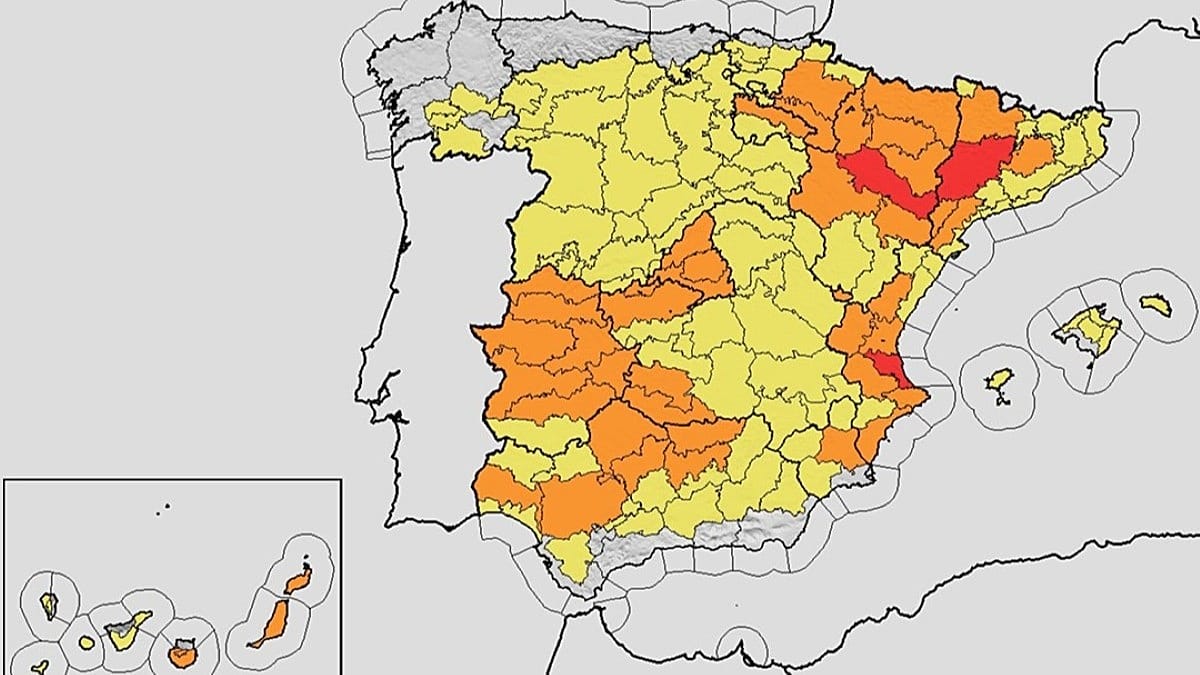
Spain is bracing for its second heatwave of summer 2026, with the State Meteorological Agency (AEMET) issuing orange alerts across large swathes of the country. The episode, which began on Sunday, is expected to push temperatures as high as 44°C in some river valleys before easing later in the week.
According to AEMET, Monday will be the most intense day of the heatwave, with widespread highs of 39–41°C in the south-western quadrant and peaks of 42°C in river valleys. In the north-west, the Miño valley and interior of A Coruña will see 38–40°C, while the southern plateau, Ebro valley, and north-eastern depressions will also experience extreme heat. By Tuesday, temperatures could reach 44°C, complicating efforts to contain the ongoing wildfire at Bisbal d'Empordà in Catalonia.
Regional Impact and Alerts
The most severe warnings are concentrated in Andalusia, where AEMET activated orange alerts for Seville, Huelva, and Jaén on Saturday, and yellow alerts for Cádiz and Granada. The Canary Islands, typically spared the worst of mainland heatwaves, are also under alert: the General Directorate of Emergencies has declared a forest fire risk for Gran Canaria and Tenerife from Sunday, with the eastern province moving to orange by Tuesday.
Across the mainland, the highest risk zones include the Guadiana and Guadalquivir valleys, the Ebro valley, and north-eastern depressions. Inland Galicia, the southern plateau, the eastern Cantabrian coast, and the Balearic Islands—where Mallorca expects 36–38°C—are also affected. AEMET’s map is being updated dynamically as models evolve, but orange alerts are confirmed for the south-west, Ebro valley, and eastern Canaries, with a surrounding yellow belt.
Health and Wildfire Risks
This heatwave follows a deadly June episode that, according to Spain’s Ministry of Health’s MoMo monitoring system, caused nearly 900 deaths. The current event is likely to meet the formal criteria for a heatwave: temperatures exceeding the 95th percentile by a wide margin, lasting at least three days, and affecting more than 10% of the territory.
Minimum temperatures will remain high, with tropical nights of 20–26°C and peaks of 27–28°C, making rest difficult in affected areas—a factor public health experts consider as critical as daytime highs. The wildfire risk is elevated: Andalusia’s INFOCA plan is at pre-alert level, and the Canary Islands have declared a forest fire risk alongside the heat warning. This comes as Spain and Italy deploy firefighting aid to Portugal, where blazes have been fueled by similar conditions.
For Wednesday, uncertainty remains due to a possible isolated upper-level depression, or “dana,” but the most likely scenario sees temperatures staying above 39–40°C in the south-west, southern plateau, Ebro valley, and south-eastern inland areas, before a gradual drop from Thursday onward.
Authorities urge residents to stay hydrated, avoid outdoor activity during peak hours, and check on vulnerable neighbors. The broader context of a summer already marked by extreme weather underscores the need for preparedness, as June’s heatwave was linked to over 4,000 excess deaths across Western Europe.