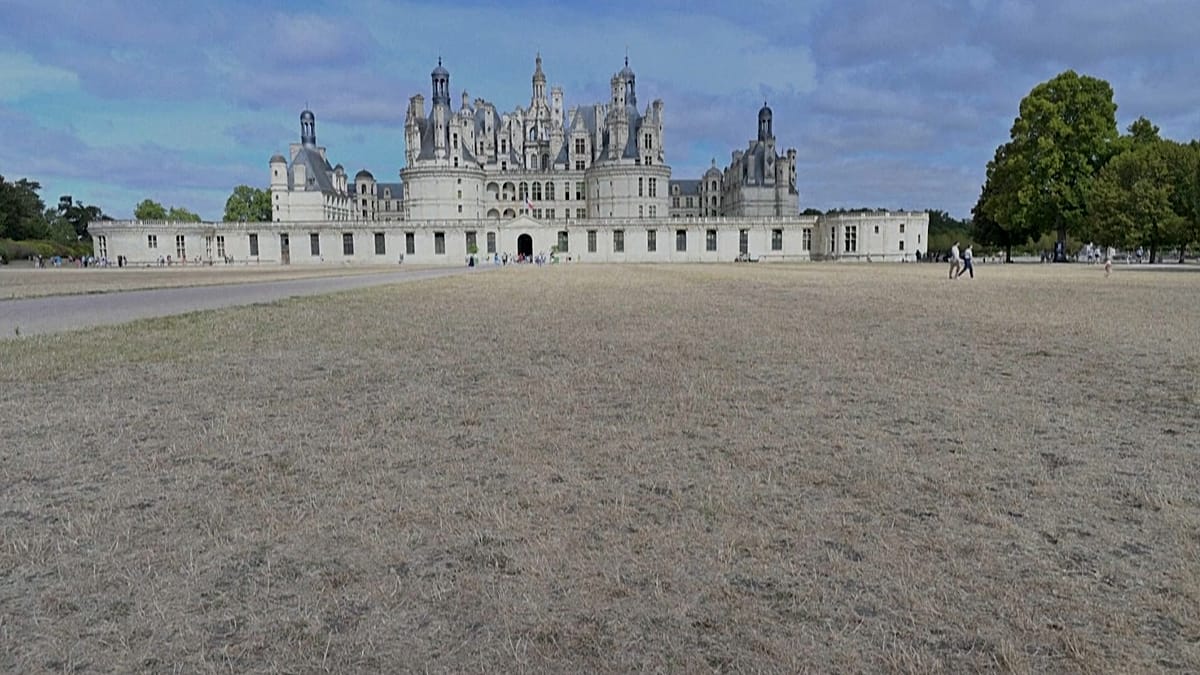
At the Château de Chambord in the Loire Valley, the summer of 2026 has left an unmistakable mark. The formal French gardens, usually a tapestry of green, are now dominated by parched yellows and browns. After successive heatwaves and months of below-average rainfall, the soil has become exceptionally dry, and even the estate's oldest trees are showing signs of stress.
Julien Billon, the head gardener, has watched the deterioration unfold. "At first, we didn't really see it on the trees; it was mainly the low vegetation with shallow roots," he explains. "Now we can see that this heatwave has started to affect the trees' root systems. I think we are going to see damage, but it will be delayed over time. Some trees may take two or three years to decline. But the impact of this year's heatwave is very, very severe."
A strategic shift in garden management
The visible damage is only part of the story. Behind the scenes, the entire philosophy of managing the estate's gardens is being reconsidered. With climate models predicting more frequent and intense heatwaves across Europe, the traditional approach to horticulture—rooted in centuries of aesthetic ideals—is no longer sustainable.
Water management has become a central strategic concern. The teams at the Domaine national de Chambord are now rethinking their plant palette, prioritizing species that can withstand high temperatures and prolonged water shortages. Xerophilous plants, adapted to dry conditions, are being introduced, and more robust tree species are being planted.
But the challenge is delicate. The gardens are a masterpiece of French Renaissance design, created to reflect grandeur and symmetry. Any change must preserve their historic character while drastically reducing water consumption. "We have to find a balance between the heritage and the reality of the climate," says a spokesperson for the estate.
The shift is not unique to Chambord. Across Europe, historic gardens and natural landscapes are being forced to adapt. In the Alps, Austria's Bärenschützklamm has dried up, a stark reminder that even mountain ecosystems are vulnerable. Meanwhile, Rome's Tiber has revealed an ancient bridge as water levels drop, and the Danube is suffering from drought, affecting everything from tourism to agriculture.
At Chambord, the changes are part of a broader European trend. The estate, which has shaped its landscape for nearly five centuries, is now writing a new chapter. "We are not giving up on the gardens," Billon insists. "We are adapting them to survive."
The immediate focus is on the lawns and flowerbeds, which have suffered the most. In some areas, the grass has turned completely yellow, and the flowerbeds have lost their vibrant colors. Gardeners are experimenting with drought-resistant ground covers and perennials that can thrive with minimal irrigation.
But the trees are a longer-term concern. Many of the estate's oaks and lindens are centuries old, and their loss would be irreplaceable. Billon and his team are monitoring them closely, looking for signs of dieback. "We are doing everything we can to help them through this period," he says. "But we have to be realistic. Some may not survive."
The situation at Chambord is a microcosm of a larger challenge facing Europe. As heatwaves become more frequent, the continent's cultural landscapes—from the vineyards of Bordeaux to the parks of Paris—are being forced to adapt. The wildfires that have swept across Europe this summer are a stark reminder of the stakes.
For now, the gardeners at Chambord are focused on the immediate task: keeping the gardens alive. But they are also planning for the long term, selecting species that will thrive in a warmer, drier climate. "We are thinking in terms of decades, not just seasons," Billon says. "The gardens will look different, but they will still be beautiful."
The transformation is not without its critics. Some visitors lament the loss of the traditional manicured lawns, which have been a hallmark of French formal gardens since the 16th century. But the estate's managers argue that adaptation is essential. "We cannot pretend that the climate is not changing," says the spokesperson. "We have to evolve, or we risk losing everything."
As the summer of 2026 draws to a close, the gardens at Chambord are a testament to the resilience of nature—and the ingenuity of those who tend it. The path forward is uncertain, but one thing is clear: the era of water-abundant gardening is over.