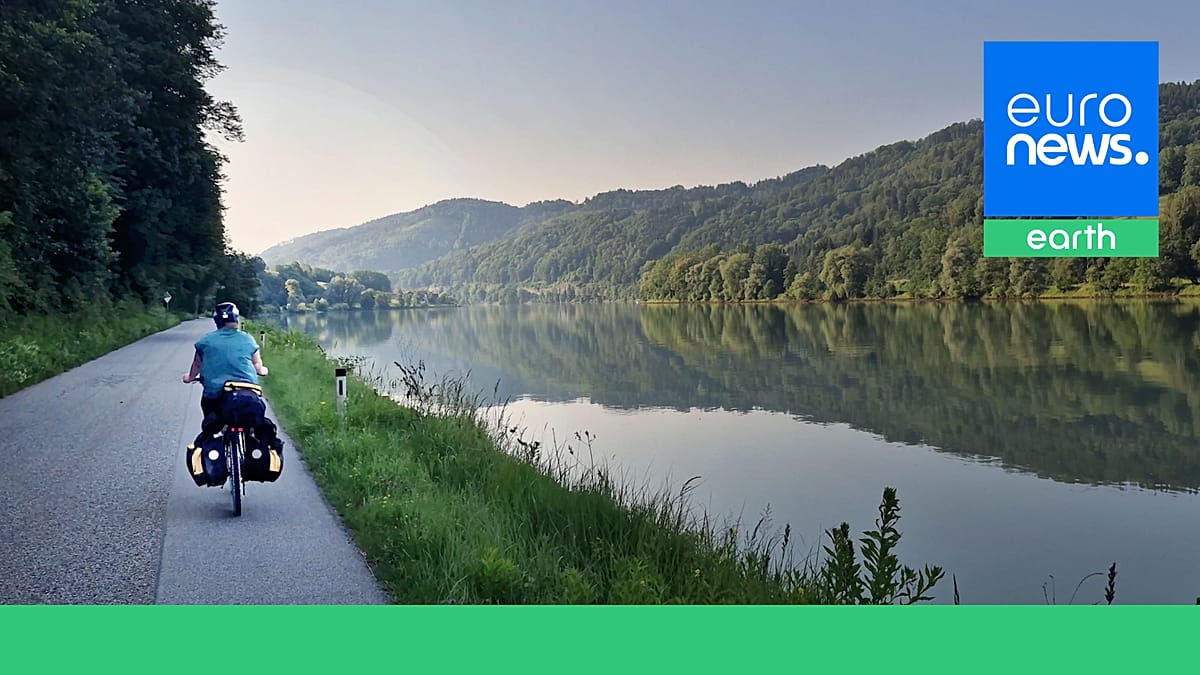
When Anna Wentsch and Callum Armstrong set off to cycle the length of the Danube, they expected a journey of discovery. What they didn't expect was to become witnesses to one of the most severe droughts in recent European history.
On 3 August, as the river shrank to record lows, Romanian authorities used a controlled explosion to redirect water toward the Cernavodă nuclear power plant, which relies on the Danube for cooling and supplies about a fifth of the country's electricity. The measure proved insufficient: the plant's final reactor was shut down on 13 August. Romania's nuclear troubles were just one symptom of a crisis rippling across the continent.
For Anna, a German-born co-founder of the New Zealand charity Conservation Amplified, the moment was stark. "To me, it was that moment of, this is becoming real now: we are actively interfering in the river ecosystem to ensure that human electricity and power needs are being met," she recalls.
Drought's reach: energy, food, and fire
The drought has hit far more than energy. Hungarian authorities sank two barges in the Danube on 15 August to raise water levels and prevent a shutdown of the Paks nuclear plant, a measure that underscores the fragility of the region's infrastructure. Emergency measures in Hungary have become necessary as the river's flow drops.
Agriculture has suffered too. Hungarian winegrowers in Villány report a 30 per cent drop in grape harvests, a blow to a region known for its robust reds. Dry soils have devastated crops across the basin, and parched vegetation has sparked wildfires. Anna and Callum witnessed one in Serbia, where the ground was so dry that "just a spark's needed for it to go up in flames," Callum says. Locals they alerted seemed resigned: "This is just normal, all the locals have called it in, people won't respond until it actually gets to a really bad state."
Across the EU, more than 580,000 hectares have burned this year, according to the European Forest Fire Information System.
Life on the riverbank: panting birds and grounded boats
The low water levels have disrupted transport and daily life. At Germany's Danube Gorge, the couple's booked ferry couldn't run; only small wooden boats could navigate the shallows. Freight traffic has stalled, with grain piling up at terminals, adding to food insecurity. Germany has even relaxed truck-driving rules to ease pressure on supply chains hit by low water on the Rhine.
But for Anna, the most poignant impact was on wildlife. "We've seen a lot of wildlife, in particular birds, panting during the day," she says. "We can take ourselves out of that environment and go into the shade, but for a stork, for example, that nests on an open platform, they don't have that ability."
The drought is hitting an ecosystem already fragmented by dams and power plants, which have severed floodplains and wetlands that once buffered against dry spells. Seeing this firsthand, Anna and Callum concluded that protecting people and protecting nature are inseparable.
Speckles of hope
Yet amid the devastation, the couple found reasons for optimism. "There are these speckles of hope everywhere of things that are already happening, and we're seeing results," Anna says.
One standout was an eight-kilometre fish bypass near Neuburg and Ingolstadt in Germany, part of a project that reconnects floodplains and restores natural river functions lost to dam construction. While it covers a tiny fraction of the 2,857-kilometre river, it shows what's possible.
On a larger scale, the Mura-Drava-Danube Biosphere Reserve—spanning Austria, Croatia, Hungary, Serbia, and Slovenia—offers a model of cross-border cooperation. The reserve enforces a no-dam policy, replants native forests, and protects migratory pathways for otters, beavers, and over 250,000 waterbirds. Around 150 pairs of white-tailed eagles now nest there.
For Anna and Callum, these projects are more than wildlife success stories. They demonstrate that restoring the river's natural functions can also strengthen the systems humans depend on—a lesson that resonates far beyond the Danube's banks.