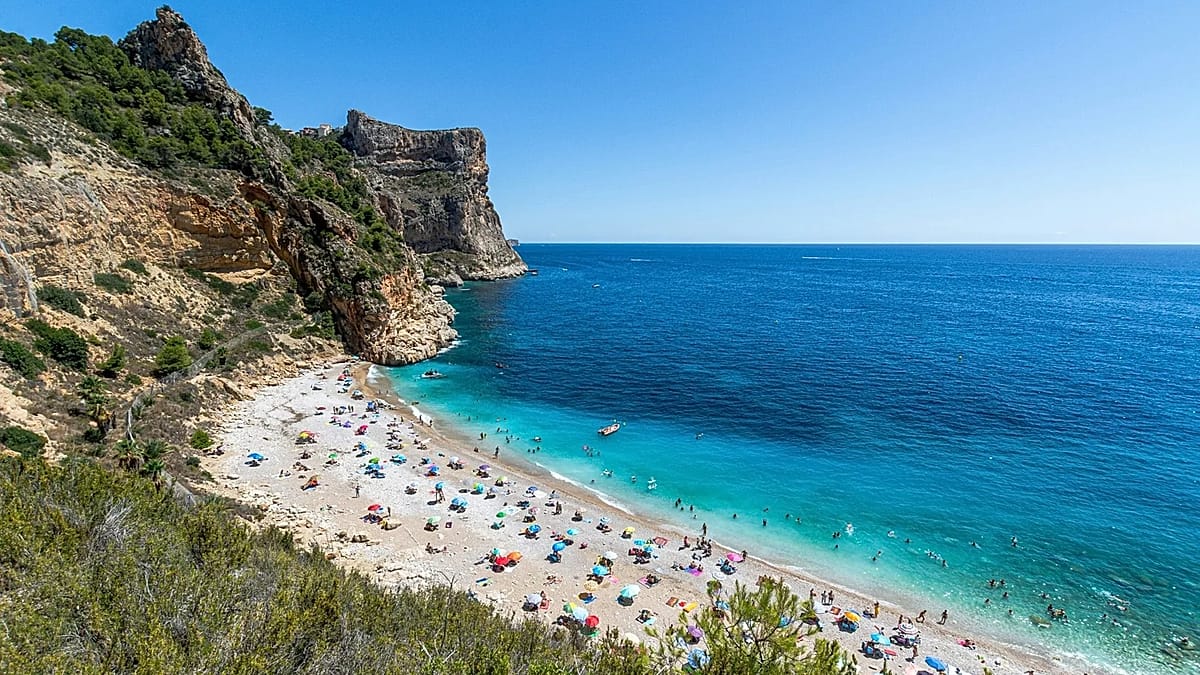
Spain’s nearly 8,000 kilometres of coastline have long drawn sun-seekers, but this year the country’s beaches stand out for more than just their beauty. The Blue Flag International Jury has awarded Spain a record 794 certifications for 2026 — 677 for beaches, 111 for marinas, and six for tourism boats. That is 44 more than in 2025, pushing Spain ahead of Greece (657 flags) and Türkiye (625 flags) in the global rankings.
Spain now accounts for 15 percent of all Blue Flag beaches worldwide. The milestone follows a strong 2025, when the country earned 750 flags. “Spain has never achieved such outstanding results in the Blue Flag programme,” said Rosario Sánchez, Spain’s Secretary of State for Tourism. She credited the achievement to collaboration among municipal, regional, and national entities, marinas, businesses, universities, foundations, associations, and citizens, all working to meet rigorous criteria in environmental education, management, water quality, accessibility, and safety.
Regional leaders and inland surprises
The Valencian Community topped the regional rankings with 151 Blue Flag beaches across 48 municipalities. Andalusia followed with 143, Galicia with 118, Catalonia with 101, and the Canary Islands with 52. For marinas, Catalonia, Andalusia, and Valencia received the most flags, while the six tourism boat certifications went to Andalusia and Valencia.
Notably, inland beaches also earned recognition. El Encinarejo in Jaén province, Andalusia, became the province’s first Blue Flag beach without a sea coast in 2024. Set against the El Encinarejo reservoir, it offers calm waters and rugged rural scenery — a quieter alternative to coastal stretches. Similarly, Playa de la Virgen de la Nueva on Madrid’s San Juan Reservoir provides beige sands, turquoise waters, and mountainous landscapes, with activities from kayaking to mountain biking.
Urban beaches remain popular too. La Malvarrosa in Valencia, once a swampy area in the mid-19th century, has transformed into a bustling urban beach with golden sands, volleyball courts, a promenade, and rows of beachfront restaurants. It attracts surfers, divers, and food lovers alike.
The Blue Flag programme, created in 1985 by the French arm of the Foundation for Environmental Education, has expanded globally. In Spain, the partner NGO is the Association of Environmental and Consumer Education. An international jury — including representatives from the United Nations Environment Programme, UNESCO, the European Network for Accessible Tourism, and the European Environment Agency — evaluates destinations annually before awarding the certification.
Spain’s record underscores a broader European trend of prioritizing environmental standards in tourism. As the continent’s travel sector recovers, such certifications offer travellers reliable markers for clean water, safety, and accessibility. For those planning a 2026 trip, Spain’s Blue Flag beaches — from the Mediterranean to inland reservoirs — provide a curated list of destinations that meet high eco-standards.