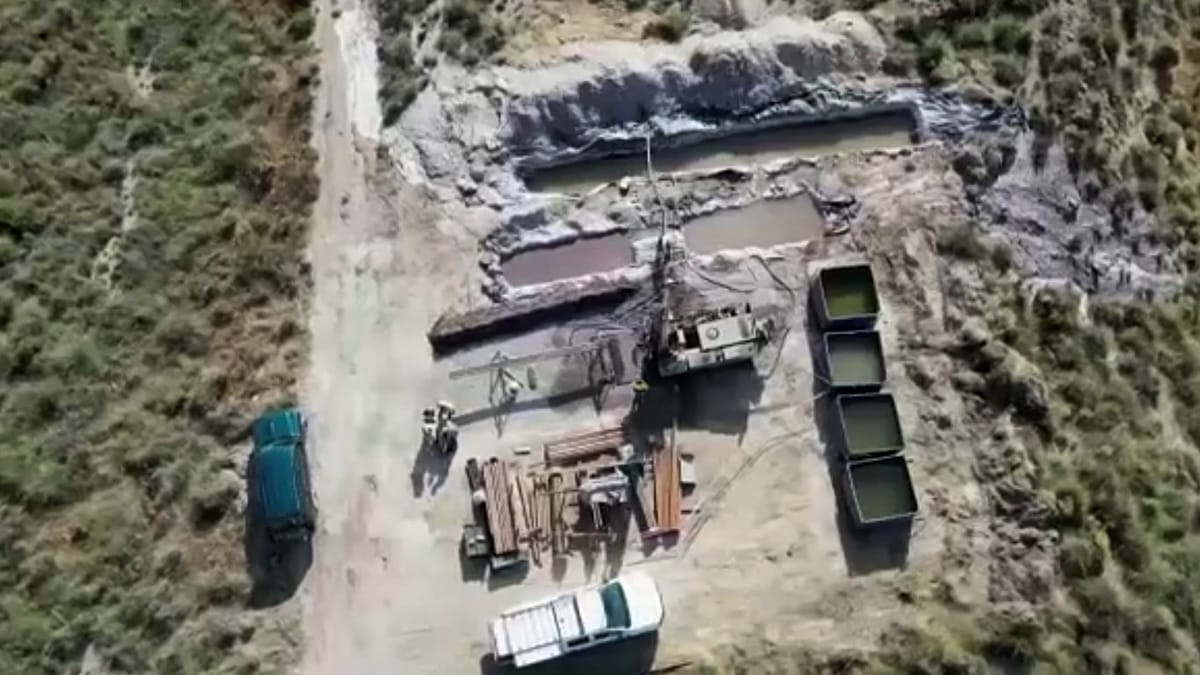
In the arid landscapes of Almería province, southern Spain, a team of geologists and planetary scientists has begun drilling 500 metres into the country's only internationally recognised meteorite impact crater. The project, which targets a structure formed roughly 8 million years ago, seeks to reconstruct the violent collision's effects on the surrounding rock and the gradual infilling of the crater over geological time.
Why This Crater Matters
The crater, located near the town of Albox, is a rare terrestrial analogue for impact processes observed on the Moon and Mars. Unlike many impact sites that have been eroded or buried, this one preserves a relatively complete sequence of shocked and fractured rock. The researchers are particularly focused on detecting shocked quartz—a mineral deformation that occurs only under the extreme pressures generated by a meteorite strike. Its presence would confirm the impact origin and help calibrate models of how energy dissipates during such events.
Dr. Elena Martínez, the project lead from the University of Granada, explained: “By extracting continuous core samples, we can see exactly how the impact fractured the bedrock, how heat altered the minerals, and how sediments later filled the depression. This sequence is a direct record of a catastrophic event that reshaped the local landscape.”
The findings are expected to feed into broader European space research. The European Space Agency (ESA) has long used terrestrial impact sites as training grounds for Mars rover missions and for interpreting data from orbiters. Understanding how impact craters form and evolve on Earth provides a baseline for interpreting similar features on the Red Planet.
Spain’s renewable energy boom has already shielded households from energy price spikes, but this project represents a different kind of investment—one in fundamental science with potential payoffs for planetary exploration. The drilling operation, funded by Spain’s Ministry of Science and Innovation, will run for several months, with initial results expected by late 2026.
The Almería crater is not the only European impact site under study. Similar work has been conducted at the Ries crater in Germany and the Rochechouart structure in France. However, the Spanish site is unique for its age and the arid climate that has preserved surface features. Researchers hope that comparisons among these sites will reveal how impact geology varies with target rock composition and climate.
Beyond Mars, the data could inform assessments of Earth’s own impact hazard. By understanding the mechanical behaviour of rocks during a strike, scientists can better model the consequences of a future collision. The project also has implications for the search for life on Mars: impact craters can create hydrothermal systems that might have supported microbial life, and the Almería crater may preserve evidence of such processes.
As drilling progresses, the team will analyse core samples for signs of ancient water flow, organic molecules, and shock metamorphism. The work is a reminder that Europe’s geological heritage—from the volcanoes of Italy to the impact scars of Spain—offers a natural laboratory for answering questions about our solar system.