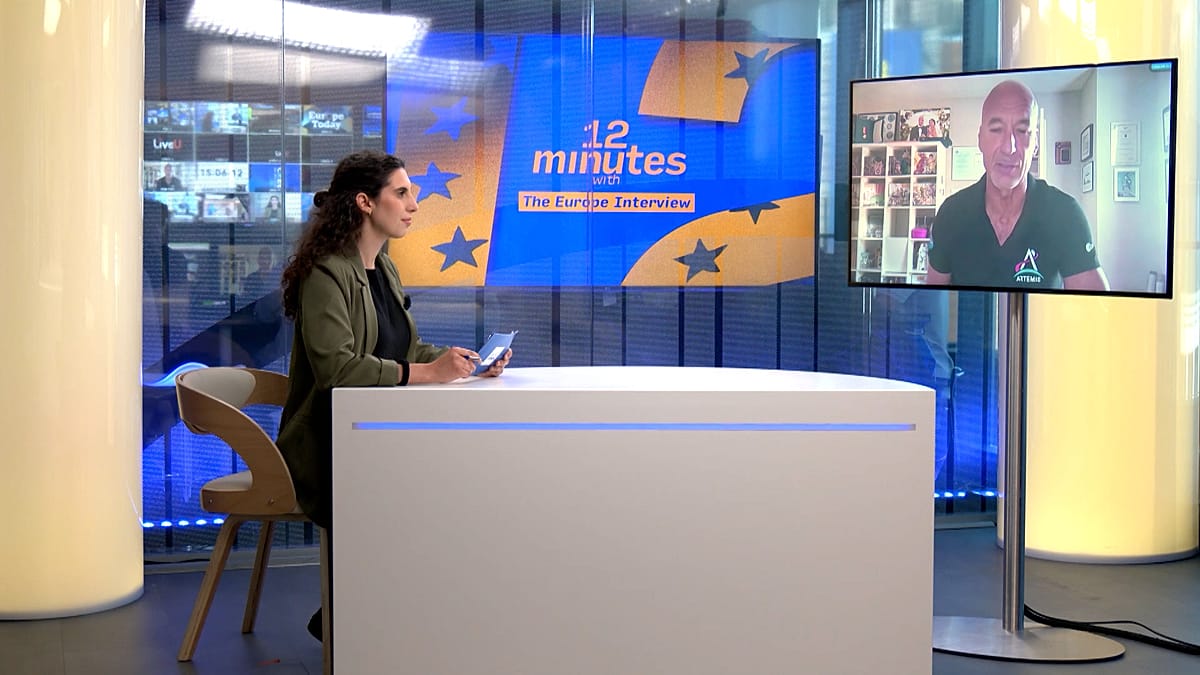
Italian astronaut Luca Parmitano, a veteran of the European Space Agency, has made clear that Europe intends to be a robust partner in the renewed race to the Moon. Speaking to Euronews, Parmitano, who will pilot NASA's Artemis III mission, said: “We as Europeans, we as Italians, we want to be strong partners of the United States in this race.”
Artemis III, scheduled for launch in 2027, is a test mission for NASA's Moon landing programme. It will send Parmitano alongside three NASA astronauts — Randy Bresnik, Frank Rubio, and Andre Douglas — into low-Earth orbit aboard the Orion spacecraft. There, they will dock with two lunar landers built by Elon Musk's SpaceX and Jeff Bezos' Blue Origin. NASA has described the flight as one of the most complex human spaceflights in recent history.
Bringing a European identity into orbit
Parmitano, who previously served as the first Italian commander of the International Space Station and spent over 366 days in space across two long-duration missions (Volare in 2013 and Beyond in 2019–2020), said the Artemis III assignment came as a surprise. “I was speechless, which is quite unusual for me, and I was really grateful,” he recalled.
He will be the first European to fly under the Artemis programme. At a public presentation in Houston on 9 June, Parmitano gave an emotional speech, calling Italy his “launch pad” and the ESA his “launch tower”. He credited the Italian public education system for his opportunity and said he aims to bring into orbit the spirit of determination — a quality he sees as central to European identity. “People of my age, we were not born Europeans. We became Europeans. This identity was desired, this identity has been a goal, something we wanted to achieve,” he told Euronews.
Complex mission, intense training
Despite the excitement, Parmitano is acutely aware of the challenges. “We have three launches that have to happen in close proximity and from very different spacecrafts,” he explained. The mission's success depends on the readiness of the lunar landers, the Orion spacecraft, and precise orbital manoeuvres. The crew will live in Orion's cramped habitable volume of just 8 to 9 cubic metres, designed for deep space conditions rather than the relative comfort of low-Earth orbit.
Training is now underway, covering crucial skills, simulations, and contingency scenarios. “Our training is very complex and wonderfully different and varied,” Parmitano said.
Space cooperation above political tensions
While relations between the EU and the US have been tense on Earth, Parmitano insists that in space, the partnership remains strong. “We don't look at what's happening at the political level; we are operators,” he said. “We all feel a common goal, which is that of the betterment of humankind on Earth, our life, and this is the next step.”
The ESA has contributed significantly to the Artemis architecture, notably by building the European Service Module, which provides electricity, thermal control, oxygen, nitrogen, and water to the Orion spacecraft. However, ESA's role was altered after NASA paused work on the Lunar Gateway, a Moon-orbiting space station for which Europe had been constructing key modules.
On the 2027 deadline — widely seen as ambitious — Parmitano argued that “to achieve complex objectives, you have to be ambitious and push hard.”
For more on European space efforts, see our coverage of Volkswagen's self-driving push and NATO's public image across Europe.