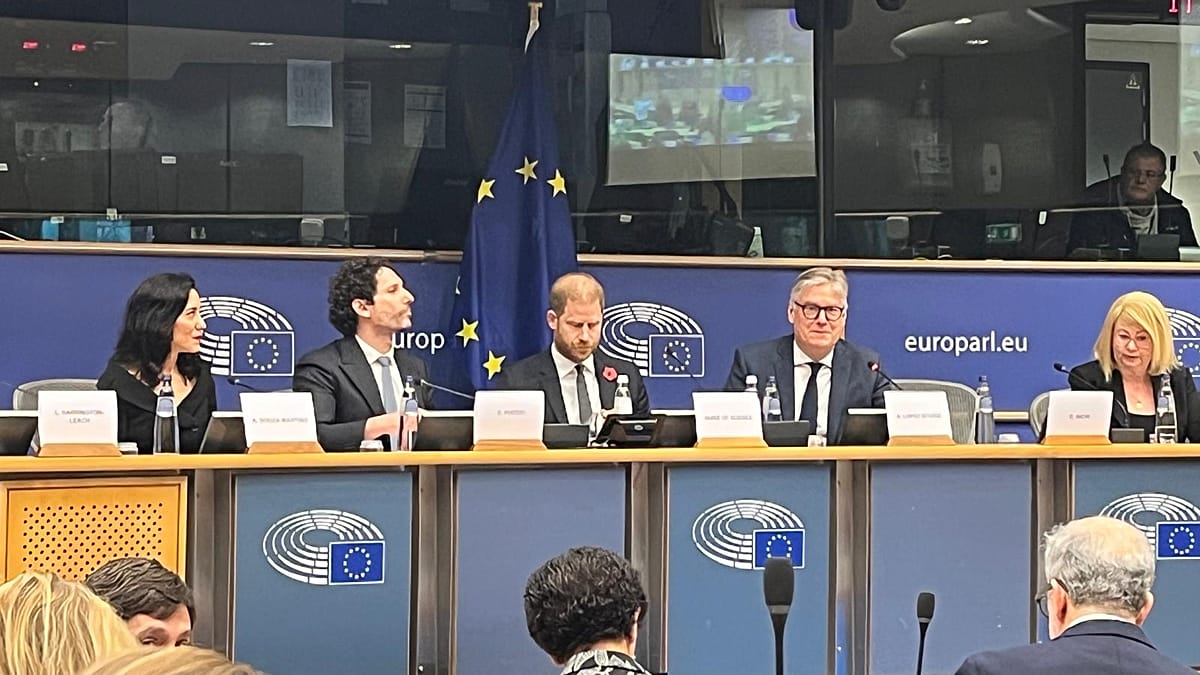
Prince Harry and Meghan, the Duke and Duchess of Sussex, brought their long-running campaign for online child safety to the European Parliament in Brussels on Tuesday, throwing their weight behind the proposed EU Kids Act. The visit marked a rare foray into EU policy-making by the couple, who have increasingly focused their advocacy on the digital risks facing young people.
In an emotional address to the Parliament’s Intergroup on Children’s Rights, Harry did not mince words about the role of social media giants. “These companies have caused so much harm, there has to be accountability,” he said, drawing a direct line between platform design and the rising toll of online harassment and bullying, sometimes with fatal consequences. His remarks echoed a growing chorus of European lawmakers and child-rights groups who argue that self-regulation has failed.
The EU Kids Act, currently under debate in the European Parliament, would introduce a suite of measures aimed at making the online environment safer for minors. Among its provisions are delaying children’s access to social media, mandatory age-verification checks, and stronger default safety settings, including restrictions on addictive features such as infinite scrolling and autoplay. Crucially, the draft law would shift the burden of responsibility from parents to the platforms themselves—a principle that Harry explicitly praised.
“For too long, parents have been left to navigate a Wild West of algorithms and targeted content,” he said. “This legislation recognises that the burden should not fall on families alone.” The couple’s endorsement comes at a pivotal moment, as EU institutions negotiate the final shape of the regulation.
A memorial for lost lives
During the Brussels visit, the Sussexes unveiled the “Lost Screen Memorial,” a display first shown in New York last year. The installation features photographs of young people whose deaths have been linked to online harms, serving as a stark reminder of the human cost behind the policy debates. Among those joining them was Sandra Spitaels, whose 15-year-old son Glenn took his own life after a nude image of him was shared on social media. Her presence underscored the real-world urgency of the legislative push.
Meghan, however, did not deliver a planned speech. Her decision to remain silent followed the arrest of her estranged father, Thomas Markle, in Florida on suspicion of possessing child sexual abuse material—a development that has dominated tabloid coverage and added a deeply personal layer to the couple’s visit. Reports suggest the past two weeks have been emotionally taxing for the Duchess, who nonetheless participated in private meetings with MEPs and an official event hosted by European Parliament President Roberta Metsola.
The couple’s advocacy has evolved from personal statements to a structured campaign, including support for families who have lost children to online harms. Their presence in Brussels signals a deliberate attempt to influence policy at the European level, where the EU Kids Act could become a global benchmark for child online safety—much as the General Data Protection Regulation (GDPR) set the standard for data privacy.
Not everyone is convinced that the legislation goes far enough. Some digital-rights campaigners argue that age verification could infringe on privacy, while others worry about enforcement gaps across the bloc’s 27 member states. Yet the political momentum appears strong, with cross-party support in the Parliament and backing from the European Commission.
For Harry, the message was clear: “We are here to stand with the children of Europe and the world. Their safety cannot be a secondary consideration.” The couple’s visit may not have produced a legislative breakthrough, but it added a high-profile voice to a debate that is rapidly moving from the margins to the mainstream of EU policy.