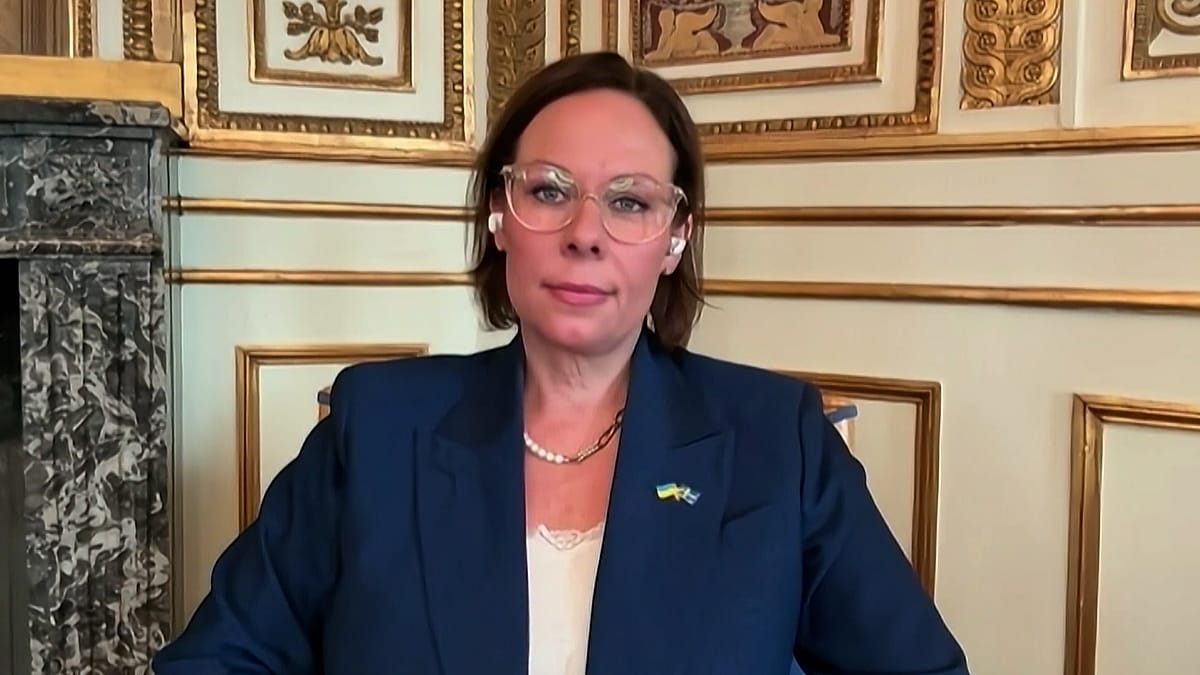
Swedish Foreign Minister Maria Malmer Stenergard has called on the European Union to use frozen Russian state assets to finance Ukraine's defence and reconstruction, arguing that the bloc must move beyond its current position. In an interview with Euronews, she said Russia's recent behaviour shows a growing desperation that demands a firm and united European response.
Speaking on the Europe Today programme, Stenergard pointed to a series of hybrid attacks across the continent, including the discovery of an explosive-laden drone at Leipzig airport in early August. She said Moscow is testing the resolve of NATO and its member states.
“We see a more desperate Russia. Russia is losing territory, losing influence, losing men, and now they are obviously more desperate testing us and testing our unity,” she told Euronews correspondent Shona Murray.
The minister's remarks come ahead of a gathering of EU foreign and defence ministers in Ireland this week, where European and transatlantic security will top the agenda. The informal Gymnich meeting in Wicklow will include counterparts from Ukraine, Britain, and Canada.
Pressure on Belgium over frozen assets
Stockholm is among several capitals pushing the European Commission to revisit the issue of using the roughly €200 billion in Russian central bank assets held at Euroclear, the Belgian financial repository. Sweden, Spain, Portugal, and the Netherlands have all signalled support for redirecting these funds to Ukraine, but Belgium has been the most vocal opponent.
Belgian Prime Minister Bart de Wever has insisted on unlimited guarantees to shield his country's financial sector from potential risks. Stenergard acknowledged those concerns but said the status quo is no longer acceptable.
“We cannot stay in the same position as we were before Christmas. We have to move on because this is what is fair to Ukraine, it's what is fair to the taxpayers,” she said. “And we have to find a way to make sure that Belgium feels comfortable with this.”
The debate over frozen assets is part of a broader discussion on how to sustain support for Kyiv as the war enters a new phase. EU ministers in Ireland are confronting drone threats, Patriot shortfalls, and the frozen-assets question simultaneously, reflecting the interconnected challenges facing the bloc.
Meanwhile, German Chancellor Friedrich Merz is expected to formally accuse the Kremlin of involvement in the Leipzig drone incident, a first for a European country. Berlin has vowed to respond, a move that could further raise tensions with Moscow.
Stenergard stressed that European unity is the key deterrent against further Russian aggression on NATO territory. She noted that recent incidents have prompted a coordinated response from the alliance, but warned that vigilance must remain high.
The push to use Russian assets comes as Russian overnight strikes on Kyiv kill at least eight, including railway workers, underscoring the urgent need for sustained financial and military support. The EU has already approved several rounds of sanctions, but the frozen-asset mechanism remains legally and politically complex.
Some member states, particularly those with large financial sectors, worry about the precedent of seizing state assets. Others argue that the funds belong to Ukraine by right, given the destruction caused by Russia's invasion. The debate is likely to intensify as the EU seeks to finalise its next budget and long-term support package.
Stenergard's comments reflect a growing impatience among EU capitals with the slow pace of progress on this issue. She insisted that the bloc must find a way to accommodate Belgium's concerns without abandoning the goal of using the assets for Ukraine's benefit.
As the EU prepares for its ministerial meetings, the question of how to fund Ukraine's recovery and defence will remain central. The outcome could shape the bloc's approach to Russia for years to come.