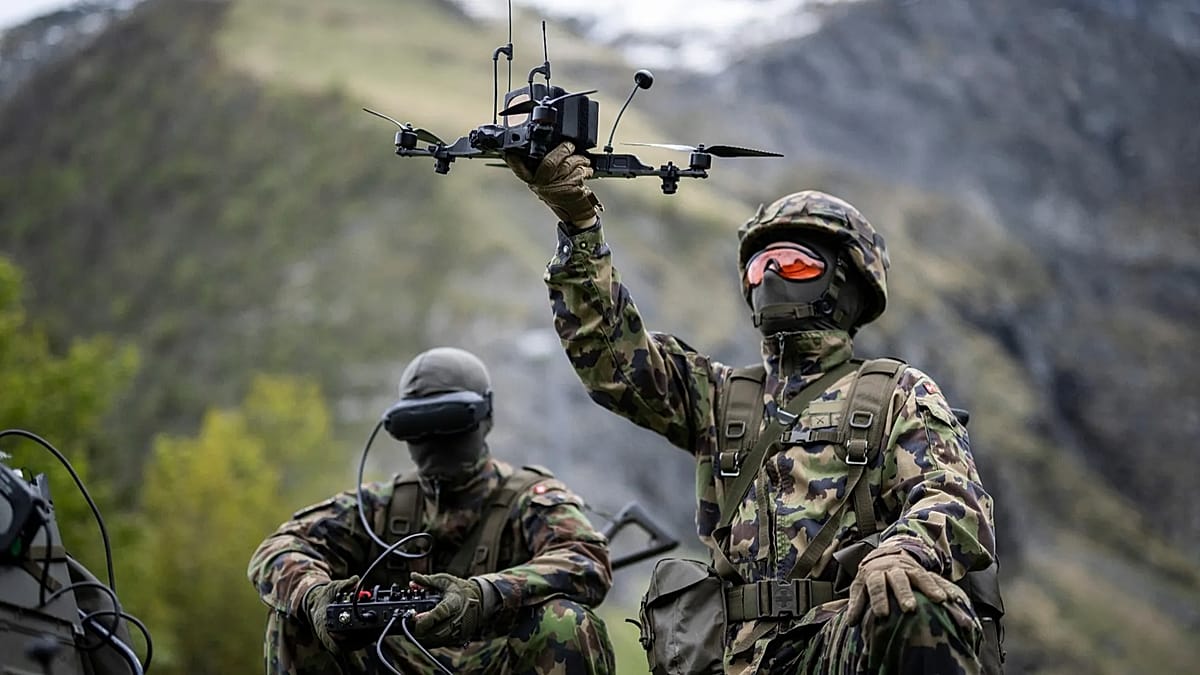
Switzerland, a traditionally neutral nation surrounded by EU and NATO member states, is significantly expanding its military drone capabilities and air defence systems. Defence Minister Martin Pfister announced in Berlin that Bern is committed to both its own security and contributing to continental stability, marking a shift in Swiss defence posture.
Speaking at a DACH meeting—the regional grouping of Germany, Austria, and Switzerland—Pfister acknowledged that the Swiss army, while still boasting a militia force of around 140,000 personnel, needs modernisation. “We want to live up to this aspiration as a reliable partner,” he said, emphasising the need to close gaps in air defence.
Switzerland currently spends about 0.7% of its GDP on defence, well below the NATO average. Bern plans to increase this to 1% by 2032, a modest rise compared to Germany’s 2.4% investment. The country is procuring the IRIS-T SLM air defence system as part of the European Sky Shield Initiative (ESSI), a multinational project launched by Germany in 2022 to enhance joint air and missile defence across Europe.
The Drone Gap and Cost Equation
Dr Marcel Berni, a lecturer in strategic studies at the Military Academy at ETH Zurich, warns that high-end systems like IRIS-T are insufficient against cheap drones. “Anyone who fights a drone costing a few thousand francs with an expensive guided missile loses the cost equation,” he told Euronews. Berni argues that air defence must be layered and rapidly deployable, drawing lessons from Ukraine’s extensive use of drones and electronic warfare.
Switzerland is following a European trend, investing in F-35 fighter jets, Patriot systems, and IRIS-T SLM to counter increased aerial threats. However, Berni cautions that the current focus on high-end systems risks leaving gaps against low-cost drones and cyberattacks. He advocates for building civil resilience and training for wartime cooperation, noting that neutrality would become obsolete in such scenarios.
The Swiss army is now integrating a “drone flying school” into summer recruits’ courses, aiming to have several trained drone pilots per platoon. Initially focused on reconnaissance, the programme is testing FPV kamikaze drones similar to those used in the war in Ukraine. The military sees drones as a fixed component of modern warfare, also exploring their use for transport and clearing unexploded ordnance.
Bern has allocated 70 million francs (€76 million) for drones and counter-drone systems in the 2026 armaments package, double the previous year’s plan. This investment reflects a broader European trend where countries like Poland and Germany are also ramping up drone capabilities. German troops are already building and testing drones in field exercises, redefining the soldier’s role.
The drone threat is real for Switzerland, despite its landlocked geography and borders with NATO states Italy, Germany, and France. Recent incidents, such as Russian drones crashing in Latvia, highlight the cross-border nature of modern aerial threats. Ukraine’s record of shooting down 33,000 Russian drones in March alone underscores the scale of the challenge.
For Switzerland, the path forward involves not just buying new platforms but also accelerating procurement, building industrial capacity, and training personnel. As Berni puts it, “Stop buying prestige platforms and instead build up civil resilience and train co-operation for wartime.” The country’s defence modernisation is a pragmatic response to a changing security landscape, balancing neutrality with the need for credible deterrence.