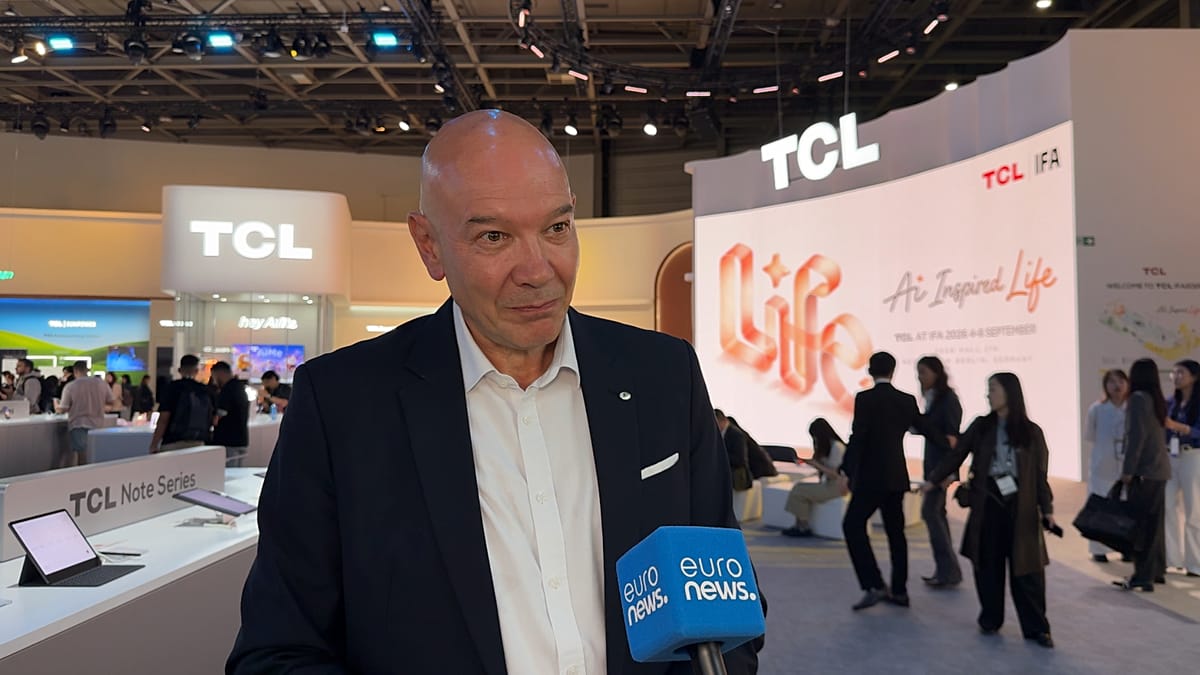
At this year's IFA in Berlin, TCL is presenting a broad vision of the connected home under the banner “AI Inspired Life.” The Chinese electronics giant, which has become a major player in the European television market, is using the trade fair to show how artificial intelligence can weave through everything from large-format Mini-LED TVs to air conditioners and augmented reality glasses.
Stefan Streit, chief marketing officer at TCL Europe, spoke to European Pulse about the company's strategy. For Streit, the key is not to add AI for its own sake, but to solve concrete problems. “Our philosophy is, when we talk about consumer products and implement AI, AI needs to solve a problem or needs to have a concrete purpose. We don't want to just put in AI for the sake of AI,” he said.
Purposeful AI in the home
One example of this “purposeful” approach is in air conditioning. TCL's systems use AI to monitor room conditions and adjust temperature automatically. According to Streit, this can cut energy use by up to 37%. “When you're sleeping and you're sleeping deep and not moving, it starts to increase a little bit the temperature. If you would move around, it starts lower,” he explained.
This focus on efficiency comes as European households face rising energy costs and tighter environmental regulations. TCL's pitch is that AI can make everyday appliances smarter without adding complexity for the user.
Bigger screens, fewer distractions
TCL remains best known for televisions, and its IFA booth reflects that. The company is pushing larger screens and Mini-LED technology, a segment where it has gained significant market share in Europe. Streit attributes this to vertical integration: TCL owns its display manufacturing arm, TCL CSOT, which he calls “the leading display manufacturer in the world.”
“Our products are super competitive, so we can drive that, and therefore you see the market is also growing more in the big size TV and mini LED [sector], and that's where we are the experts,” he said.
But with screens proliferating across devices, TCL is also addressing digital overload. Its NXTPAPER technology, available on some smartphones, lets users switch to a simplified e-reader mode that filters out much of the blue light and disables notifications. “When you want to read on a weekend, you don't want to have the disturbance of every app that gives you a notification,” Streit noted.
Beyond the TV: displays everywhere
TCL's broader ambition, however, extends far beyond televisions. The company's NXTHOME concept brings together displays, appliances, and connected devices to demonstrate how they might work together in daily life. Streit argues that TCL's expertise in display technology gives it a natural advantage in this space.
“Today, almost everything has a display,” he said. “But you know all the other categories... this is just at the beginning. For all of these displays, they come from TCL CSOT, so we really can bring this visual experience in all of these products.”
That includes AR glasses, which Streit jokingly calls “James Bond glasses.” The device projects information directly into the user's field of view, useful for translation or navigation. “It actually projects the pictures in my natural field of view and you don't see it, but I will get some information,” he said.
As TCL pushes into new product categories, it faces competition from established European appliance makers and tech giants. But Streit is confident that the company's manufacturing scale and display know-how will set it apart. “We look at these visual experiences or how we can use displays in all kind of shapes and formats or use cases,” he said.
With IFA 2026 drawing to a close, TCL's message is clear: the future of the home is not just about bigger screens, but about making those screens—and the AI behind them—work more intelligently for consumers across Europe.