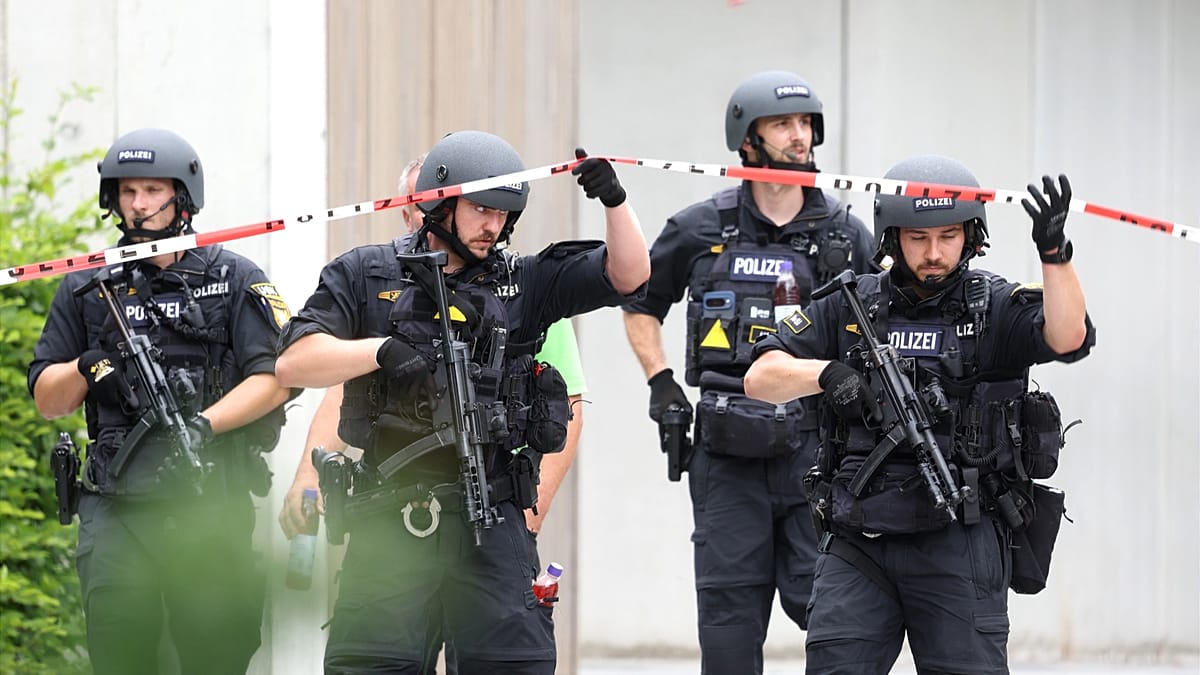
Police in Bavaria have arrested a 16-year-old boy after a knife attack at a secondary school in the town of Schongau, a community of roughly 12,000 residents nestled just north of the Alps. The incident, which unfolded on Wednesday at the Welfen grammar school, left two girls with serious injuries, though authorities have confirmed their lives are not in danger.
A spokesperson for the Bavarian police told AFP that the attack appeared to be a deliberate "rampage" targeting the school. While press reports suggested the assailant used a knife, the spokesperson could not immediately confirm the weapon. The suspect, described as a 16-year-old male, was apprehended after a brief period on the run, with police deploying six helicopters—including one for medical evacuation—as part of a major operation.
Police Response and Community Reaction
Local authorities urged the public to avoid the area around Schongau, stating on their X account that "a suspected perpetrator has been arrested." They later clarified that the individual was a 16-year-old boy and that they are "currently assuming that the perpetrator acted alone." A contact point for parents and relatives was established at the Schongau fire station, reflecting the scale of the emergency response.
The attack has sent shockwaves through the small Bavarian town, where such violence is rare. Schongau, located in the district of Weilheim-Schongau, is known for its historic old town and proximity to the Alps, making the incident all the more jarring for residents.
Context of School Violence in Germany
Serious violence at educational institutions remains uncommon in Germany, but the country has seen several high-profile incidents in recent years. In 2025, a 45-year-old teacher was seriously wounded at a vocational college in Essen, with the prime suspect—a 17-year-old Kosovan—shot by police before his arrest. Prosecutors cited "jihadist" motivations in that case.
Earlier, in January 2022, an 18-year-old German student killed one person and wounded three others in a shooting at the University of Heidelberg before turning the gun on himself. The deadliest recent attack occurred in March 2009, when 17-year-old Tim Kretschmer killed 15 people—nine students, three teachers, and three passersby—at his former school in Winnenden, near Stuttgart, before committing suicide.
These events have prompted ongoing debates in Germany about school security, mental health support for young people, and the spread of extremist ideologies. The Bavarian attack, while less lethal, underscores the persistent challenges faced by authorities in preventing such incidents.
As investigations continue, police have not disclosed whether the suspect had any prior criminal record or known affiliations. The school, which serves students from grades 5 through 12, has been closed for the day, with counseling services offered to pupils and staff.
This story is developing, and European Pulse will provide updates as more information becomes available.